Thoughts on the World Cup
Posted: June 30, 2014 Filed under: Uncategorized 3 CommentsThe World Cup is into the knockout stage and we have seen some surprising scores. These results have raised some questions which are being debated in soccer circles around the world. So here is the Soccer Yoda’s take on the newest discussions among soccer fans.
Just how good is the USA?
The World Cup has created tens of thousands of new soccer fans in this country, at least for a few weeks. Many of those bandwagoners don’t really understand the traditional position of the USA as a less-than-fearsome team. So, losing to Germany produced many many long faces and talk of “backing in” to the knockout phase. On the other hand, before the tournament began, very knowledgeable soccer people claimed that the USA had no chance of getting out of the Group of Death in the first place. In 2006, the USA played a poor game against Ghana and lost. In 2010, the USA played a good game against Ghana and lost again, although in extra time. This time we played a poor game against Ghana…..and won! Then we played a better game against a good Portugal team and drew, but should have won. Against Germany we played with one eye on the Portugal-Ghana game and were very aware of the situation -which called for conservative play. The Germans were better, anybody who was surprised at that doesn’t know their soccer. But, compared with previous World Cups, the play of the Americans has been immensely improved. It didn’t take a horrible goalkeeping error or a totally overconfident opponent to get us through to the knockout phase as it did in 2010 and 2002.It was done on merit by a team that deserved to advance because of one simple fact – they were better than 2 of the other three teams in the group, Group of Death or not. So, how good is the USA? Better than half of the top 32 national teams in the world. And maybe better than that. We aren’t top 5 material yet….Brazil, Argentina, Netherlands, France and yes, Germany, are – day in and day out- still above our caliber, but the Soccer Yoda believes that the USA is in the next tier, regardless of what happens against Belgium.

Dempsey scores in the first minute against Ghana
Is ticky-tacka now dead?
During the 1970’s the Dutch introduced a style of play which stressed possession of the ball, even if that possession didn’t immediately lead to attacks on the opponent’s goal. In order to maintain that possession, players needed to move from traditional positional places to spots closer to the teammate with the ball. This movement inspired the name “total football” for this style of play. Although the Dutch eventually became somewhat more traditional, the movement and possession left its mark on world soccer and most teams incorporated elements of the Dutch game. Around 2008 or so, Barcelona, being inspired by manager Pep Guardiola, took the Dutch concept to new extremes. They shortened the passes, strung them together in long sequences and gradually approached the opponents goal. The “ticky-tacka” passes eventually wore down even the best of teams and Barca had a fast enough defense to cope with the counter attacks that opponents were reduced to attempting as their only available offense. Spain, consisting of many Barcelona players, adapted the style and became the best national team in the world. So, with Spain going out of this Cup amazingly fast and Barcelona having a less-than-expectation season, the pundits are claiming that ticky-tacka has had it. Well, that may be true to an extent, but not because of this tournament. Spain (and Barcelona before it) in an attempt to speed up it’s offense and shore up it’s aging defense, lengthened the passes and went more directly to goal. But without a truly dangerous goalscorer and with that older, slower and mistake-prone defense, it just didn’t work. Ticky-tacka might be dead, but if so, it’s because it’s own originators stopped using it. Spain’s tactics in 2014 bore small resemblance to it’s 2010 team. However, other teams, both national and club, have adapted elements of the possession-first game. Even if it doesn’t consist of hundreds of 5 yd passes, the influence of ticky-tacka is very present. So ,it isn’t dead, it has evolved as it has spread – just as total football did.
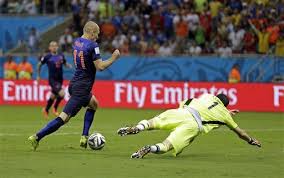
Spain gives up another goal vs Netherlands
When is a penalty a penalty?
One thing that players, coaches and fans want from referees is consistency. Calls can be argued, but if they are made with a predictable view,then players and coaches will know how to play and spectators will know what to expect. In this tournament, the most momentous call, the penalty kick ,has been anything but consistent. FIFA must better define what constitutes a penalty and instruct it’s referees to call it correctly. But meantime, defenders need to understand that anytime they go to ground or grab an opponent or even stick out a foot in the penalty area, the whistle may blow. They need to adjust their play accordingly and midway through the tournament that hasn’t happened. So, the calls continue to come and the controversies continue to demand our attention. Hopefully we will see wiser play from defenders and more predictable calls from the refs.
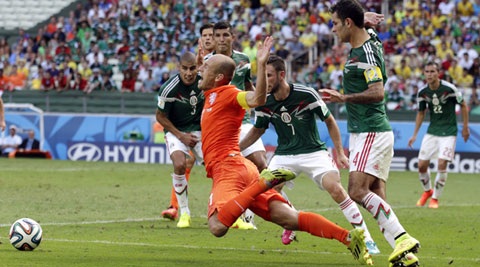
A huge “maybe” penalty against Mexico
Is soccer a moment or a movement in the US?
Without a doubt, with no possible debate, it is an undeniable fact that the 2014 World Cup has generated by far, the greatest amount of interest of any prior World Cup and ( despite what the soccer haters say) this is NOT the Olympics. I have NEVER seen thousands of fans viewing Olympic sports in outdoor venues watching on huge screens. I have NEVER seen hundreds of fans cramming themselves into individual pubs and sports bars to watch ANY Olympic sport. This is an unprecedented outpouring of interest in soccer in this country. It’s a sports happening here in the US just like it is in the whole rest of the world. Finally. As a sign of the massive amount of interest in the World Cup and therefore in soccer , the haters are out in force. Mad Dog sports says that “nobody really cares about soccer” and then to back up this assertion mentions the fact that ” the MLS only averages 20,000 or so to each game”, then Ann Coulter says that the interest in soccer is an example of our nation’s “growing moral decay” and that soccer isn’t really a sport because a sport must have ,” danger of personal humiliation and major injury” (she was being sarcastic,right?). Then ,to top that, Keith Ablow of Fox Business News says that the interest in the World Cup is part of a conspiracy engineered by the Obama administration along with relaxed marijuana laws. WHAT? The most sensible comment I have heard came from ESPN:”The interest in the World Cup is merely a visualization of the growing soccer movement in this country. It’s been going on for years, gaining participants and followers at ever faster rates and the Cup has motivated almost all of them at once.” Will millions of World Cup fans desert soccer and the US team as soon as the Cup is over? Absolutely. Will millions more continue to play, coach, follow and watch the sport as they did before the Cup? Certainly. More importantly – will an undetermined amount of Americans follow up on their new-found interest in soccer despite it’s “moral decay” and the threat of conspiracy? For sure. Soccer is here to stay, it isn’t getting any smaller and those who continue to minimalize it’s growth or berate it’s followers will just look more foolish than they already do.
It’s the World Cup!
Posted: June 12, 2014 Filed under: Uncategorized Leave a commentEvery four years, the largest athletic event in the world takes place. Nations stop everything they are doing ( well, almost everything) and hold their collective breaths as they watch their athletes try to bring home glory to their country. No, it’s not the Olympics…..it’s the World Cup. After 2 years of qualifying tournaments, the 32 representative teams are meeting in Brazil to decide which nation has the best collection of soccer players.
Of course, it’s not that simple. There are some countries who feel they should be playing but didn’t make it…..some in very dramatic and heartbreaking circumstances (Panama- probably the toughest exit). There is the fact that a European country has never won in South America. There are injuries that hurt teams (France) ,there is the weight of incredible expectation (Brazil), there is homegrown skepticism resulting from many disappointing cups (England). Of course, there is the joy of just being in Brazil (Mexico), of careful optimism (Switzerland) , of the idea that being in the cup at all is the most fun thing possible (Australia).
This is FIFA’s showcase and considering the fact that many host countries have to prepare for years, the event usually comes off well. This year the Brazilians have faced economic problems, construction issues, demonstrations in the streets against the tournament because of the strain on the country’s resources. Contrary to popular opinion, everyone in Brazil is not apparently a soccer nut. However, many say that once the games begin, even the demonstrators will don their yellow/ green and dance and sing while their team dances around opponents in their unique Brazilian way.
Any predictions of results won’t mean much in a couple weeks, or probably in a few days. Of course, Brazil is the favorite, Germany is always strong, Argentina has got the players although perhaps not the teamwork, Italy’s defense always rises to the World Cup occasion and Portugal has a somewhat beaten -up Christiano Renaldo, who might be capable of pushing them beyond all expectations all by himself. And we have the good ole USA, with no chance to win, according to our own coach. For us The Group of Death has made any expectations tenuous at best.
But one thing IS for sure……if you are a soccer fan, this is IT. This is the best four weeks that has occurred in the last four years and will occur for the next four. This is the passion, the involvement ,the immersion , of soccer at it’s ultimate moment. So, it’s time to put aside petty things like the economy, climate change (or not) , small national differences ( does Crimea have a national team?) and watch our sport at it’s biggest and at the world’s single most watched event. Enjoy!
P.S. You can catch the Soccer Yoda’s views of the tournament as it unfolds at Twitter : @the_soccer_yoda See you there!
Soccer’s Triple Conundrum Part 2 + Breaking News
Posted: May 29, 2014 Filed under: Uncategorized | Tags: Champions League, Donovan, FIFA, Klinsmann, Real Madrid, Sergio Ramos Leave a commentIn my last post, we discussed the rules of the game and how they allow an unlimited number of options in regard to tactical decisions that soccer coaches make. These decisions are made in each game, sometimes based on the particular circumstances of that game. But, there is a larger decision to make, the decision to have an overall philosophy of play – be it strong defense or possession first or pass/move or whatever type of play the coach and organization decides is their preferred mode. Each game the team works on developing the philosophy of play, attempting to become more proficient at it. Sometimes the philosophy will come into question for a specific game and the coach will have to decide if this time a departure from the norm is called for, or does “team style” mean EVERY game regardless of situation. So there are two difficult decisions or conundrums to be made- one for each game and one for overall style of play.
A few weeks ago Chelsea and Liverpool played an important match which had a large bearing on the English Premier League title. Chelsea played a very defensive formation, putting a large number of defenders in front of their goal and basically daring Liverpool to break them down. Liverpool tried but never managed to accomplish that feat and when a misplayed control and a slip on the turf combined to give Chelsea a goal, Liverpool’s fate was sealed. This particular game illustrates our soccer conundrums in that while Chelsea and manager Jose Mourinho had no trouble deciding how they wanted to play, Liverpool manager Brendan Rodgers faced a more complex situation. Rodgers has always preached and practiced a pass and move offensive brand of soccer. This season the Liverpool squad was great at it, although it occasionally cost them goals on their defensive end. But, for this game, a draw and the one point in the standings that is earned by a draw would have helped Rodgers toward the championship. The idea of sitting back and walking away with a 0-0 result must have crossed Rodgers mind, but he chose to stay with the “Liverpool Way”.
After the game the soccer world was abuzz with conversation concerning this tactical battle between Mourinho and Rodgers. The Soccer Yoda listened with great interest, one- because he is, after all, The Soccer Yoda- and listening to the soccer community was of great interest; two- he is a Liverpool fan, so there was the added incentive of hearing what people were saying about his favored club. But during the many discussions in person, on radio and on television, Soccer Yoda heard one caller to a phone-in program bring up a very interesting point. The caller said,”I wonder what NBC would have thought if Rodgers had decided to take the draw and the two sides simply stared at each other for 90 minutes, Liverpool in their half of the field with the ball, and Chelsea in their half without it”.
To fully grasp the weight of the callers comment, we must take into consideration the fact that NBC paid $250 million for a three year ownership of the Premier League television rights in the United States. The company owns a number of channels and has successfully shown league games this season on these channels with the viewership increasing each month. The expenditure was a gamble, but it seems to be paying off well. The increasing soccer audience in this country has managed to get up at early weekend hours to watch the arguably best league in the world and NBC appears to have pulled off quite a coup in its purchase. The televised matches have absolutely increased American interest in soccer. Many new fans, perhaps thousands of them, have been drawn in by the drama and action of the sport and of this particular league. Although a dull draw in the Chelsea- Liverpool game probably wouldn’t have dented the viewing numbers much, a series of similar matches definitely would take a toll. In this country and to a much lesser extent in others, a third question arises at high levels and perhaps at lower levels also: what is good for the game? I am pretty sure that Mourinho and Rodgers probably didn’t give that question a seconds thought combined…..yet for American coaches , when faced with competition from other sports and attempting to convert sport fans to soccer, the question ,” should we do what is best for us or what is best for the game?” should take at least a moments thought.
The only entity which is specifically tasked with doing things for the good of the game is FIFA, the international organization which governs most all soccer in the world. But FIFA fails at that job time after time. For example, FIFA hasn’t yet been introduced to the stopwatch. The concept of stopping the clock during specific events such as injuries, goals, substitutions, blatant timewasting, etc. is seemingly unacceptable to FIFA so not only does the timewasting constantly occur, but once in a while the added time which is supposed to nullify the effect of any stoppages during the game comes into question – like this past weekend when no one could figure out how the Champions League final got 5 minutes of stoppage time. Real Madrid used those added minutes to score a goal, force extra time and eventually win the title. More important issues like racial abuse, overspending by rich clubs, breaking contract rules governing youngsters, get a slap-on-the-wrist approach. No, FIFA does little for the good of the game and awarding the 2022 World Cup to Qatar probably tops the “not for the good of the game” list of FIFA actions and nonactions.
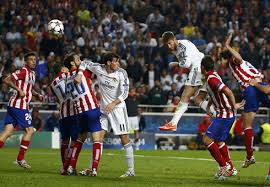
Sergio Ramos scores for Real Madrid late late in the Champions League final
So, it falls on other organizations; national federations, leagues, clubs, and coaches to ponder whether their actions are for the good of the game or if they should even worry about that concept when faced with more immediate and closer-to-home decisions. Certainly, in many countries………………………………………….We (actually I , the Soccer Yoda) interrupt this post to bring you breaking news!!!!
Landon Donovan, the all time leading national team goal scorer and arguably the best player ever to represent the United States, has been left off the USA World Cup roster by coach Jurgen Klinsmann !!

Landon Donovan scores the winning goal vs Algeria in the 2010 World Cup
Ok, this actually happened a few days ago, but I couldn’t post this piece without mentioning the most talked about soccer controversy that this country has ever seen. I am not going to repeat all the arguments, theories and accusations that have been discussed since Klinsmann announced the 23 player World Cup roster. Gad, even his announcement of the roster caused a stir, coming as early as it did, even before any tune up matches were played. But, in a sense ,the decision falls under the category of “good for the game”. How so? The news of Donovan’s absence from the team has been announced and discussed on virtually every sports network and talk show in the country. Who would have ever thought that the NBA playoffs, the upcoming NFL season, the daily MLB scores, would ever be pushed back on the sports news agenda by news of a surprising soccer roster announcement? If Jurgen wanted to make sure that the country was talking World Cup soccer- even non-soccer people, mind you- a month before the actual tournament begins……well he certainly did it. Even I have been asked by individuals who know little and usually care less about my sport….” what’s up with this Landon Donawhatcha thing?”. So, in that regard……in consideration of the third conundrum-the good of the game…..way to go Jurgen! As for the good of USA World Cup fortunes……well, that remains to be seen.
Soccer’s Triple Conundrum Part 1
Posted: May 4, 2014 Filed under: Uncategorized 1 CommentI know that using a definition to begin a speech or a paper or virtually any large group of words put together for public consumption is considered a cliché. However, I will risk being clicheish because I believe it is appropriate for this post. So, here goes: According to the modern authority on word definitions, Wiktionary (using Webster would have really been cliché ), a conundrum is a difficult choice or decision. Because of the manner in which soccer as a game is constructed, it presents a conundrum to coaches and managers when they devise tactics for particular games. This conundrum then compounds to a larger difficult choice for soccer coaches and sometimes even soccer organizations that may affect the manner in which they are viewed by all that are familiar with them as soccer entities. And THAT conundrum compounds again ,especially in the United States, into a choice that affects the sporting public and those organizations which use sports as a means of livelihood. So, soccer presents a triple conundrum of decisions, expanding in their breadth, which is unique to it as a sport. And, while the triple conundrum is ever-present, recent events have thrust it into the forefront of discussion by soccer fans everywhere.
Let me explain:
Soccer puts 11 players on the field. This makes it one of the largest sports in terms of number of players actively participating in one game at any one time. In addition, the rules of the game make no restrictions as to their placement other than the offside rule which only restricts players when the ball is played to them and that restriction only applies to half the field. There is no “line” of players to be adhered to, no required number of defensive or offensive players, even the goalkeeper doesn’t have to stay in front of the goal if it is deemed important for that player to go farther wide or up the field. The sport allows for 11 players to position themselves anywhere on the field and run almost anywhere on the field from those positions. This makes for a near infinite set of choices as to where those 11 are going to be positioned.
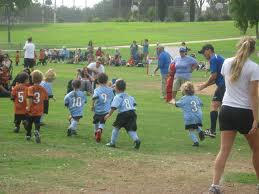
beehive soccer, not effective, but not against the rules
Studies of the game have determined that the single greatest factor that affects goal scoring is the space, devoid of defenders, that surrounds an offensive player when that player the ball strikes the ball towards the goal. The better the player, the less space is required at increasing distances from the goal. But it is a universal fact, at any level that the game is played at, that the more space an attacker has when shooting, the greater the chance of a goal being scored. So each soccer team has a decision to make: how many players to place at which positions in order to increase the chances of achieving that team’s aims. All choices have positives and negatives. Put 11 players in front of one’s own goal and the chances of giving up a goal are definitely lowered , but 1) one lowers one’s own opportunity to score and 2) the opposition gets many chances to try and get the ball through those many defenders and accidents do happen. Put 11 players in front of the opposition goal and while this will certainly increase one’s chances of scoring, should the other team manage to get the ball past one’s players they have an empty field to run through and lots of space from which to shoot. If one strikes a balance, there is a chance to score AND a chance to defend. This appears to be the best choice. However, some teams can do neither very well and end up failing at both ends. So, it’s a decision which must take into account a team’s strengths and weaknesses as well as the other team’s strengths, weaknesses and positioning. One factor rings true however: in many situations the aforementioned “space” is extremely important and how much space is given up in front of one’s goal is often the determining factor in game results. Many games, at all levels, are decided when one team attacks so much and in such great numbers that their defensive space is left open and the opposition counterattacks and scores despite having spent minimal time in front of the other team’s goal. Goals “against the run of play” are common in soccer.
Sometimes other factors affect the decision as to what type of formation a team will use. Last weekend, Chelsea’s manager Jose Mourinho was faced with just such a conundrum entering his very important game with Liverpool. Given that Liverpool and Chelsea were the top two teams in the English Premier League, this game would have a large impact on deciding the eventual champion. Mourinho had these factors to consider, 1) his starting goalkeeper and starting central defender were both injured 2) Liverpool has one of the best attacks in the league 3) only 3 days after this game, Chelsea was playing Atletico Madrid in a European Champions League semifinal that was actually more meaningful than the Liverpool game. So, despite having one of the most talented (and expensive) teams in the world, Chelsea rested some major offensive players and played an extremely defensive formation, determined to make it difficult for Liverpool to score even at the expense of their own offense. This is something Chelsea has done many times in the past, and it has worked for their purposes quite often. Defensive formations and philosophies are used at times at all levels of the game, and particularly with professional teams. But usually it’s a small club playing a large one, hoping to avoid an overwhelming rout. For a team like Chelsea, one of the largest clubs in the world, playing another large club, in a very important game, in the most watched league in the world……well, the discussion of Mourinho’s answer to this difficult choice has been the subject of major discussion in the soccer world.

Chelsea’s double wall defensive shell
Why such discussion? If an American football team uses extra defensive backs its not a big deal. If a basketball team plays cautiously and falls back on defense quickly to prevent fast breaks by the opponent, it’s not worth hours of discussion by practically all of the sports commentators and fans. Why has Chelsea’s defensive posture against Liverpool and other teams generated such interest?
Soccer is called,” the beautiful game” for a reason. Players controlling the ball; moving quickly down the field; linking passes with each other; combining to form a cohesive, interworking group; that is surely what makes the game “beautiful” . On the other hand: many players parked in front of their goal , kicking the ball away from their goal without a purpose other than preventing a score against them- that is not what gave the sport the “beautiful game” description. Most soccer fans appreciate the attributes of a positive team while understanding the need for defensive play at times during a game. When a team goes into a “shell” , pundits want to know why- they require a good reason for play that negates all that is “beautiful” about the game. If a team uses this strategy often, the soccer public tends to consider that team with disdain ( not the fans of that team of course, provided that the strategy produces wins). At levels less than professional, other factors enter into consideration. If a team or an organization avows player development as one of their major goals or even as THE goal of that organization, then overly defensive play runs counter to their goal. It is difficult to argue that playing total defense is a means of developing great soccer players, even if it may keep a score close or produce a surprise win. Soccer coaches and organizations face a conundrum when deciding on a philosophy of play for themselves. This can produce some tough decisions. The Soccer Yoda faced just such a decision in a big game in his career, just as Liverpool manager Brendan Rodgers faced a similar decision against Chelsea, although Rodgers decision was on a much higher and larger scale.
Early in my career, I decided that developing the physical and tactical skills of my players would be my number one objective . I hate losing but I had faith that as my teams increased in their quality of play so would their number of wins. ( see prior post Organizations and Technicians). This philosophy treated me well with few difficult decisions to make until one Saturday afternoon when my high school team played our top local rival in a big league game watched by over 1500 soccer fans from all over the state of Maryland. The other team was coached by a top quality coach (two time NATIONAL high school/youth Coach of the Year top quality!). The opposition began the game with 9 players sitting in their defensive half and refusing to advance into our defensive zone. Amazingly, we scored on a corner kick late in the first half. So, at halftime Soccer Yoda was faced with the first conundrum of this post. I knew that if I fell back and adopted the same strategy that our opponent was using, we would, in all likelihood, emerge with a one goal victory unless the opposition changed tactics, which would have been fine in itself. But the second conundrum affected my choice. My overriding philosophy kept yapping at my brain,” you are here to teach players the beautiful game“, so I stayed the course. My defenders fell asleep ( my fault) , we got caught by a counter attack – not once but twice and lost in overtime 2-1.
Brendan Rodgers could have also played defense against Chelsea and almost assuredly earned a 0-0 draw. The point he could have gained would have kept Liverpool in position to win their last two matches and win the league without help from any other teams. He chose to keep to his offensive beautiful game style. Unfortunately for him, a poorly controlled pass and a slip on the grass, combined with an inability to crack Chelsea’s packed defense and Chelsea won the game. He too, was faced with the “larger than a single game” conundrum: do I stay with my overall philosophy, do I coach for the beauty of the game, or do I do what helps us earn points toward a league title ? He too chose to stay with his pronounced belief. And he too suffered for it, at least on the field in this one instance.
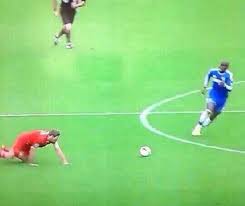
One slip cost Liverpool the game and possibly the title
So this week , soccer people world-wide have discussed the continuing debate: does a coach try strictly to win , does a manager coach the team to entertain, do coaches need to develop players even at top professional levels? Is Jose Mourinho a genius for adapting defensive tactics when he feels it is needed, or is he a bad influence on other coaches and a negative for the game as a whole? How do these issues affect youth coaches and the decisions they make? Tough questions. These decisions then open the door to questions that affect the game as a whole, at least in this country- the third conundrum- questions larger than a team’s or organization’s decision on their philosophy of game tactics. And that will be the subject of our next post!
Liverpool, Seattle and the Xbox
Posted: April 22, 2014 Filed under: Uncategorized Leave a commentThe past couple of Sunday mornings, The Soccer Yoda got out of bed at the ridiculously early hours of 5:00 AM and 4:00 AM.. Now for many this is a commonplace activity, mandated by work hours that require an early awakening. For many others, early rising is a Ben Franklinesque habit, born of the concept that somehow life is better, more productive and ….well.. makes a person “healthy, wealthy and wise” (if accompanied by “early to bed”.) And it is true that a good cup of coffee, a breakfast snack, a beautiful sunrise….these can certainly start the day right for those inclined to enjoy them. I, on the other hand, don’t have to get up early, nor do I want to awake with the sun. No..The Soccer Yoda enjoys rising to very late mornings (sometimes even early afternoons!). These late risings are preceded by late evenings in a sort of anti- Poor Richard lifestyle (Rich Richard?). The reasons that I can manage this schedule and prefer to do so are two-fold. One- I do not hold a job that requires rising early in the morning. In fact, I don’t hold a job at all. In 2009, after 43 years of steady employment , I became a victim of the Great Recession, my position was eliminated and I became unemployed. I was able to survive because for most of those 43 years I was saving toward retirement. Granted, I thought it would be the typical retirement – you know, where the employed tells the employer that he/she isn’t coming to work anymore instead of the other way around. Nevertheless, I was prepared for the event. Two- I live in Las Vegas. Vegas is a city that doesn’t get moving until late night. Happy hours , complete with half price appetizers and pizzas, begin at midnight. If a person doesn’t have to wake up until late in the morning, this makes for many late late evenings.
So, what was I doing up at those unheard-of early times ? Getting ready to watch Liverpool play games that would go a long way toward deciding the English Premier League championship, that’s what. Getting ready to watch only the biggest games that Liverpool has played in years. Getting ready to be either exhilarated or depressed, excited or solemn, happy or sad. Liverpool sat on top of the league with 5 games to go, Chelsea in second, Manchester City third. City was the overall favorite for the title, Chelsea is always a top team, and Liverpool was considered an upstart who hadn’t proven that it belonged among the championship contenders. At the beginning of the season City and Chelsea had goals of winning not one , but two league titles, that of the European Champions League as well as that of the Premier League. Liverpool, on the other hand, was hoping to finish fourth in the Premier League, so that it could at least play in the Champions League next year. Liverpool hasn’t qualified for Champions League play in 4 years. They have had a surprising season, perhaps overachieving, being spurred on by its second year manager Brendan Rodgers. Rodgers has introduced a brand of soccer that’s easy to watch, pleases the purists and gets results. All of this makes for great soccer , worthy of losing some sleep for any soccer fan, much less a Liverpool fan like myself. This begs the question – why Liverpool? Over the years I knew that Liverpool was one of the better English clubs, winning many titles and cups during the 1970’s and 80’s. But I didn’t follow them, or any European club, for that matter. I’m not English nor did I travel to Liverpool during either of my visits to England. Up until 6 years ago, I didn’t know of any Liverpool players except Steven Gerrard and I knew of him for his play for England, not for his club achievements. The answer to the question – why I am a Red’s supporter? Well, it is not any of your typical reasons. I wasn’t born there, I never lived there ( I’ve never even been there), my family could care less, I didn’t see them on tv and fall in love ( well, not exactly). I’m not even that enamored with their colors.
It’s been said that men are nothing more than boys , just with bigger toys. Yes, I’m guilty as charged! I was completely captured by the first Pong console I owned. It was a great combination of tech, physical skill and competition. It could be played at a minutes notice, in a small space and if you didn’t have an opponent, the console itself was more than worthy. It hit all the points that my game-playing psych thought were important for great entertainment. I eventually graduated to Atari and other versions of video games. As each new advancement appeared on the marketplace, I had to have it. So naturally, when the “soccer” game “Pele World Soccer” was published, I was right there! This game required a vivid imagination to think it was soccer. Three circles moving around a closed area with the aim of guiding the “ball” into a goal was a far cry from the game I had a passion for. But, it said “soccer” in the title (it could have said hockey or pinball , for all it resembled soccer) so I played it a fair amount of time. Gradually though, PC gaming became my tech hobby and shooting space ships full of aliens took up my gaming hours. The development of the Xbox 360 changed all that. The graphics were excellent, the sound was realistic and (mainly) a game called FIFA, named after and licensed by the international soccer organization, was made for it. Now THIS was realistic. Real teams were included with real players who mirrored the quality of play that they exhibited in the real world. A gamer could manage a team, buy and sell players and then control the players in matches against other real teams controlled by the computer or ( with somewhat less ability to manage the roster) play against other gamers from around the world. I was hooked! But what team to manage? Decisions, decisions! I decided to manage in the English Premier League as I was more familiar with it than other leagues and wanted some quality players to control ( the MLS was not very good at that point). I didn’t want to manage the best team, that wouldn’t be a challenge- the best are supposed to win. No glory in winning with one of the top sides! I didn’t want a bottom team, the computer was pretty good and that task would be impossible and frustrating. So I looked for a better-than-middle- but-not-amongthebest-team and there sat Liverpool, in fifth place at the time. I knew of Liverpool’s history of being one of the best organizations in the soccer world during the 1970’s and 80’s. But it had been years since they had won the real league championship, so if I could guide and play my virtual Liverpool to the top, that would be an accomplishment. So it was “look out xbox computer! Here comes The Soccer Yoda managing Liverpool against you and your soon-to-be defeated computer-controlled players and teams!”
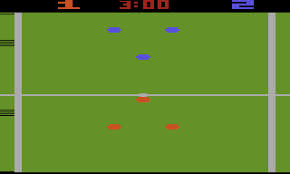
Pele World of Soccer Video Game
Competing against the xbox 360 was great fun. I skillfully managed my team, won matches and snatched the championship for several seasons. One day, about a year after beginning play with the FIFA video game, I turned on the TV to watch some real soccer and ….whoa….there on the television was a team that looked just like “my” team on the xbox! They had the same uniforms and …wow…the same players… as “my” team! The players on the screen even had a passing resemblance to “my ” players! Well, what do you know…it was Liverpool!…the real one…on my TV! BUT ,there was one major difference: they weren’t managed by The Soccer Yoda, they were managed by some guy named Rafael Benitez…and he wasn’t doing a very good job. They didn’t play like my xbox Liverpool and I grew frustrated watching them….”c’mon, make that pass…where are you running…shoot the ball!!!!”. Then…” that’s more like it…good defense!…great pass…GOAL!!” And, just like that, I was a fan. As time went on, more games were televised until I could watch almost every Liverpool match on my television. Then, my new phone gave me up-to-date bulletins as to player moves and manager quotes and such. When my youngest son bought me a Liverpool jersey as a present, it became official and being a Liverpool fan has been evermore engrossing as the years have passed and especially now, during this surprising and exhilarating season. And, THAT is why I was up in the wee early hours these last few Sundays, jumping up and down, twisting and turning, and despite my best efforts to be quiet, letting out such a yell when Philippe Coutinho scored the winning goal against Manchester City…. my wife came running out of the bedroom to see what was the matter.

Coutinho celebrates winner against Manchester City
Ironically though, things have changed on the xbox ( now Xbox ONE). A couple years ago, I discovered the excitement of competing with real people on FIFA instead of the computer. Despite the best attempts of programmers, real people are more unpredictable and more fun to play against than the computer (even the new improved version). However, I found that using Liverpool against real opponents was a problem….the team lacked the video game attributes ( the FIFA teams are designed to play very closely to their real counterparts) to compete successfully against good players using other teams that play more efficiently in video games. Eventually ,I gave up using Liverpool and found another team that I can compete with very successfully against other FIFA players—the Seattle Sounders— even the new 2014 Sounders with a somewhat revamped lineup. At present, I am ranked in the top 19% of 220,000 soccer-loving, crazed video gamers who play against each other on the Xbox one. Not too bad for a older guy with slowing reflexes, weakening vision and a couple other things to do rather than play Xbox. (Only a couple, though)

Clint Dempsey competing as a Sounder,,on FIFA 14
Has using the Sounders in FIFA turned me into a Seattle fan? Nope, one fanatical fanship per sport is enough. After all, it occupies your time, your emotions and sometimes your pocketbook…….although the other day I did catch myself checking the TV schedule for Sounder’s games………but….I just can’t let myself be a wacko fan of the real Seattle Sounders….it would cut into my FIFA time!
Organizations and Technicians
Posted: April 8, 2014 Filed under: Uncategorized | Tags: Brazil, Brendan Rodgers, Laurel, Omar Saleem, Pele, Ray Vigliotti, USSF 3 CommentsAfter a fall-winter hibernation, the Soccer Yoda has awaken and has begun writing once again. This is an exciting time in world soccer; the World Cup is approaching, Europe is host to a couple of very tight league races, Euro Champions League has more teams capable of winning than in any recent year and the MLS has begun a new season with more quality players and ever-increasing interest. There is much to keep the soccer enthusiast happy, interested and deeply engulfed in the sport. Of course, there is controversy. FIFA is embroiled in the usual pre-World Cup craziness concerning the readiness of the host country stadiums and therefore the accompanying “how did this place get picked for this?” question/accusation is making the rounds. This time however, that query is being leveled at the next next venue also as inquiring minds are looking to 2022 and wondering how Qatar, yes- Qatar, is ever going to pull off hosting a World Cup with all that entails , while somehow lowering summer temperatures about 30 degrees from normal. All this activity has provided lots of inspiration for me to put the pen to paper again ( ok- the fingers to touch pad). But the final push to post this blog again was provided by recent comments from perhaps the greatest soccer player of all time and a small article about my newest favorite coach.
Last week, Pele was interviewed by the Associated Press. He has a book coming out and since the interest in Brazil ( the World Cup host) is growing every day, his views are interesting to hear. He spoke on a variety of topics, one of which was the growth of the game in the USA. “People should be careful, because I think that here in the United States today, they play more soccer than they play in Brazil. Its important that American kids know that. We don’t have the same support they have in college, university. Soccer is becoming very, very, big in the United States. The base, with the kids, is more organized than in Brazil, Argentina, Uruguay. No doubt.” This sounds extremely favorable……arguably the greatest player ever says the USA is the coming power in soccer. Now, I think Pele is a very special person. I have been fortunate enough to meet him and discuss the game with him for a few moments. I found him to be gracious and personable. He wasn’t into himself at all and was genuinely interested in what I had to say. But, his view of the present situation in this country, while not exactly wrong- is ……..incomplete. There is more involved if we are ever going to get to the “watch out Brazil!” stage. And I was lucky enough to have had a first hand lesson as to the reason.

Pele – always a professional
During my first couple of seasons as originator and head coach of the Laurel (Md) High School soccer team I had zero players with prior soccer experience. There was no youth program in the area ( or virtually anywhere else in the nation at that time) and I did not have the benefit of students raised in other countries. We managed winning records in those seasons, but no championships. One day, three of my graduating players came to me and with big smiles announced that,” coach, we are setting you up for the future!” I inquired as to how they were “setting me up”? ” We got little kids playing!” “Yeah, little kids!” “yeah, playing soccer!” It seems that they were kicking a ball around the street and a number of 9-10 year old boys came up and joined them. “They have been playing every day ….even without us!” “They love playing soccer….cool huh?” “When they get here, you will be set!” Four years later, my situation hadn’t changed much…..no youth club kids, no foreign-born players, a string of winning seasons but no trophies. There was one major difference though – me. I had spent the years learning everything I could about the game. Books, clinics, playing myself, watching every game I could. I grabbed every article in sight, especially if it discussed the Dutch and their “total football” philosophy of play. And then, during my first day of practice for the 1975 season, a group of new students showed up and after about two minutes of watching them knock around the soccer ball , I knew — the “little kids” had arrived.
The timing was perfect, I was ready to teach my new learnings and install a system which stressed possession and ball control. A philosophy in which concepts were more important than positions, which resulted in a free-flowing offense style. The “little kids” ( who weren’t very little anymore) took to it with open minds and able skills. In the next 3 years we went 37-6, won several county and regional championships and reached the state finals. After high school, the group had representatives in many college programs of all sizes including a captaincy of a national Division 1 finalist team. They were represented on the USA under-19 team , the US Olympic team and even had a member reach professional status. It cannot be emphasized enough; until high school they had limited experience playing with uniforms and referees, goals and scoreboards. They were a very rare group in the United States, then AND now, players who grew up playing soccer in the street and backyard, not on the club field.
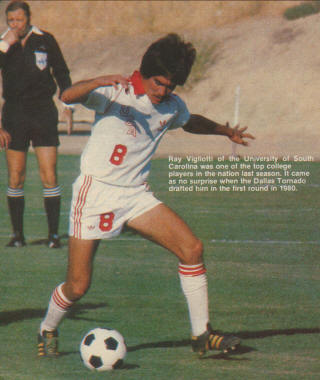
Ray Vigliotti – one of the “little kids” who developed his skills playing in the local streets.
Last week, Omar Saleem published an article titled,” What Youth Coaches Can Learn From Brendan Rodgers”. Mr. Saleem lives and coaches in the United Kingdom and edits, publishes and occasionally contributes to a newsletter – These Football Times. The article immediately caught my attention. You see- the Soccer Yoda is a Liverpool fan! And not just a casual fan either. I have gotten up at ridiculously early hours to watch the Reds on tv, have several Liverpool jerseys and T shirts, and have been seen dancing wildly around our loft after Liverpool scores. The reason for this loyalty goes back a few years and will be discussed in a future post. But it is a passion has been growing with time and has received a boost with Liverpool”s recent success. That success has been largely attributed to Brendan Rodgers, who is in his second year as Liverpool’s manager. He has introduced a philosophy based on possession and ball control, one where concepts take precedence over positions, resulting in a free-flowing offensive style (sound familiar?). The Soccer Yoda loves this kind of play and has ever since,.. well….those ” little kids” of Laurel High School played it in their less-skilled than Liverpool but not less enthusiastic manner. The article discusses how Brendan ( I’ve never met him, but I feel like we are on a first name basis) uses the ball in every training exercise, from warm-ups to cool-downs. He has increased his teams technical ability as he has developed their style and the results have produced a jump in their place in the English Premier League and an offense that is scoring goals at an unheard-of pace. The article goes on to say that if more youth coaches would also use the ball for all their training, perhaps their players would also increase their technical ability and , given their age, at a greater percent of increase than Liverpool’s players, who were already pretty proficient when Brendan arrived. This is something that the USSF coaching schools have been preaching for decades with some success, but recent observations show that there are still many coaches in the US that like to have their players run laps, do conditioning exercises, build their “toughness” by doing whatever “guts” exercises those coaches can think of. Given the location of the article, the English must have that problem also.

Brendan Rodgers on the training ground
But I know this……the little kids of Laurel ran no laps or did any conditioning exercises while playing and loving to play their sport in the street. Brazil’s players are world-famous for their ability to work magic with the ball, that proficiency is gained in the streets and on the beaches. They, perhaps more than any other group, take joy in playing with ball, in becoming the world’s master technicians. I suspect that while developing this ability, they do not run laps or do conditioning exercises or have to listen to coaches screaming at them to “want it more”. Pele is correct in this- the USA has a large soccer organization, and it’s getting larger. But for us to threaten the likes of Brazil or Spain or Argentina or Germany on a regular basis, either we need lots more street soccer or lots more coaches emulating Brendan Rodgers. We need our youth to love the game and love to play the game, wherever they are- street , backyard or club field. Even a large well-run organization will not do it simply because it exists.
The Biggest Weakness in American Youth Soccer
Posted: September 23, 2013 Filed under: Uncategorized 4 CommentsThe other day I stumbled upon an article written for Fox Sports by Leander Schaerlaeckens, an established soccer writer who has written for many US publications. In this article he writes about the problems with American youth soccer. You can read the article here if you wish, I’ll be discussing it in this post and will let you in on it anyway.
Certainly all is not perfect with the youth soccer system in this country. For one, its a conglomeration of different organizations with different backgrounds who have different goals for their participants. Sort of like a melting pot of expectations which have sprung up in an atmosphere of entrepreneurship. Wow, who would have expected that in the United States? While this is simply the American way of doing things, it is quite different from the system in most other countries. Most youngsters in the world learn their early soccer lessons in the streets, in the yards, on the pavement, on local fields. They learn in groups of 2 or 3 or maybe 5 or 6. They play with everything from good soccer balls to rolled-up rags. When they do join a club, it’s a club which runs under the control of their local “football association” which is a part of their national association which comes under the auspices of FIFA. FIFA controls virtually all the soccer played in the world. However, in the USA , while most of the organized soccer is part of the United States Soccer Federation – affiliated with FIFA – a great deal of the game is played by other organizations which are independent of world-wide soccer.
One of those organizations is the American Youth Soccer Organization (AYSO). Founded in Torrance, Ca in 1964, AYSO has been on the scene since the soccer boom began. In the early days, when the USSF was just getting its act together in regards to youth involvement, AYSO represented a viable option (sometimes the only option) for a youngster wanting to play the game in the western USA. Many of our early national stars had an AYSO experience when growing up. The organization operates on 6 basic philosophies, most of which are certainly admirable. Everyone plays; Good sportsmanship is required; Positive interaction between coaches and players; these are all excellent driving concepts. The last philosophy is player development…now this is what we are all after, isn’t it? Certainly , Mr. Schaerlaeckens is. He talks about the USA not producing the quality players that a country with our size and economics should produce and relates that shortcoming to our youth system. Again, player development is an admirable goal. But when taken in context with two other philosophies, problems arise. All applicants are accepted regardless of talent and experience – nothing wrong with this idea, everybody has to start somewhere. Balanced teams – now this is a principle that is largely ignored by other groups and seems to be great idea, after all who wants to see those 7-0 blowouts that bore the winners and depress the losers? To accomplish this principle AYSO redistributes the players on a regular basis, changing their coaches and teammates so that the local league is balanced. And that is a direct contradiction with the philosophy of player development. This means that the best players play on teams with the worst players since a) everybody is accepted and b) teams are redistributed. Good soccer players figure things out quickly and younger players are perhaps quicker than older players. They learn fast that if they pass the ball to certain teammates they are doing a disservice to their team. While the better player might give the new kid a chance to get the ball during an easy win, these are balanced teams, remember? All games are close, are competitive, and no player of any age is going to take a chance on losing the game by playing the ball to a teammate who is likely to make a mess of it. In addition, there are limits on the player development of a youngster who isn’t playing with others of at least equal skills. How does one learn to deliver and receive a wall pass if teammates are incapable of making a return? It is accepted world-wide that to truly advance, top players must play with and against other top players. AYSO contradicts itself with its philosophies of balance and acceptance when combined with player development.
All this is readily apparent to quality players and their parents. As a result ,in many localities the more serious player either leaves AYSO after a time, or doesn’t join it in the first place. AYSO has become the bottom rung of soccer quality in many places and the participation numbers reflect that placement. 650,000 AYSO players nationwide versus 3 million USSF youth players represents a near 500% greater size of the FIFA-affiliated group. I speculate that AYSO isn’t bothered by this. They have their goals and their philosophies and they are doing an excellent job of living up to those to the benefit of many kids. I know about this from personal experience. My granddaughter began playing the game as an 8 year old in a “recreational league” here in Las Vegas. She was placed with a team in a league of girls none of whom had any real experience. As the team had no coach, her mom (whom played at the U. of Maryland as a college player and was a decorated high school player) and the Soccer Yoda co-coached the team. Over 5 seasons the girls went from girls trying to play the game to becoming actual soccer players. During this span they learned the game, developed their skills and after a couple seasons of getting the basics down, they went on a tear ,losing only 2 games of their last 31. Now remember, this was a recreational league. At no time did we think that we were competitive with the local soccer clubs and indeed ,we lost a couple players to those clubs. My granddaughter, though, developed other interests despite becoming quite a decent player at that level. She dropped the sport for a season but a friend told her about AYSO and playing with her friend was appealing. As a result, she is playing this season and enjoying it. She is also overall the top player on the team ( I might be a bit biased). Her prior team would make mincemeat of her present AYSO team and that was a recreational team which couldn’t compete with the clubs. All involved with the AYSO here seem very happy with it, but make no mistake, there are no future Mia Hamms or Alex Morgans coming from this league if the girls playing don’t leave for better competition. AYSO finally recognized this and in 2009 , 45 years after original formation, they introduced the FLEX program for better players. But those contradictory philosophies are still there, so the same problems exist, just at a higher level.
This is not a criticism of AYSO, it is what it is and does a fine job of providing a fun, balanced experience for lower level players. The problem is that Mr. Schaerlaeckens, after coaching teenagers for a few seasons of AYSO in Westchester ,NY , has used his experience as a indictment of the whole youth system in the country. “And from observing the practices at the bottom of the sport I cover, I learned a great deal about the genesis of some systemic issues that persist at the top of it in this country.” Sorry , but the comparison between a below- recreational league experience in NY that practices for an hour once a week and plays 6 to 8 games a season with the upper level elite teams springing up across the country is ridiculous. It is possible for a pre-teen youth in this country to experience a formal soccer education equal to any in the world. I have seen pre-teen soccer camps in the Netherlands and our kids are just as good at that level. Granted , at the teen levels, we may drop some as we don’t have lots of professional teams with established academies churning out potential professionals. For one thing, our educational priorities in this country are a bit different than in many other nations. (That’s another discussion). But one thing is certain, the reason as Mr. Schaerlaeckens says,” …the United States continues to lag behind in the production of sufficiently skilled and savvy soccer players to compete with the very best, as its economic and demographic makeup suggests it should.” , is not AYSO or any supposed relationship with its program and the top USSF youth programs. IF there is a lag, it is not due to our still developing youth system. It is far more likely due to the fact that soccer is not the main sport cultural activity in this country, that youngsters still don’t play hours and hours of street soccer. Although Fox Sports is to be commended for its commitment to the sport, it is difficult to understand how they could publish an article that clearly shows a lack of understanding of our youth system. Would they publish an article about a local low-level church basketball league and relate that to our lack of domination over the last several World Basketball Championships ? Perhaps one of the problems is our media, that there are still national-level sportscasters who know little about soccer or who actually belittle it, that a far-off-base article is published by a national media outlet. Let’s face it, until our sport becomes a national pastime with a passionate following of millions of soccer-knowledgeable fans both following and participating ,we may always “lag” in producing large numbers of world-class players. But, if we can develop about……say 20 or so who can compete with any in the world… that may be all we need. And if we can’t, despite having everything else going for us…..well, go ask Mexico.
We’re Going To Brazil!
Posted: September 11, 2013 Filed under: Uncategorized | Tags: Clint Dempsey, Costa Rica, Eddie Johnson, Jozy Altidore, Mexico, Michael Bradley, United States, USA 2 CommentsBulletin! We interrupt our regularly scheduled post to bring you this special edition! The United States men’s soccer team has beaten Mexico 2-0 in Columbus ,Ohio to clinch a spot in next summer’s World Cup to be held in Brazil! The win represents the fourth time the USA has played a World Cup qualifier in Columbus and the fourth time the score finished at 2-0 for the Americans. But the road to this win wasn’t very smooth. Actually, it was quite the opposite. Since we last discussed the USA men’s team (The Will to Win – A Tale of Two Games) things have been a bit rocky. The Americans and their coach Jürgen Klinsman have learned quite a bit about themselves and about what represents the best way to replace missing players with this team. It took a loss to Costa Rica and some hard luck and questionable refereeing to teach those lessons, but in the long run this was a positive outcome for the Yanks.
It actually started in England almost a week before the Costa Rica game when American forward Jozy Altidore strained his hamstring while working out with his club team Sunderland. He missed their Premier league game that weekend and it was feared that he wouldn’t be available for the important matchup between the USA and Costa Rica later that week. The game was being played in Costa Rica where the USA has never won and with Altidore on a scoring spree with his national team, his presence would be sorely missed. Then shortly before the kickoff in San Jose, things got worse – a lot worse. The first game between these two teams in this hexagonal qualifier was played in Denver in a snowstorm. The USA won 1-0 and the Costa Ricans were enraged that the game was played in the first place. So this second matchup between the two was considered by the Ticos as their chance for revenge for the field conditions that night in the cold in Colorado. They got their revenge in an unconventional and unplanned manner. A few hours before the game it rained quite heavily in San Jose and the field took quite a bit of water. There was never a question of not playing the game, but the conditions were not ideal. The grass was wet and the turf loose and just before kickoff, Michael Bradley planted his left foot on the ground while taking a routine kick in warmup and the turf gave way. He twisted his ankle and the injury ruled him out of the contest. By game time Altidore was doing better, but Coach Klinsman decided that he would rather save him for the Mexico game 4 nights later, therefore giving Jozy more time to rest his hamstring. So, now, just before game time, Jürgen found himself down not just one, but two of his most important players.
In a situation like this, a coach has several options. Option 1 is to simply substitute the two “second string” players for two injured starters and leave everybody else as they were. There is another possibility though, especially if the coach feels that there are better players available than the replacements for the missing starters, even if those better players typically play other positions. Klinsman chose the latter option. He moved Landon Donovan from his expected outside midfield spot to a forward position where he could linkup with Clint Dempsey in a two forward system. This wasn’t what Dempsey was familiar with when playing for the USA and required some adjustment by both players. By moving Donovan, the right midfield position which Donovan would have played opened up and Jurgen solved that question by using Graham Zusi. On paper this wasn’t too drastic a solution as Zusi had played decently in prior qualifiers during the spring, but he isn’t Landon Donovan by a long shot. Coach Klinsman covered Bradley’s absence by moving outside defender Geoff Cameron to Bradley’s holding midfielder spot. This position requires a mountain of playmaking and creative passing and Cameron ,while having some experience as a midfielder, has always been a defensive midfielder so he was thrust into an unfamiliar role with only a few minutes to prepare. In Cameron’s place , Michael Orozco Fiscal was used, again with only a few minutes to get ready. Now, if you are counting, that is five- count’em- five positions that were changed with either new players or roles. So, half the field players starting the game were not the original players on the original starting team in their original starting positions.
The Costa Ricans were VERY fired up for this big contest, in front of their home fans, with first place in the hex at stake. They pressured the USA all over the field from the opening whistle and the Americans played like half of them were not the original players on the original starting team in their original positions, which, as we know (see above) they weren’t. In ten minutes ,the Ticos were up 2-0 and the Americans were still looking around to see where everybody was playing. As the game went on, the Yanks got better and by the second half the lead was down to 2-1 and with the introduction of Eddie Johnson and Altidore, a comeback was certainly possible. However, as happens so often, by pressing forward a team leaves space open at their back and the Costa Ricans countered well to score again. So the United States 12 game winning streak was snapped and we learned that the team does not really have that many interchangeable parts. On top of the loss, the referee went on a late game yellow card spree and by the time he was done three more Americans were out of the Mexico match. As the ref was Mexican, this opened the door for lots of questions, but that is a discussion for another post.
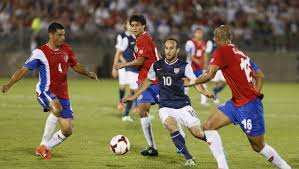
Donovan surrounded by Costa Rica as he was most of the game
For Mexico, Bradley was still out with his sprained ankle and Altidore was still out also, just for another reason than injury. He was one of the recipients of the ridiculous yellow cards and therefore had to miss the game. Also missing with yellow cards was the previously discussed Cameron and defender Matt Besler. So, once again Jürgen Klinsman was faced with missing starters for multiple positions. This time , however, Jürgen went for option 1 above. He simply dropped in the second tier players for the missing starters and kept the basic system and chemistry intact. In particular, he used Eddie Johnson for Altidore and Kyle Beckerman for Bradley. Now, make no mistake, Johnson isn’t Jozy. But he does have some definite strengths, mainly his ability to be a beast in front of the goal in the air. Beckerman is a poor mans Bradley, but by putting Donovan in the his outside midfield role and surrounding Beckerman with players in familiar positions, Klinsman lowered the pressure on him. The game was in the very friendly Columbus Crew stadium and the Mexicans came in with a new coach, a miserable record in this competition and even more questions about their team than the Americans had. And their questions weren’t about injuries and cards, they were about talent, attitude and chemistry. Hmm, that makes injuries and cards look minor. After the first 15 minutes or so, those injury and card problems got even smaller. The Yanks started putting things together and by the end of the first half it was a promising game for the USA. Early in the second half, Johnson did his corner kick thing again, as he has done before in recent games for the US and as he had just barely missed on in the first half.
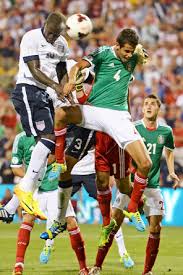
Eddie Johnson scores on a corner kick against Mexico
Later Donovan scored on a nice set up from his teammates and the Mexicans were left wondering if they will make it to the World Cup. Not so for the USA -combined with the Honduras-Panama draw- the Americans are definitely into the finals in Brazil. The crowd in Ohio was crazy, representing the new American passion for the game and for the American national team. I must say, that seeing all those red scarves raised during the national anthem is a stirring site, unseen in any other athletic event. And now, we get to enjoy the World Cup in the best possible way- while rooting for our country.
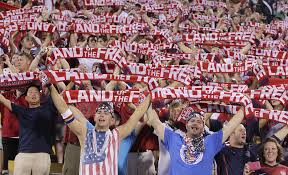
The loud, proud crowd in Columbus!
Early Season Rundown – English Premier League
Posted: September 4, 2013 Filed under: Uncategorized | Tags: Arsène Wenger, Arsenal, Daniel Sturridge, England, Gareth Bale, Liverpool, Real Madrid C.F. 3 CommentsThe new soccer season is off and running and in Europe the transfer window is now closed until January. This means we actually know who the various teams have on their rosters and we can get a inkling of what the new season will bring us in terms of competition for the different league titles and qualification for tournament spots. So, it seems appropriate to run down the more watched leagues from around the world and report our early season reaction to results so far. Today, we examine the English league.
Although there is lots of debate as to which league has the best quality of teams, the most watched set of teams undoubtedly is the Barclay’s Premier League in England. After only 3 matches there are some small surprises and lots stories to follow. At this point, due to a raft of new coaches and players, the league is filled with “ifs” and “maybes”, making it extremely interesting .
Perhaps the biggest surprise is the team on top. Liverpool is the only team in the league to still have a perfect record and although to some fans that fact is not totally unexpected , the manner in which they have accomplished their record certainly is surprising. Last year the Reds scored lots of goals and gave up lots of goals. However, they failed to score against teams with strong defenses who sat back and they often gave up bad goals to those same teams. As a result, they failed to earn wins against weaker teams and this cost them valuable points. This season they have three 1-0 victories against a variety of competition including mighty Manchester United. They have scored just enough to win- one goal in each game. They have scored that one goal in the first half of every game with the same player (Daniel Sturridge) when playing their mini-Barcelona style and have played three strong defensive second halves to earn the victories. Whether they can keep this up is a BIG question. However, in a few weeks Louis Suarez comes back from his suspension for making lunch out of Chelsea’s Branislav Ivanovic last year and IF he combines well with Sturridge , the Reds offense will improve and they will be a genuine contender.
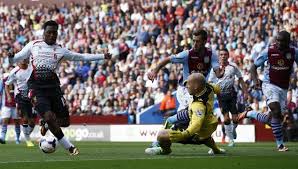
Daniel Sturridge scores a great goal against Aston Villa
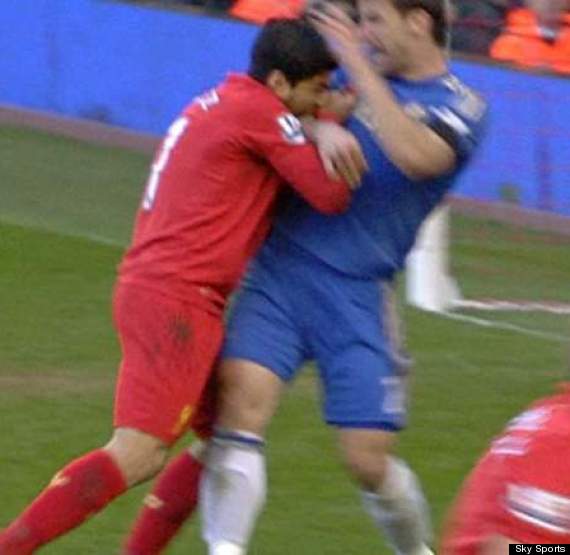
Louis Suarez gets hungry while playing against Chelsea last spring
The teams sitting just below the Liverpool are not very surprising overall. Chelsea, Manchester City, Tottenham, Arsenal…..all are expected to challenge for high positions and there they are already. And , just below them sits Manchester United. 3 of these of these teams have new head coaches and there is a natural adjustment period to new styles and personalities.Chelsea not only has a new coach but they have a roster which consists largely of skilled midfielders, meaning they must change their style. So far that has produced some uninspiring play but the only error to their record is the slumberfest draw against United. (See our last post). Speaking of the Red Devils, we referred to them above as mighty ,maybe we should call them Maybe Mighty Manchester United. Like so many others, they have a new coach in David Moyes. He is considered to have done well with much less talent at Everton but coaching talented players is a different experience and except for a last minute buy of Marouane Fellaini from Moyes old club, he did nothing on the transfer market. Whether United’s talent can win the league again with a new unheralded coach is the big maybe here.
Manchester City has new coach Manuel Pellegrini. He has done good things in Spain, but the EPL is a world of its own. Pellegrini has spent some major funds this summer to bring in new talent. But new coach with new players frequently means time to adopt and City’s loss to newly promoted Cardiff City didn’t inspire any belief in a quick transition. Man City has always been a hard-to-figure up and down squad. They have had good players and mostly solid results the last few years, but every once in a while they have a real stinker of a game. They will be a threat to the rest of the top teams but the many questions to be answered also bring some doubts and many “maybe’s”.
The biggest “maybe”, however, has to be Tottenham Hotspur. They sold one player, Gareth Bale, to Real Madrid. This record breaking sale gave them enough money to buy a whole team, so that’s just what they went out and did. Spurs bought 7 …..yes SEVEN ….quality players with the Bale funds. They got enough variety in players to improve all areas of their team if they jell together. Now that is a big IF. Soccer is a funny game when it comes to chemistry, both on and off the field. Often players don’t connect well if they don’t play complementary roles on the field and it’s not that uncommon for various off-the-field activities ranging from politics to women to effect on-the-field performance. So , putting together that many new faces will be tricky for Andre Villa-Boas, the Tottenham coach. So far, they haven’t shown anything special on the field with two close wins over theoretically weaker teams and a loss to Arsenal. But it’s a long season and Tottenham will certainly be interesting to watch.

Selling Gareth Bale funded a new outlook for Tottenham
That brings us to Arsenal. Arsenal does not have a new coach. And except for one quality transfer (more about that in a bit) they don’t have a new team. Last year they finished fourth which is a prime position because it is the lowest spot which guarantees participation in the European Champions League. Playing the Champions League is a BIG deal. It brings in more money and , perhaps more importantly, it can bring in more good players. Teams that don’t make the Champions League often have problems attracting quality players, it is almost as if a non-ECL team is “minor league”. Arsenal has an incredible record of consistent high performance under long-term coach Arsene Wenger. Perhaps it was this consistency which led the Gunners to believe that they could get by with little or no activity on the transfer market. So, after getting wiped by Aston Villa 3-1 in their first game, their fans went nuts on them for their lack of spending for new players.. This inspired more activity than the previous singular never-gonna-happen attempt to get Suarez from Liverpool. On the last day of the transfer window Arsenal bought Mesut Ozil from Real Madrid. Now this guy is for real. He became expendable to Real because 1) Bale will play his position behind Real’s forwards and 2) the sale recoups almost half the funds spent to get Bale. Ozil could make a real difference if Wenger puts him to good use and on the surface that looks promising. Ozil can play Arsenal’s mixed passing and running game and Wenger is a veteran in working with talent. And, after that opening debacle, Arsenal has actually looked pretty good. With the inclusion of Ozil they could be a real threat to the other top squads.

Arsenal fans were not happy with their lack of transfer activity
As far as the rest of the league goes…….right now Stoke City is sitting up there with the big boys. They lost their opener to Liverpool and that was a deserved loss. But since then they have played well under new coach Mark Hughes who is attempting to add style to their traditional bully-boy defense combined with long-ball offense. So they are another interesting team to follow. Aston Villa has Christian Benteke which makes them always a threat if the opposition doesn’t take them seriously (as Arsenal found out). Swansea plays a controlled passing game and they have surprised since being promoted 2 years ago, Everton is a big-team wannabe who ALSO has a new coach in Roberto Martinez ( jeech, so many new coaches!). He too likes the control game but despite having a couple quality players, whether they can adapt is a question. Sunderland has American-on-a-hot-streak Josie Altidore and could surprise. Crystal Palace is newly promoted from the second division, but has brought in several new players and has displayed a feisty manner of play which earned them a nice win against Sunderland and a close loss to top contender Tottenham. They, perhaps, bear watching the most of all the “lower teams”.
So, the Premier League this year has far more stories than ,”can Manchester City catch Manchester United?”. On paper, it has more balance than in recent years and certainly more question marks. That makes for very interesting watching and hopefully very entertaining soccer. We will see!………………………….. Next week- Spain’s La Liga!
The Will to Win- A Tale of Two Games
Posted: August 27, 2013 Filed under: Uncategorized 4 CommentsEven The Soccer Yoda takes a vacation now and then, but I am back and two particular games that have been played in the last couple weeks stand out to me as examples of how the desire to win manifests itself in soccer and how, unfortunately, sometimes it doesn’t.
The United States national men’s team rode an 11 game winning streak into Sarajevo to battle a Bosnian team that was on a 9 game win streak itself. Now, lets be honest, this was a friendly, an exhibition, a game which had no effect other than to each teams pride and possibly to some movement in FIFA’s national team ranking- which is notoriously inaccurate yet referred to often as a measure of strength among teams representing their countries. Bosnia stood proudly at number 13 on the list while the USA was 19. How the teams got there , though, told a story that indicated a wide gap in comparative ability level. The Bosnians have been playing in their World Cup qualifying group and leading it. Their results include a convincing 3-1 win over Greece, a team which can be very good on occasion. While the Americans have had a series of good results in their group also, world soccer common sense says that teams like Greece and Slovakia are much stronger than Honduras or Jamaica. Recently the US had a strong showing in the Gold Cup, but again this was against supposedly weak competition and many of the teams, including the USA, used second string lineups. The Bosnians were not using a second team and they were playing at home where they would want to showcase their new-found strength. Meanwhile, the Americans were short of players toiling in the MLS at home which included Oscar Gonzales, a defender who performed well in the spring qualifiers and ( much more notably) Landon Donovan and Clint Dempsey. Dempsey had just moved to the Seattle Sounders from Tottenham, which greatly increased his pocketbook if not his reputation as a world class player. In addition, the last time the Americans played a European first string that was leading it’s World Cup qualifying group, Belgium whipped up on the Red White and Blue 4-2. So everything indicated that the Americans were in for a tough time.
In the first half those indications were born out, The Bosnians showed a high level of control and poise while the Americans looked nervous and perhaps out of their league. A giveaway by Eddie Johnson, who was playing as a wide midfielder in Klinsman’s 4-2-3-1 setup created a bad situation for the American defense and Edin Dzeko found a way to put the ball past Tim Howard and into the goal. Later in the half the Bosnians scored again and the game appeared over. However, there were a couple of indicators all was not settled. One was Josie Altidore. The Bosnian defense was having a tough time dealing with him and resorted to knocking him around as their only means of coping. This produced a free kick near their goal which Altidore took ,brimming with confidence. He barely missed but a sharp observer would have noticed that he wanted that kick and was very disappointed that he missed. The other indicator was that toward the end of the half, the game turned as the USA settled down so that at halftime there was some optimism that the second half could be different; but being down 2-0 in international soccer typically means defeat.

Michael Bradley played well, as usual.
At the half, coach Klinsman made an important tactical change. He took Eddie Johnson and put him up front with Altidore. Johnson had a very strong Gold Cup as a forward and perhaps his threat would give Altidore more room to work. When the second half began, the play of the Americans indicated that they didn’t think the matter was settled even if most observers and apparently, the Bosnians ,thought otherwise. The Bosnians made a couple changes at the half, but the players brought on were not a big step down. Sure enough, only 10 minutes into the half, Michael Bradley found Altidore running with some space. Josie showed great skill and composure by settling the ball and slipping it to Johnson who was all alone since Altidore has drawn the defense. Eddie calmly put the ball into an open goal and it was a new game. Only 4 minutes later Altidore again got the ball close to the Bosnian goal. But, unlike the first half, he had some space to beat his defender.He took a wide touch, did a half turn and fired a left-footed rocket into the far corner of the goal. The game was even, the USA was proving something to the spectators both in the stadium and on TV, and Jurgen Klinsman – again- was looking like a genius. The Bosnians attempted to take back control but the American defense, consisting of players who had not played together before, was learning on the run. Late in the game ,Altidore gained another direct kick near the Bosnian goal. Again, he immediately indicated that he was going to take it, again he struck it with confidence and then we found out why he was so confident…the ball just cleared the wall and curled into the upper near corner of the net. A world-class free kick from a world-class forward. Amazingly enough, the Americans still weren’t done and just a couple minutes later Bradly ran 30 yds through open space and slipped the ball to Altidore who couldn’t miss. The Bosnians did get a late late goal to make the last couple minutes interesting, but overall the shocked crowd was treated to a display of the increasing competitiveness of the USA team and of their will to win even when they appeared to be overmatched and the game appeared to be over.
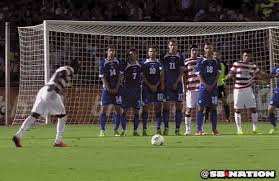
Altidore taking his goal-scoring free kick
On the other hand……yesterday Manchester United played Chelsea in the seasons first BIG English Premier League matchup. Both teams had won their games leading up to this one and with both teams having new coaches, it seemed to be a great opportunity for those leaders to establish themselves. Chelsea coach Jose Mourinho has a team that simply cannot play “Chelsea football”. The traditional strong speedy forward or two combined with the rock-solid defense so typical of past Chelsea teams has been replaced by a myriad of midfield-types. Good control, some tricky dribbling ,good passing….the Blues have over a dozen of these guys and just spent $50 million on Willian, one who is just like the other ones. So Mourinho is installing a more possession oriented style and while showing flashes of quality, overall the team has looked uncomfortable with holding the ball and looking for support. Meanwhile Manchester United, the defending champions showed that Robin van Persie is a great offensive threat ( which everybody knows) in defeating Swansea 4-0 in their opener. But , if it is possible to look bad while winning by such a margin, they did it. David Moyes is their new coach, replacing Sir Alex Ferguson who coached the Red Devils for 27 years. His job is to change nothing and keep winning. The lack of activity on the transfer market so far indicates that he has the “change nothing” part down , yesterdays game should have been his chance to show that the “keep winning” part is also in good hands.
Both teams displayed patience on offense and numbers on defense. This is typical at the beginning of games and especially when two new coaches are facing each other, attempting to see what the other guy is doing before committing to a course of action. The problem is that the “feeling out” period never seemed to end. Neither team truly went on the offensive, neither team was willing to sacrifice a defender to go forward to help, both seemed content to sit back. Chelsea didn’t even start with a forward, using Andre Schurrle as a fake forward ( known as a false nine to the soccer world). Messi plays the same role for Barcelona. Schurrle is not a Messi, and the rest of Chelsea isn’t a Barcelona. While the defensive nature of the Blues might be excused given their new style, what about Man U? Yes, they hoped that Van Persie could work some magic and Wayne Rooney played like he 1) really wanted to win 2) really wants to stay with United and not go elsewhere (like Chelsea). But unfortunately Rooney was the exception. As the television commentator explained in exasperation,” neither side is willing to take a chance to win”. Any American viewer new to the game, tuning in to see what the fuss is all about, is still wondering. Some 0-0 draws can be exciting. Teams attempting to find ways through the defense, keepers making fabulous saves, shots just missing or hitting the woodwork…. this had none of that. Look, when the biggest moment of the game is an appeal for a questionable handball, the game just stinks. As representatives of arguably the best league in the world, Chelsea and Manchester United increased the arguing yesterday. The Soccer Yoda cannot imagine Real Madrid and Barca, or Bayern Munich and Dortmund putting on such a display. The game last night was a disservice to the GAME, as well as to the respective teams.
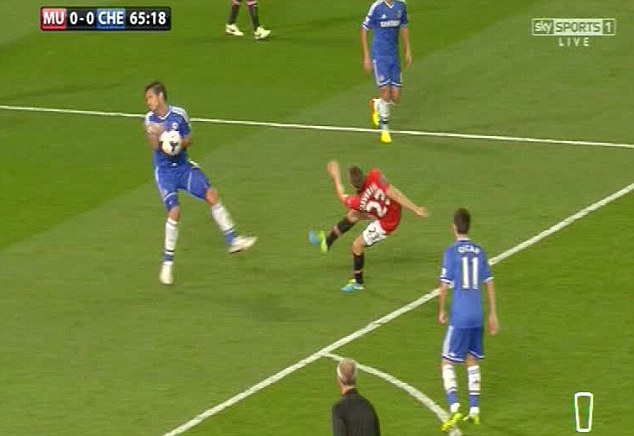
The most exciting moment of the Chelsea- Manchester United game
When one compares the two games, the difference really stands out. Yes, Chelsea and Manchester were playing the standings game, each gaining a point which might make a difference next May. The USA- Bosnia game had nothing at stake except pride. But , that’s the rub, isn’t it? The friendly could have easily been played for a draw, who would care? The match up between rivals at the top of a important league had much more at stake. So, they played scared? Two new coaches had a chance to show themselves. Well, neutral soccer fans and certainly fans of the teams themselves have to hope that what they saw was not indicative of the future. As for fans of the USA, the will to win, shown by the both the coach and the players gives great hope for the future and especially for next year in Brazil.
 The Soccer Yoda
Recent Comments