Soccer Scoring- It’s about time and space
Posted: August 12, 2013 Filed under: Uncategorized 2 CommentsWhen watching soccer, whether its a high level game between 2 top world class teams or a youth contest, I usually hear the same type of comments concerning the play: “team A is much better, they have many more shots than team B”; “team A has kept the ball in Team B’s half the whole game!”; “Team A is the better team, they have won the midfield and everybody knows that the team that wins the midfield wins the game.” Often these observations are correct, the team that has kept the ball, pushed the opposition back, taken more shots, etc. is the better side and the score reflects the difference between the teams. But often, despite one team dominating the statistics, the other team scores the goals and wins the game. Then I hear,” they were lucky”; “we were robbed!”; “we would win 9 out of 10 games”; etc. But the fact is that in modern soccer, at all levels, many times what seems like an unjust result is not that at all – it’s just one team accomplishing the necessary objectives to win and the other team failing to do the same.
First of all, lets look at the object of the game. It is NOT to dribble better or control the ball well or shoot more accurately. Soccer isn’t gymnastics- there are no points given by judges for style. The objective is to put the ball in the goal more than the opposition- it is that simple. All the other attributes are means to an end – to score more than the other guys. So, to accomplish that end, it makes sense to examine goals to see if there is something consistent about the scoring of goals. Something that should be an objective of teams that want to score.
When we take a good look at what happens when goals are scored, here is what we find: in the vast majority of goals, the scorer has enough individual “strike time” inside that scorers “scoring zone”. To explain: every player, at all levels from age 5 to 65, has a distance from the goal that if given whatever time the player needs to kick the ball to best of that players ability, that player will put the ball in the goal, even if there is a player ( like a goalkeeper) blocking the goal. For a five year old it might be 3 yards and 10 seconds while for Cristiano Renaldo it is more like 25 yards and a half a second. The better the player, the larger the “scoring zone” and the shorter the “strike time”. Yes, it is true that sometimes balls go into the goal from defensive errors or from accidental kicks, etc. But the vast majority of goals come from players being given the needed “strike time” inside that players “scoring zone” and that player executing the kick or head to his/her ability. It is a given that in order for a player to get the needed time, there must be a distance between that player and the defense. Again, for younger or poorer players that distance needs to be larger; for Messi – give him an inch or so! Therefore, teams that wish to score goals need to get players into their scoring zones with space between them and defenders and with the ball. Defenses need to deny either the place on the field or the space or the ball or all of these.
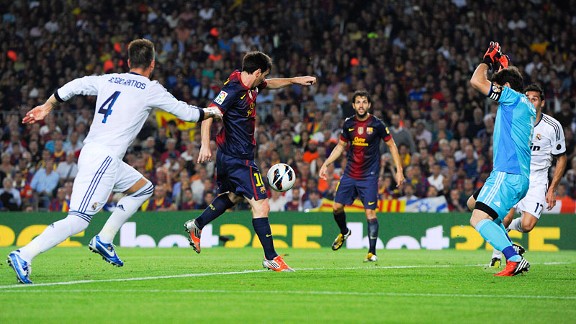
Messi needs only a little time and space to score
To accomplish the combined objectives needed to score and needed to prevent scores, there are different strategies. We can look at the extremes to examine the different ways to accomplish the same objectives. Barcelona is famous for their tici-taca style (see previous posts). In keeping possession, they deny the other team the ball and therefore the chance to score. By keeping the ball on their feet they increase their chances to get players into scoring zones. However, because the short passing takes time, defenses are more able to organize themselves to deny the space ( and therefore the time- are you getting this?) that Barca attackers need to shoot the ball well. It is through a combination of passing and player movement that Barcelona opens up defenses to gain the time needed. And , every so often, they get fouled. Direct kicks, by their very nature, give the offensive team time to strike the ball. Talented players use that time and despite packed defensive zones, they score a high percentage of those kicks if the kick is taken within their scoring zone.
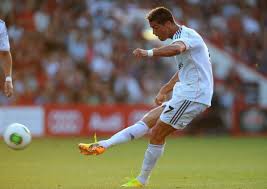
Renaldo scores a direct kick against Chelsea last week.
On the other extreme, lets look at Chelsea of 2011. That team played defense by marking tightly, by using numerous defenders, by denying space in front of their goal, making few if any mistakes and had a great goalkeeper behind them in the rare instance that a shot did get past the defenders. Meanwhile, they were blessed with some fast, strong forwards who could get behind defenders, move quickly into open areas and could hit the ball well with little time needed. They were the opposite of Barcelona- they gave up possession of the ball. But they didn’t give up scoring opportunities on defense and when they attacked it was fast and purposeful. They went directly to the goal and although they didn’t get lots of chances to score, they did get good ones and frequently that was enough, when combined with their tough defense, to win games. When the two styles clashed, they defeated Barca in route to their Champions League title.
In discussing team strategy to get players into the positions they need to score goals, lets not forget the role of individual brilliance in scoring. Even the best defense can have trouble defending players who create their own space by their speed or moves with the ball or both. Alex Morgan ,of the USA womens national team, has great ability to run quickly with the ball. Often she opens up defenses simply by running past them and creating her own space. Players who can create their own chances become double trouble when combined with a team that knows how to get them the chance to do so. But the rule is still true. Great individual players need the ball in their scoring zone and the time to strike it, but they often get themselves into that position rather than rely on their teammates to do it for them.
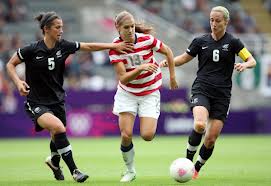
Alex Morgan beats two defenders with her speed and control
When watching a soccer game therefore, rather than look for ball position on the field, or who has the most shots, look for which offense is creating space ( more on how to do that in a future post) and which team is denying the ball or denying the space. If one team is controlling the play is the other teams goalkeeper being called upon the make difficult saves or is everything easy? Are the many shots coming close to goal or just being blocked or missing wildly? Remember, its not just the fact that one team has the ball or the better position on the field – it is what that team is doing with the ball and the position to create space near the goal for its offensive players. It is whether that team is giving up space in its half when the other team does get the ball. Yes, better players use the ball better and that is the first thing to teach youngsters….and yes, USUALLY the team which is better with the ball wins the game. But as the level of play gets higher and defensive mistakes get fewer, it is the team that gets its players into their scoring zones with the time and space they need and with the ball that typically wins the game.
The Best of Two Worlds – One Can Dream!
Posted: August 5, 2013 Filed under: Uncategorized 26 CommentsIn 1961, I watched my first “real” soccer game. ABC had started a sports anthology program called The ABC Wide World of Sports. It quickly became a popular item on TV, showcasing many sports that normally got little or no tv coverage and changing our sports cultural language forever with its famous intro each week , touting sports with their “joy of victory and agony of defeat”. The game I saw was the English FA Cup final between Tottenham Hotspur and Leicester City. The game was notable for being the first international sporting event shown on the Wide World of Sports and for the fact that Len Chalmers, a Leicester defender, broke his leg after 20 minutes and because no substitutes were allowed in those days, he hobbled around the field until only 10 minutes remained in the contest. It was also notable because by winning, Tottenham accomplished the first “double ” in 64 years as they had already won the First Division League Championship. For me, an American teenager raised on American sports and American sports organization, the constant reference to the “double” by the commentators during the game was very confusing. Was this the championship game or not? Obviously the teams had defeated a number of rivals to get to the final and obviously this was BIG stuff in England. After all, there were 100,000 fans in attendance. I surmised, at first, that this was the culmination of a playoff type of system. I thought that these two teams had reached the tournament through some form of qualification and therefore this was THE championship game. As the game went on , I learned differently and by the end it dawned on me that , by gosh- the crazy English had more than one championship! What were they thinking? How does one know who is the best team if different teams win the different competitions- as had happened for 64 consecutive years?
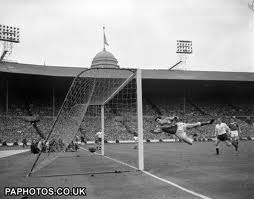
Tottenham scores against Leicester in the 1961 FA Cup final
What I didn’t consider at that time, was that 100,000 people and many more on television, were watching the culmination of an alternate competition to the regular league contests. Which meant that LOTS of money was being spent by fans of teams that were eliminated from possible league glory but were advancing in the cup tournament. What a stroke of marketing genius! If a team cannot win one competition…well perhaps they can win the other!
Today there are many more than two competitions for good soccer teams in Europe and other continents who follow similar setups to that of Europe. As an example,top English Premier organizations are entered in these competitions this year:
Premier League- 38 games played from August 2013 to May 2014
FA CUP- almost every team in England (758) plays in this single elimination tournament
League Cup- 92 professional teams from the top 4 divisions play in this tournament which is single elimination except for the semifinal which is played in two legs.
Champions league or Europa League depending on prior year results, better teams enter the Champions League – European competitions with group play moving into home and away elimination games until the single game final. The Europa championship is considered a nice win but the Champions League winner is considered the European club champion!
This is 4 – count’em- FOUR- competitions! ALL Premier League teams play in the first three of these. So, if a fan’s chosen team isn’t doing well in the league….well, there is always the cups! Compare this to our American single competition sports system in which teams which aren’t doing well are finished in the league for all practical purposes somewhere between halfway and 2/3 of the way through the season and just play out the remaining games. Sometimes our lower teams are even accused of throwing late season contests in order to improve their draft position. And the difference between European Soccer and American sports is even greater than this. NOBODY accuses poor performing European soccer teams of throwing late season games. Quite the contrary!
European countries of any significant size have enough professional soccer teams to fill more than one division. Of course, the top division is considered to be the “major league” and any lesser divisions are like “minor leagues”. At the end of each season the bottom teams from each division are relegated to the lower division the following year. The top teams in each division move up to the next higher division the next season. This promotion/relegation system creates intense competition among the lower teams as the season progresses to a conclusion. There is no thought of dropping games to get a better draft choice ( actually European soccer has no draft choice system). In England, the top two second division teams automatically qualify for promotion to the Premier League while the next 4 teams enter a playoff with the winner joining the top two in getting promoted. This means that 6 teams have a chance of joining the top division each year. Meanwhile the bottom 3 Premier league teams drop to the second division. AND the top 5 Premier League teams qualify for European tournaments the next year. Add it all up and 8 out of 20 teams in the Premier League have accomplished or failed to accomplish a goal at the seasons end. Given the closeness of the league results, usually 13/14 teams out of 20 are still engaged in VERY meaningful competition as the season winds down. In the USA ,by the seasons end of our sports many teams are simply playing out the schedule, especially the bottom teams. BTW, even though we have more than one level of pro soccer leagues, the worst MLS teams do not drop down to the minors. The reason for the failure to adopt the promotion/relegation system in the US is the control that owners have over their respective sports. Even though the public interest and corresponding attendance and TV viewing numbers are huge toward the end of each year, no group of American sports team owners is going to risk dropping out of the major league when their teams have bad years. Heck, in the NBA the best way to improve a team is to trash it completely, finish at the bottom for a couple years and make sure to get good players in the college draft. The competition in pro basketball is not only to be the best but to be the worst!
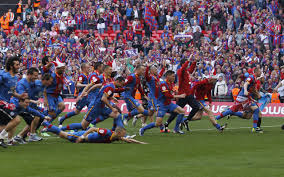
Crystal Palace players storm the field after winning promotion to the Premier League
Even though the system of league movement and cup tournaments makes for great competition and high hopes for supporters during most of each year, all is not perfect with professional world soccer. Yes, American sports could use a dose of “something to play for” toward the end of each season ( ok, I know about “playoff position” but the number of teams fighting for those spots at seasons end is far smaller than the number of soccer teams in each country fighting for promotion/relegation and cup titles). BUT, world soccer has no draft of younger players nor any salary caps. Therefore, in a system like baseball but far worse, the rich teams get richer while the rest have little chance of consistent glory. A rich owner who is willing to spend crazy money is far more the prerequisite for success than a know-how to pick young talent and the ability to develop younger players into stars. Even Barcelona, who has been the poster club for youth development, joined the “buy-our-way-to-championships” movement with it’s huge outlay of funds to acquire new world star Neymar. Poorer teams that do develop top talent frequently sell their best to richer teams for money to help them survive. World soccer could use some lessens from yankee ( and I certainly don’t mean New York Yankee!) sports in regard to creating equal-opportunity-to-succeed leagues. In a way, the various cup tournaments are the only way many middle-of-the-road team supporters can hope for accomplishments from their beloved clubs because those organizations don’t have the money for consistent wins. But anything can happen in a single elimination tournament and hope always springs up when the cups are being competed.
In the hope of the Soccer Yoda- in some future dream world- soccer clubs of all types will have a chance for championships due to the equal spending rules of soccer leagues to come. And American sports will offer more than one avenue for teams to accomplish great things each year. I know this dream seems like science fiction but then, whoever dreamt that 41,000 Americans would stream into Dodger Stadium to watch a meaningless soccer game between an American team and an Italian team? Yep, happened just last week!
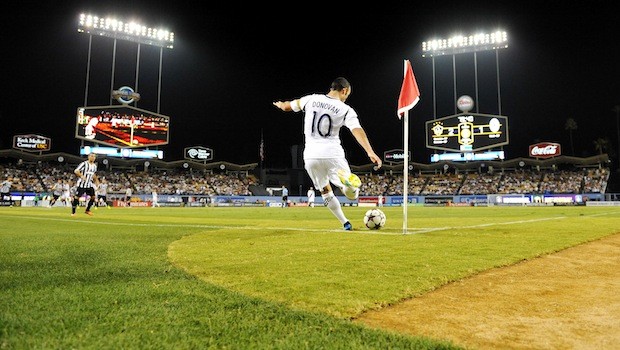
Landon Donovan takes a corner in Dodger Stadium for LA Galaxy vs Juventus
The Gold Cup: What Went Right
Posted: July 29, 2013 Filed under: Uncategorized 3 CommentsEvery two years, the regional confederation of soccer associations that make up the Caribbean, Central and North America areas has a tournament to decide the champion of the region. The official name for the organization running soccer things in our region is the Confederation of North, Central American and Caribbean Association Football or CONCACAF. The tournament is called the Gold Cup. The Gold Cup is held the year after and the year before the World Cup. Not all nations comprising CONCACAF can enter the tournament, only 12 teams get that honor. North America gets 3 invites and since North America consists of only 3 teams (Mexico is North American in soccer geography) all 3 are automatic invitees. This is great for the USA and wise for CONCACAF. The tournament has been hosted by the US the last 8 times it has been played and has generated increasing attendance numbers over the years as interest in the sport grows in our country. This year the crowds actually were slightly less than in 2011, a drop has been attributed to the increasing use of MLS stadiums. While producing great views for attendees and the excitement of filled stadiums for everybody concerned, these venues also limit attendance somewhat since they are generally smaller than the large stadiums that were used in prior years. Central America gets 5 invitees out of its 7 teams and the Caribbean gets 4 participants out of 31 possible teams. Those two areas have their own tournaments to decide which national teams represent those regions in the Gold Cup. One would think that the Gold Cup would be used to decide which nations from CONCACAF can enter the World Cup, but FIFA, in its marketing wisdom, has a separate tournament specifically to decide World Cup participants. So, what does the Gold Cup mean, other than naming CONCACAF champion? In past decades it didn’t mean anything, however now there is an additional benefit for the winner. It turns out that FIFA has begun a tournament that is held in the host country of the World Cup exactly one year prior to the cup. This provides the host country an opportunity to run a smaller tournament than the actual World Cup in order to get a dry run of its systems and organization before the big event actually takes place. This “practice ” event is called the Confederations Cup and consists of the host country, the prior World Cup champion and representatives of the 6 soccer confederations around the world. CONCACAF decides its representative to the Confederations Cup by having a playoff of the last two Gold Cup champions. So, as this years winner, the USA gets to play in a game against the 2015 Gold Cup winner for a place in the 2017 Confederations Cup to be held in Russia. If we win the Gold Cup in 2015, we get an automatic bid to that tournament.
This is a lot of soccer isn’t it? It is so much soccer in fact, that the teams playing in all these various qualifying and regional tournaments run the risk of tiring and injuring their players. So sometimes some of the countries use B teams (or at least some B players) in the Gold Cup to allow for some rest for their top players. This also allows for those coaches who choose to do so, to “try out” their lesser players to see if they can earn their way into their countries top team. Of course, not all coaches choose to do this all the time and as a result some lopsided results can occur. Probably the most notable of these was the 2009 final when Mexico played their best team and USA coach Bob Bradley played a B and C team. The result was a 5-0 pounding by the Mexicans that Mexican fans still talk about although the result meant little as a test of the two countries national teams.
This year both the USA and Mexico chose to play reserve players due to the high number of games they had played during the spring and early summer. This cost the Mexicans heavily as they played a disappointing caliber of soccer and were defeated by Panama twice. This result might have cost Mexican coach Jose del la Torre his job as the Mexicans haven’t exactly lit up their World Cup qualifying schedule either. But for the USA, winning the championship with a team consisting primarily of World Cup wannabe players and winning by outscoring the opposition 20-4 and winning by thoroughly dominating almost every game……there may be a gap opening between the Yanks and most of the rest of the region. Many fans would argue that there SHOULD be a gap, after all we are the UNITED STATES of AMERICA and Belize is……..well, Belize. But, lets face it, as a soccer “undeveloped nation” until the last 10-20 years or so, the USA hasn’t been much better or actually better at all than many of the small nations that comprise CONCACAF. But things have become very different in the region lately and this tournament showcased that fact for three main reasons:
1) Overall USA depth- as said above, the USA used, for the most part, players who are not A team national players. There was no Clint Dempsey or Michael Bradley. But the group who did play displayed a level of technical skill and understanding of team strategy that many would have thought to be beyond a bunch of lower caliber Americans. There are several reasons for this. Of course, on the youth level we are producing thousands of decently skilled players who filter up to the top levels in ever increasing numbers and playing ability. The MLS is getting stronger and as our “national” league, it is giving our players a chance to refine their skills and gain experience at a level that was not possible even just 5 years ago. Rimando, Beckerman, Johnson, Besler….all play in the MLS and all had strong tournaments. In addition, many more Americans are playing in strong leagues in other countries. The Mexican league is providing a place for Beasley, Corona, and Torres among others; Europe also has teams using Americans. Once a rarity, now Yanks are placed in many European teams and yet that fact alone does not qualify those players for national team duty of any level much less the top tier. We can put a team on the field that can trounce Belize or El Salvador or Cuba and yet not be good enough to beat a team of different Americans. If the USA is to be a large national power in the soccer world, that is as it should be, but it is a very recent development.
2) Landon Donovan- lets say that LeBron James says he is tired after the NBA season and doesn’t want to play with the national basketball team for a while ( something he is actually saying- from some reports). Can you imagine that if he were to decide after his “rest” to go back to playing USA basketball, that he would be told,” now you have prove yourself and play with a lower level team to show us you are ready for top caliber national basketball”? Can you imagine what he would say if that WERE the message to him? It could be argued that Landon Donovan is the LeBron James of USA soccer and he did exactly that. And he was given that exact response when he indicated that he was ready to rejoin the national soccer program. So, what did he do? He played in the Gold Cup tournament and lit it up. He scored goals, he assisted goals ,he provided leadership. He provided a classic light moment when he put on sunglasses thrown at him by idiot, classless El Salvador fans in Baltimore (more about THAT in a future post). He showed that he can provide our World Cup team with another top level player and make the USA that much better. He was THE class player of the tournament in more than one way. And, in the final, when he seemed to disappear for long stretches of the game, he seemingly came out of the ground to provide the touch that resulted in the winning goal. That’s what great players do and he raised his reputation as a great player in this tournament.
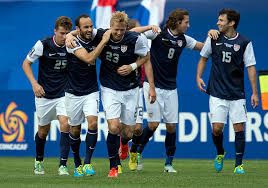
Donovan congratulates Shea after they engineer the winning goal
3) Jurgen Klinsmann – last March there were many doubters about Klinsmann and his coaching of the USA national team. Not any more. Of course, we could talk for long stretches about his 4-2-3-1 formation, about the use of that system by both the World Cup team and the Gold Cup team, about his choice of players to run the formation. Suffice it to say that the USA has become a possession-minded team, keeping the ball for long stretches (69% of the game yesterday) ,probing for openings, attacking quickly when those openings occur or when they are produced by the passing and movement of the team. In other words, Klinsmann has the USA playing like a quality, modern soccer team. But there is more to it than that. He has an amazing knack for making changes to his team, both before and during games, that pay off well. Just recently, against El Salvador, Eddie Johnson scores 14 seconds after entering the game and yesterday Breck Shea scores one minute after coming on the field ( what took him so long?) Previous USA coaches Bob Bradley and Bruce Arena were well known for their emotionless appearance during games, especially Bradley. And their “I’ll just sit here and watch the proceedings” demeanor was getting copied by far too many American coaches. Klinsmann always has and continues to be actively involved in the game action. As an American coach on the World stage, he NEEDS to be that involved. I remember back in 1979 in Australia during the U-20 World Cup, then USA coach Walt Chyzowych was tossed from a match for vigorously complaining about the lack of fairness by the referee. Later he was told that” Americans don’t know how to foul, how to be fouled and what and when to complain”. That lack of respect remains today in the eyes of many observers. In Jurgen Klinsmann we have a coach who has played and coached at the highest levels. He knows how the game is supposed to be called by world-class referees and he obviously isn’t afraid to let that be known. We should expect a different level of respect by world referees now that they know he isn’t going to sit by and watch Americans get bad calls just because it is thought that we don’t have the experience to know what is going on on the soccer field.

Coach Klinsmann actively watches
The Gold Cup was a step forward for USA soccer, not just because we won the tournament, after all we have done that before this. It was who won it, how they won it and the attention it garnered from the American sporting public. Things are getting to be lots of fun for American national soccer and the future only looks even brighter!
We’re Better Than We Think We Are : Part 2
Posted: July 21, 2013 Filed under: Uncategorized | Tags: 2010 FIFA World Cup, Boston Massacre, Chelsea, Chelsea FC, England, North American Soccer League, United States, World Cup 6 CommentsLast post, we talked about the formation of our country and our connection with the British and the English language. We related that when the “soccer boom” started in the late 1960’s and early 1970’s most Americans involved in the sport looked to international “football” people as being more knowledgeable and experienced than they were themselves. At that time an American who wanted to learn more about the game almost always used resources from outside our country. Books, seminars, clinics, coaching courses- you name it- they were available and almost always written or conducted by someone from elsewhere. This was understandable, after all the USA had virtually no history in the sport internally and except for one inexplicable victory over England in the 1950 World Cup, no moments to brag about externally. So we read and attended and traveled. Because of our language and culture, most of our learning came from the British. This was ok, after all they invented the game. AND they had won the 1966 World Cup didn’t they? AND they did it with a flair for the unexpected! They ignored traditional formations and tactics and adopting a strategy without wingers and with lots of passing and movement and players coming from behind. It was the soccer equivalent of climbing the cliff at Quebec and beating the French! So they were the best to learn from, at least at that time.
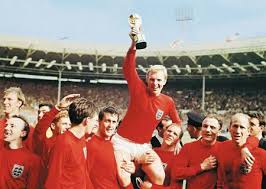
England won the 1966 World Cup at Wembley Stadium
This respect for foreign knowledge and experience developed into a kind of hero worship. We talked foreign soccer more than our own soccer, we adopted British “football” terms even though we had plenty of our own words we could use. We even wore our hair like they did……( ok, we had already begun doing that when the Beatles arrived). Crazy, but I knew Americans that suddenly developed English accents when they started talking about “football”! And there is no worse English accent than an American talking in what he/she thinks is an English accent! We started a pro league , the North American Soccer League (NASL) which garnered a TV contract, drew good crowds in some locations and spent way too much money importing internationally known players. Despite the crowds and TV , the league lost money and so had to cut back on the stars which then cost crowd size which eventually cost the tv contract and that cost the league its existence. But the youth leagues continued to grow and the soccer presence in this country continued to increase.
What didn’t increase was the respect that the average world soccer person gave to Americans who were involved in the sport. I personally experienced “soccer discrimination” many times. International players that I played with often refused to pass to the Americans on the team. I was yelled at several times by English players for being in the wrong place and/or making the wrong move with the ball. This was confusing since I was attending national licensing courses and also learning from some fairly knowledgeable people…like the coach of the NASL champion NY Cosmos, for one. Here I was, discussing tactics with Julio Mazzei who was coaching Franz Beckenbauer , Giorgio Chinaglia, Carlos Alberto, etc. but my learning didn’t suit the guys who had moved here 10 years before and “knew” that Americans didn’t know soccer. As it turned out what they didn’t know was what was happening in world soccer strategies. And they couldn’t believe that an American, any American ,could be more caught up on the sport than they were. The lack of respect wasn’t limited to the British. In one case, my team played a team composed of workers from the embassy of a third-world country whose identity I don’t recall ( I wouldn’t name it even if I did remember). We were located in the Washington-Baltimore corridor, so it was easy to pick up games with embassy teams like El Salvador and Greece, to name a couple that we played. On this day we were warming up and the opposition was laughing and carousing around. They certainly weren’t taking the game very seriously. Our team was about 75% American, but one of our group understood what they were saying. “They think we aren’t any good because we have so many Americans!” , he reported. The game began and the laughing and commenting continued along with a propensity to foul us from behind. The fouls produced some yellow cards from the referee, but mostly it produced gales of laughter from our opponents. We kept our cool and just played the game. They continued to joke about the Americans playing soccer, which was pretty surprising since we proceeded to open a gap between us and them on the scoreboard. At the end we won 5-0 and they still were making fun of our game. This prompted one of our group to comment,” Now we know why the undeveloped countries of the world are undeveloped!”
Of course, today times are different……or are they? Last spring I watched Chelsea play Barcelona in the Champions League at an English pub in Orlando, Fl. I was neutral about the game, but I did appreciate Barca’s passing and control game far more than Chelsea’s ” kick it up field as soon as possible and outrun the opposition” style. The pub was filled with Chelsea fans most of whom originally hailed from Britain. I sat next to a fine English gentleman who actually rooted for Manchester United, so he wasn’t any more emotionally involved in the outcome than I was, but was a fan of the sport. During the game I was engaged in a “conversation” by one of the Chelsea fans about my knowledge of the game. He objected to a comment I made about Barcelona’s refusal to dive after each slight contact from Chelsea. “What would you know about it?” I explained that I followed the sport, had lots of experience, had coached some very good players, etc. This made no impact on him, he became increasingly belligerent, kept referring to my nationality and finally blew me off with,” oh, go play some baseball!”. I responded by referring to HIS nationality in a very unflattering way, and thus almost suffered a repeat of the Boston Massacre. My new English friend saved the day, but it was apparent that the crowd in that pub didn’t respect American soccer any more than the British seemingly respected anything American 250 years ago.
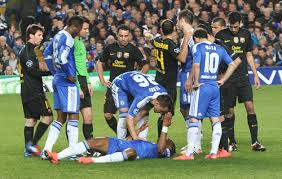
A Chelsea player goes down vs Barcelona.
Well, I am here now to announce that a new day has arrived! We are a much-better-than -average soccer nation. Actually, as of now, this month, July 2013, it has become apparent…..AND factually verifiable, that American soccer-on the national team level- is equal to that of England! Yes, you read that right.
Consider- the USA currently is in first place in it’s World Cup qualifying group- England is second in theirs although they have played one less game than the leader. Of course, one might argue the strength of the groups…..England is second to ………….Montenegro……………who? Montenegro!………………..who? Their group also contains superlightweights San Marino and Moldova. Look, Jamaica is trailing our group, but Jamaica would thump San Marino! Also, our group contains Mexico, who has made it to the quarterfinals of the World Cup for the last 5 times. None of England’s group competitors can make that claim. The under-20 World Cup just concluded and neither the USA nor England made it out of their group. However, there was a large difference in group strength. Our group contained eventual winner France ( whom we tied) , semifinalist Ghana and Spain- considered#1 in the world going into the competition. England’s group consisted of Iraq, Chile and Egypt. None of these are considered strong soccer nations and yet England couldn’t manage even one win. At the same time, the u-21 European championship was held and England went 3 defeats and out. Of course, the last face to face meeting between the USA and England was in the 2010 World Cup. It resulted in a 1-1 draw and after the group phase was done, we had won the group while England finished second. So, based on these recent results, the USA is at least equal to England at this time.

England goalkeeper Robert Green gave up a bad goal to the USA in the 2010 World Cup
Are we yet Spain, Germany, Brazil, Italy, Argentina, France? No, not yet, but we are better than at least 190 out of FIFA’s 209 soccer playing nations. So the time has come to stop looking at anybody who plays or even talks soccer and who hails from outside this country like they are an expert. We know our stuff, we have people who know the game as well as most any other country. It’s time to act like it ……and we can start with our soccer verbiage.
We have adopted many English “football” terms. I say that we should use OUR words- they work as well and they are OURS. Look-we know that in England the TV is a telly and that fries are chips and chips are crisps. But we don’t use those terms ourselves. So first of all: the land where the game is played is a “field”, not a “pitch”. Can you imagine the confusion if the movie had been called “Pitch of Dreams”? On the field we play a soccer “game”. Americans use the term “match” for individual athletic contests: a wrestling match, a boxing match, even a golf match. But it is a basketball “game” because it involves teams. When we play a soccer game, we wear a uniform. A “kit” is a group of utensils used for some purpose. Along with our uniform we wear “soccer shoes” or perhaps “cleats”. We wear “boots” when we ride horses or go Texas two-stepping. If a soccer game ends with the score even it’s a draw or a tie. A tie is NOT a game or a set of two games, not in this country anyway. When we want to see when we have future soccer games we look on the schedule. There we see the dates of those future games. “Fixtures” are things that water comes out of in our bathrooms. If we want to take the ball away from our opponent during our soccer game, we make a soccer tackle ( different than a football tackle). If we get “stuck in”, it’s usually in our car in mud. We play our professional soccer games in stadiums- our “ground” is the land that our backyard is on. And our fast players have lots of speed, “pace” is the amount of distance covered in a set period of time.
Of course, terminology is just one area in which to develop soccer self-respect ,but it’s a start. We are a better soccer nation than we think. And, remember my antagonist in the Orland pub? It turned out that he wasn’t English, he was Scottish, which is a real distinction in British soccer circles. A few months after our “discussion”, the USA played Scotland and the result was a 5-1 thrashing in which the “hapless Scots handed a footballing lesson by Donovan and co.” according to the Mail Online , May 27, 2012. So he can go play some bagpipe!
A Short History of the USA and Soccer: We’re better than we think we are, Part 1
Posted: July 17, 2013 Filed under: Uncategorized | Tags: Battle of Quebec 6 CommentsIn the middle 1700’s the French and English had a war over…. well ,things in general. But here on this continent it was about who would keep their colonies. The British, exhibiting a flair for the unexpected, ( remember that- we will talk more about it next post) climbed a cliff near Quebec and thereby defeated the French and took the city. Thus, we colonists to the south of that battle continued to speak English and the rest of Canada did the same, except for the province of Quebec who just wouldn’t learn a new language…for 254 years now and counting.

The British climbed the cliff and we don’t speak French
A few years later the colonists south of Canada decided that they had had enough of being “colonists” , especially since the British didn’t seem to consider them worthy of much respect ( remember that also). So, those colonists rebelled, won the war and their independence and became us… Americans.
Now the mentality of these “Americans”, out of necessity , was rather belligerent, outspoken, aggressive and increasingly confident. Meek people don’t cross oceans in little boats in order to start over in an unknown, undeveloped land filled with possible dangers. 150 years later many people from other parts of Europe and the world crossed the ocean in better boats, but still faced the unknown, just a different type of unknown. Unknown acceptance, unknown jobs, unknown future. Again, not for the meek.
Meanwhile, back in England, lots of males were running around kicking a ball for sport. Some picked the ball up and carried it, at least until someone else knocked them down. They all set up a goal ,tried to get the ball into the goal and kept count of how many times that was accomplished. In 1863, a bunch of the guys playing these games got together, drew up rules ( which banned using one’s hands) and formed the Football Association. The guys who liked carrying the ball got mad, took their balls and went home ( no pun intended ). The “no-hands” game was called football, but in order to differentiate it from the “carry-ball” game, it was often called “association football”. Since most of the time the men playing the game either had no teeth, or were filled with ale, or both, the word “association” became rather butchered and eventually became “soccer”. (I’m not really sure about the no-teeth and filled-with-ale part.) It should be noted that the “carry-ball” people eventually formed their own group and called their game “Rugby” after the school where (according to legend) the ball was first picked up. Since the term “Rugby” gained widespread use, the term “football” became the name for the no-hands game around the world and the English term “soccer” wasn’t used much.
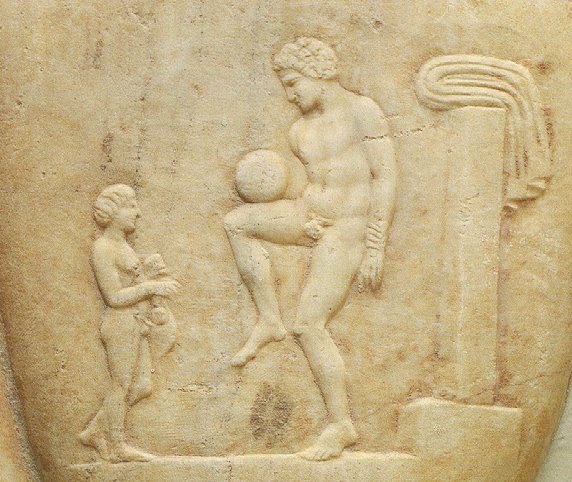
In ancient Greece women minded the children and men played soccer. In much of the world things still haven’t changed- well, the clothes maybe
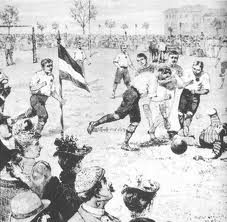
In old England “football” was played in between towns
Over here, college boys were playing the same games, more or less, and eventually had the same decision to make; which brand of “football” would they ALL play. Being Americans ( you know-aggressive, brash, etc) ,the carry-ball game won out. After all, it allowed players to knock each other down, block each other even if the ball wasn’t around them, etc. Since a big ocean separated us and England, the rules the colleges adopted only marginally resembled Rugby and they didn’t consider using that name. They just stuck with “football” although by the time they finished fooling with the rules, feet had little to do with it.

A 1902 football game between Michigan and Minnesota- the game bore no resemblance to soccer
“Football “grew in popularity as more and more colleges and universities picked it up. Some guys continued to play the “no-hands” game although there weren’t many. However, around the rest of the world, it was a bit different. In England, “football” or “soccer” ( are you following along?) was definitely more popular than Rugby and when the English went off on their British Empire adventures they carried their balls with them ( that’s getting old, isn’t it?). They played football in far off lands and it became popular among the natives and in not-too-many years the whole world was playing football. So when people immigrated to the USA , many brought their favorite sport with them. But here, if they went to see a “football” game, it wasn’t what they were expecting. It was our type of “football”: you know- the no-feet football. So the alternative name “soccer” became the norm for the sport that the rest of the world calls football and that very few played here- just those new to our land that didn’t want to give up their game. That was the situation for decades, until 1966.
In 1966, ABC televised the World Cup final from London on a summer Saturday morning. In a previous post I have talked about my personal experience with that game. What is important on a large scale is that the ratings that morning were far greater than anyone imagined possible. Several businessmen spotted the numbers and decided that the time was right for the introduction to the USA of soccer as a professional sport. There was more than one group and they really weren’t that successful, but something else occurred with the inspiration of those leagues. Various groups in certain areas of the country, encouraged by the pro’s, began youth soccer leagues. These youth programs were almost always run by men who weren’t born in the USA but who loved the sport and saw an opportunity to encourage its growth among American youngsters. The youth leagues grew like crazy….in my town of Columbia,Md, the organization was formed by a German and a couple Englishmen with 60 kids in 1971. Participation in Columbia went from 60 to 300 to 600 to 1000 in just a couple years. Around the country the number of “home-grown” Americans helping these youth leagues was understandably initially small and those who were participating were learning from the “experienced” internationals. As the sport grew ,more “knowledgeable” soccer people came to the US to help teach and coach. Although just about the whole world was represented in this influx of soccer people, our language and culture dictated that the majority came from England. And therefore soccer in this country was influenced in many ways by the English. One thing was sure, American soccer people knew they were the new kids on the block and the typical American confidence and brashness tended to be absent from them. It was a “we want to learn, we are new at this, we know we aren’t very good” mentality. And that was probably the correct way to be….in 1975. But things have changed and its time for American soccer people to understand that fact. More about that in Part 2- my next post!
Changes to the game: For better or for better
Posted: July 10, 2013 Filed under: Uncategorized Leave a commentI am a soccer nut. I love the game, I love the strategy, I love the drama, I love the international scope, I love the fact that size is not an inherent factor in the quality of players, I love the work that must be done to develop the skills needed to play the game at ever rising levels, I love the fact that the mental side of the game can be as important as the physical side. BUT, there are aspects of the game that I do NOT like. There are parts of the game that, to me, are detrimental to the “good game”. There is a negative side to soccer that is unsportsmanlike, runs against the nature of “fair” competition and produces results, on occasion, that have nothing to do with the game at all. It is these parts of soccer that I would like to see changed. And it wouldn’t be very difficult to do so.
As an American, one grows up watching “our” games change their rules often. The NFL changes some rules virtually every year. Basketball has a different set of rules for each level, with the international rules actually differing the significantly from the our professional, college and high school rules, which are different from each other. However, in soccer FIFA is the world standard and with the exception of American schools and some American youth leagues, FIFA’s rules are world-wide. And FIFA tends to be very tradition-oriented! In order to understand this, it helps to understand the perspective of those across the Atlantic, who have the largest say in soccer rules. Once, when traveling in England with a team of high school age boys, we visited Aston Villa’s ground in Birmingham. The question was asked of the team official who was escorting us,” How have you done recently?” He replied ,” Since 1900 we have a rather respectable record!” The boys looked at each other- they thought the question was ,”recently!” But, lets face it, when there are stone fences in your yard that are 1,000 years old, 1900 IS recent! So there is a reverence for history and FIFA looks at that history of the game and makes changes to it VERY slowly and VERY carefully.
So….I am not expecting any of these suggestions to be enacted any time soon or perhaps any time at all. But , even a soccer nut like myself sees the need for upgrading the experience of the game. By the way, the amount of scoring is NOT one of my issues. Oh, I know about the millions of Americans who view 1-0 matches as an excuse for a good nap. However, there are also millions of Americans ( and more everyday) and many more millions around the world, who appreciate the drama of a low-scoring game and the kind excitement that a goal can produce that is unmatched in any other sport. There is a reason why Andres Cantor started shouting ,” GOOOOOOOOOOOOOOOOOOOAAAAAAAAAAAAAAAAAAAAALLLLLLLLLLLLLLLLL!” and found himself famous ( he actually copied that call from an earlier Latin American commentator) . In my opinion ,the only real consequence to the number of goals scored is the fact there is a significant number of draws. Comments about kissing close family members aside, a draw is not necessarily a negative result. It is considered acceptable in soccer EXCEPT in competitions when a victor is needed and THEN we get stuck with the most ridiculous method of determining that victor. So in that regard a few more scores would help. More about that in a few paragraphs.
Timewasting……….the largest drawback to the game. Sooner or later, in so many matches, one team begins to find ways to loiter. I’m not talking about passing the ball around without intent to score, at least that is playing the game. I am referring to the players lying on the ground supposedly injured; slow-motion goalkeepers taking goal kicks; substitutions that put everyone to sleep while players take slow ministeps off and on the field. Sometimes it actually starts at the beginning of the game. The method of adding time to the game is inaccurate and obviously doesn’t deter the slowdown in game action. Rarely does the amount of time added equal the time taken by non-game activity and sometimes the amount of added time makes no sense at all. Plus, the constantly running clock can create crazy situations. Last season during a Champions League match one team scored a late goal but still trailed. Of course, the scoring forward ran into the goal to retrieve the ball for a quick restart, however the keeper tried to prevent him from doing so. A wrestling match ensued in the goal, as the keeper attempted to stop any fast resumption of the game…it was ridiculous! What is frustrating is that all that is needed to correct the situation is a stopwatch. Stop the time whenever 1) the ball goes over the endline….so on goal kicks, corner kicks, after goals…..the clock stops! 2) whenever play is stopped by the referee on the field….injuries, cards, substitutions. Its simple……we do it here is the USA for “our” sports and even for some forms of soccer…..where is the problem with this? 90 minutes of PLAYING time and that’s it.
I was watching a Confederation Cup match on tv a couple weeks ago with a granddaughter in Maryland. She had played lacrosse but admitted that “I know nothing about soccer”. As I how elaborated on how wonderful the game was, one of the players slid another from behind… hard. She exclaimed,” wow, that was tough!”. The ref pulled out a yellow card and I explained…..she asked,” so how many minutes in the penalty box?”. When I informed her that there was no penalty box, she was incredulous,” so everybody gets a free hit?” Of course, its not that simple, there are penalties for accumulated yellows over time and there is always the risk of a “straight red”, but when one considers the aspect from the perspective of a single game, she was right-everybody gets a free hit. And they are used…..frequently…….far too frequently……to the detriment of the game and often to the detriment of the player getting hit. My granddaughter was right, there should be penalty box. 10 minutes off the field with the offending team playing short during that time for any player getting a yellow card. “Unsporting behavior” , the definition of a yellow card offense, should not be merely a caution with no consequence other than a greater penalty the next time. The game is too valuable for players to get “free hits” to use to injure opponents and disrupt play.
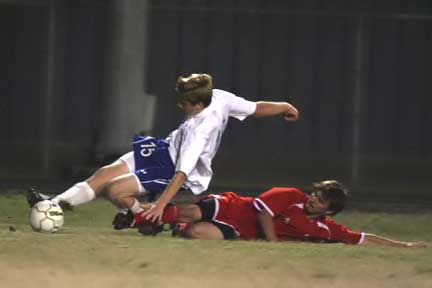
A player using his “free hit”.
As we know, one of the common sights on the field, is the player writhing around as if he has broken his leg, or ruptured a spleen or perhaps suffered a heart attack. Amazingly, within minutes, he is perfectly ok and ready to resume, having delayed the game or interrupted the rhythm of the opposition. Once in a loooooong while, a referee will have the guts to issue a yellow for simulating a foul, but that is a rare circumstance indeed. Once I was coaching a team of under-10 boys who watched lots of soccer on tv and started imitating their heroes.They rolled around on the ground with every bump, scaring their moms to death and causing me to get far more exercise than I wanted what with constantly sprinting out onto the field , only to discover that they were “all right in a second”. So we instituted a team rule….any player who caused the game to be stopped because they were “hurt” came off the field for a minimum of 5 minutes. Suddenly everyone was ok and my players became much tougher. I propose the same policy at all levels of the game. Any player who stops play for an injury must come off for 5 minutes and their team plays shorthanded until they return. Of course, the reader will say that this policy would encourage more fouls in order to force opposing players off the field. However, if the previous change that I proposed was in place, players would have to think twice before taking opponents out. An infringing player who gets a yellow gets 10 minutes off in order to get a player from the other team off for 5 minutes? Not a smart trade. But as for the “nothing” hit; the imaginary strike that puts too many players down so that they may waste time and try to evoke sympathy….no more.
Finally, here is the last but most controversial and major change that I propose.
Can you, the reader, imagine lining up to take foul shots to decide the NBA title? How about “Home Run Derby” to name the World Series champion? Worse yet, let’s kick field goals to decide the Super Bowl! Absolutely ridiculous! But penalty kicks to decide soccer championships ? That’s ok. NOOO , it’s NOT! Well, as they say in FIFA13,”it’s imperfect, but no one has come up with anything better.” Look here, I have an idea!. At least let’s play soccer and let’s reward the better team, the one that creates chances, one that is forward thinking and not negative. During extra time, we award 5 points for a goal, after all scoring goals is the objective of the game. However, we also award 1 point for every corner kick earned when the defensive player who last touched the ball is entirely inside the penalty area. So, no running to the corner of the field to force a corner, a team must go to goal. Think of the possibilities. Does a keeper automatically push a shot over the bar, knowing he gives up a point? Perhaps he waits to see what the ball will do first. Do teams play back in extra time, knowing that while a goal is fairly easy to prevent, a corner may not be so easy to stop? Once a point is scored the losing team has to push up, thus opening up the game. Once a team does go ahead, do they fall back, risking giving up points and losing their lead?At present, most extra time periods consist of neither team wanting to concede a goal and PK’s are inevitable. Certainly it’s an intriguing process, far better than the dice throw that is penalty kicks.
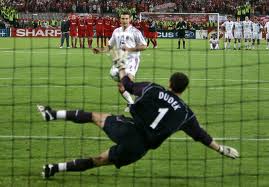
This decides championships. Really?
Please notice that not one of these changes involves the rules of PLAY. Yes, I propose to change the way the game is timed, is enforced and ( in extra time) is scored. But I do not propose any changes to the way the game is played, nor the number of players, or the field or goal measurements. I imagine a flowing game with few stoppages, even fewer dirty hits or professional fouls and one that is accurately timed. In cases where extra time is called for, I imagine teams thinking that the time to attack has come, that good soccer will win out. None of these changes are difficult for FIFA to put in order, if they could forget history for a while, and think of the good of the game. What do you think?
Brazil 3 -Spain 0 Tactics for the Common Person Part 2
Posted: July 3, 2013 Filed under: Uncategorized | Tags: Barcelona, Brazil, messi, neymar, soccer, Spain, tactics 6 CommentsPreviously on the Soccer Yoda:
We discussed Brazil’s whomping of #1 in the world Spain and the reaction to it in soccer circles. And we talked about the basic concepts of Spain’s ticky-tacka style of play and why it has been so successful (please see our last post ).
And now, Part 2:
Teams facing Barcelona knew they must adjust or continue to lose. Since the style typically calls for slow play, they knew they had plenty of time for their players to fall back into defensive positions. So, rather than battle for the ball up field and get beat by the combination of lack of numbers on their part and great ball skills by Barca, they fell back into a defensive shell. They usually formed two defensive lines ,each consisting of 4 defenders, with the backs lining up around the top of the penalty area and the midfielders about 10 yards in front of them. Although the two remaining forwards even dropped back on occasion, usually they stayed farther up, waiting for the opportunity to counter-attack against the drawn-up and often out-of-defensive-position Barcelona defense. By the way, this is not a new nor uncommon defensive tactic against pass-possession oriented teams. I, myself, even at my much-lower- than- world- class level, have seen this as far back as the early 1980’s and as recently as last spring when my under-12 girls ran into 9 pulled back field players who simply refused to cross into our defensive half of the field. This defensive shell strategy achieved some success in lowering the number of goals scored by Barcelona. But unless a team had a very fast ,strong forward or two, it merely delayed the inevitable and made the scores easier to digest. On occasion Real Madrid or Chelsea ( teams with just such an attack) actually won, but it didn’t change the basic Barca strategy.

Typical defensive shell used against ticky-tacka
The question must be asked , ” why not attack them farther up than in front of your goal”? The answer is a bad case of Lionelphobia (I made up that term), which is defined (by your Soccer Yoda) as ,” fear of Messi”. Let’s face it, when playing against the best scoring machine in the world, who has terrific speed, quickness, ball skills AND a nose for the goal; it seems like suicide to give him space by pulling your players up. So, even good teams fell back, tried to absorb a game full of pressure and counter-attack when they got the ball, which wasn’t often.
So far we have considered Barcelona and Spain to be virtually the same squad, just playing against different teams in different competitions. For the most part, they are. BUT, there is one MAJOR difference; Messi is from Argentina, he doesn’t play for Spain. And the Spanish have nobody else at near his level to replace him. That hasn’t made much difference the last few years, other than the Spanish scoring fewer goals -as an example, they won the World Cup with a succession of 1-0 victories. They continue to ticky-tacka, they hold the ball, they make the opposition chase, they fended off the Netherlands in the World Cup final when the Dutch tried to hit them out of their possession. And on occasion, they break through and score plenty, as in their 4-0 win over Italy in the European championship.
So what happened against Brazil?
First, it must be made clear that the Barcelona/Spain defense has gotten much weaker in the last couple years. The combination of injuries and age have slowed them down immeasurably. This makes them even more susceptible to fast breaks than before. They don’t see many of these quick counter attacks though, because the opposition doesn’t see much of the ball. One thing about ball possession; it’s a great form of defense. It’s a fact – a team must get the ball at their feet, even if only briefly , to score. No ball=no goals. Commentators have often spoken about the evils of “possession for possession’s sake”. They say a team must do something offensively with the ball when they have it. Not necessarily so….the best way to play defense is not actually having to play defense. Spain has continued to be tough to score on because opponents don’t get the ball much. As for Barcelona, this past season they decided to attack somewhat more quickly ,therefore scoring more goals. BUT that opened the way for more counters and against the better teams they gave up more goals. When Messi got hurt toward the end of the season, Barca suffered, going out of the Champions League rather decisively.
But remember, Spain doesn’t have Messi. There is no Lionelphobia. As a matter of fact, there is no fear of Spanish forwards at all. So Brazil decided to play Spain’s game , but from a defensive standpoint. When the Spanish moved to provide their guy with the ball those passing options, the Brazilians moved also. They refused to be outnumbered around the ball and when they got there , they pressured the ball and they frequently got it. And when they didn’t win the ball quickly, they fouled. The ref gave them some latitude when it came to yellow cards, so they broke up Spanish possession and broke up the rhythm of the game. Yes, they opened themselves up to fast attacks. Remember , that’s what you do when you move players to the ball and away from balanced defensive positions. They basically dared the Spanish to fast break on them. And with only a couple exceptions, the Spanish couldn’t do it.

Brazil equaled Spanish numbers and pressured the ball
So what about at the other end? The Brazilians knew the fast attack was on- find the open spaces and run! And they have their own version of Messi!
Neymar da Silva Santos Junior is a fast, skilled 21 yr old Brazilian forward who has been lighting it up in the Brazilian league for a couple of years. He was somewhat young and inexperienced on the national level, but no more. He scored amazing goals in the Confederation tournament and created more goals for others to score. To go with him the Brazilians have Fred, who doesn’t seem to do anything except 1)magically appear in the opponents penalty area whenever the ball arrives there and 2) find a way to put it in the goal- even if lying on top of it, as he did on Brazil’s first goal Sunday.
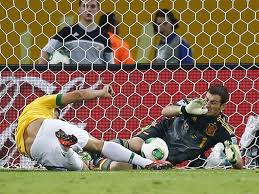
Fred scores lying on the ground

So the Brazilians pressured Spain at the ball instead of falling back into a shell, they attacked quickly at the Spanish defense knowing that the Spanish would be out of position because of the ticky-tacka style of offense and knowing that they were quicker and faster than the Spanish defenders. Why-because of Spanish age? Yes ,but mostly because of Neymar. AND they knew the Spanish offense would probably be too slow and unskilled to take advantage of the space the Brazilians would give them. They were right on all accounts. Oh, one other thing……not small….at any level of any type of competition….The Brazilians simply wanted it more. Sergio Ramos ,longtime Spanish defender said after the game,” one day the moment will arrive when you don’t win, we are not machines”. It seems as if the Spanish almost expected to lose. The Brazilians had something to prove, they were at home, they were quick , fast and well rested. The Spanish were none of that.
So, what is the future of ticky-tacka? Is it dead like many are proclaiming? Is Barcelona and Spain in big trouble? Well, not Barca. While it is true that they could certainly use some youth and speed on defense, they have something Spain does not…..actually TWO things that Spain does not. As mentioned before, Messi is still there, providing a good reason for teams not to take the chances that Brazil took against Spain. And if that were not enough, Neymar- the very player who made the Brazilian strategy viable, moves to Barcelona this season. Any team pressuring up field against Barcelona will have to deal with arguably the two best scoring threats in the world. Messi and Neymar and ticky-tacka–oh my!(Sorry about the old movie reference)
As for Spain….they have a year until next summer’s World Cup to figure out what to do. They need better forwards, they need faster defenders, they now have the motivation to make up for Sunday’s defeat. As Iker Casillas ,the Spanish goalkeeper said,” this wasn’t the World Cup”. Time will tell.
Brazil 3 -Spain 0: Tactics for Common Person Part 1
Posted: July 2, 2013 Filed under: Uncategorized | Tags: Barcelona, Real Madrid, ticky-tacka Leave a commentOn Sunday Brazil gave Spain a 3-0 beating that was a shock to the soccer world. Not the fact that Brazil won – many thought that was possible. But few predicted that the Brazilians would trounce the defending World Cup champs , Euro championship,28 consecutive wins, no 1 in the world ,etc Spanish team in the manner that they did. And now , of course, the bandwagon jumpers are claiming that Spain is dead and that their style and that of the Spanish club Barcelona that makes up the majority of the Spanish squad has had it also.
The Soccer Yoda says ,”not so fast!”.
Now, to understand the what happened Sunday from a strategy standpoint, we must look at the tactical plan used by Spain and Barcelona ( it is very much the same) and see what Brazil did to defeat it. I will describe it by the basics. If the reader is a very knowledgable soccer person, you might find this part boring (that’s assuming you don’t find the whole blog boring!) If you are a fan, the forthcoming explanantion could be enlightening. If you aren’t a soccer person at all, you will learn much……but I am not sure what you are doing here in the first place! (Don’t leave though!)
One of the main concepts of modern soccer that most coaches accept (not all, mind you) is that in order to win a team must keep possession of the ball for at least a portion of the game. Just kicking and shooting isn’t enough; passing the ball around while looking for and creating openings is needed. In order to do that there must be more offensive players around the ball than defenders. Rule 1 of possession soccer : outnumber the opposition around the ball! To do that a team must (at least to an extent) forget the concept of spreading out and playing position. Players must move into positions that give the ballholder options to pass without interception. At least one player must be open, so there has to be more offensive than defensive players in the vicinity.
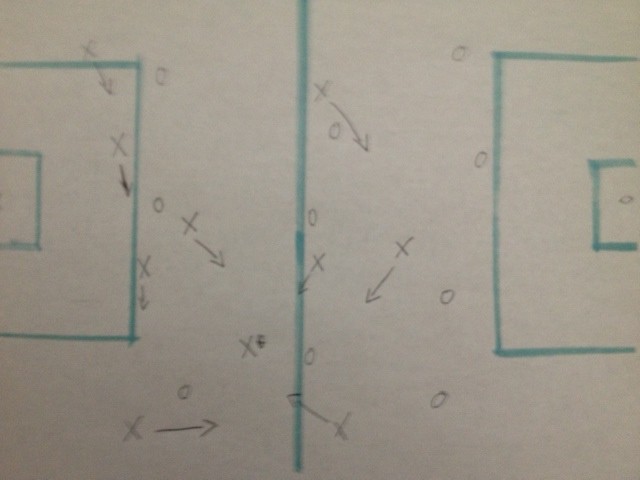
team x attacks to the right in a typical situation, note players moving to teammate with the ball
A few years ago Barcelona started taking that concept to the extreme. They moved their midfielders around so much that it became a moot point as to what position they played other than “midfield”. Their forwards moved back to help in the “outnumbering”, so much so that some observers said they had no “real” forwards at all. The center forward ( who often wears #9-that’s a soccer history thing) moved back so much that the formation was called the”false 9″. And yes, defenders joined in also. It is VERY common for Barcelona backs to go down the wing when the opportunity presents itself. The supporting players get so close to the person with the ball that often the passes are very short ( 2-3 yards) and one might wonder why they passed it at all. Commentators called these super short passes “ticky” passes and the next super short pass was a “tacka”pass and lo and behold, the style got a name! Ticky-tacka became the signature style of Barcelona and since the Spanish national team consists mostly of Barca players, it became their style also.
What happened on the field was that teams employing traditional “spread-out” formations could never get the ball. They couldn’t intercept the passes because not only were they outnumbered , but the Barca/Spain players had incredible ball control, passing accuracy and the vision to spot the open player ( and there always was one). They got physically and mentally tired of chasing the ball all game trying to avoid being “it” in the game of keep-away being played against them. The Barcelona offense would move down the field, often at a very slow pace….I mean a VERY slow pace! At a Barcelona match that I saw at Barcelona’s Camp Nou stadium, they averaged 27 passes per possession; AVERAGED 27 passes! Sometimes it got into the 40 and 50 passes without an opponent touching the ball. When they arrived within striking distance of the goal : they often only had to beat the keeper, a few out-numbered defenders and the offside rule in order to score. The rest of the defending team had been passed by the passing!

team x player hasn’t passed the ball BUT now has many options AND receiving players will also have options
In one memorable game Barcelona played Real Madrid in what is referred to in Spain as “El Classico”. Whenever these teams meet it is an “El Classico”. That’s how good Real is. They are always among the world’s best club teams. Barca was just really getting into the ticky-tacka and Real didn’t adjust at all. The result was a humiliating 5-0 defeat and ( as they say) it could have been worse!
The ticky-tacka does have a weakness, of course. All styles ,formations, etc in all sports have strengths and weaknesses. Ticky-tacka’s inherent weakness is the very movement that sets it up. On the rare occasions when the ball IS lost, the team is in a poor position to defend in the spaces that have been left open by the movement. Sometimes they have less backs than they would like; sometimes the entire team is caught upfield as they were passing the ball around. So the counter-attack is their Achilles heel. Any team playing this style effectively must have fast defenders who tackle well and understand the situation when the other team is coming at them. A good goalkeeper doesn’t hurt either. For Barcelona and therefore Spain, that wasn’t a problem, they had the required backs and keeper and next thing you know, they were winning almost every thing. Barcelona was being called the best club team “ever” by more than a few, and the Spanish national team started a winning habit that had few bumps. Opponents did try to adjust ( more about that next post), but largely to no avail. But things have changed in the last few months, cumulating in Spain’s defeat on Sunday. What has happened? What did Brazil do to breakup ticky-tacka? Next post ( probably tomorrow if the Soccer Yoda can get off the xbox) we will talk about why. How’s that for a teaser?
Youth Soccer- To Win or Not to Win
Posted: June 25, 2013 Filed under: Uncategorized 6 CommentsAs youth soccer has spread in this country one would expect that the hundreds of operating youth leagues would be producing players of ever-increasing quality. As a long time observer of the game in the USA, especially at the youth level, I can tell you that ,overall, this IS happening. But, there are constant complaints that our country isn’t producing enough world-class players. Perhaps this is because we haven’t won the World Cup , at the men’s level anyway. Or because we aren’t feeding the world’s leagues with hundreds of first class players. Perhaps it’s because we still have an inferiority complex about the game (more about this in a future post) and so insist on bringing in “experts” from other countries. And once here, the “experts” have to have something at which to be an “expert”! However, I shouldn’t lay this completely on imported soccer people. Many home-grown soccer “experts” also continually complain about our youth system. And , almost always, the first issue which is brought up is that of “winning” soccer at the youth level and its effect on the development of youth players.
The idea is that youth coaches, in their endeavor to win games, sacrifice the development of technical and tactical prowess of their players. Experts constantly talk about developing quality players as the goal of any worthwhile youth program. I have no problem with that concept. However, they also talk about the concept of attempting to win games as if it were some great disease epidemic which has spread across America and must be cured before any real quality players emerge from our country. I can remember when a certain MLS team announced its connection with a local club here in Las Vegas. They had several of these so-called experts discuss their philosophy and the first thing they brought up was that winning was not important. Not at U-10, not at U-12 or at u-16, not at any level of youth soccer.
At any level of any endeavor, whether sports or music or writing or moving furniture, there are always those who will tell others how they should do it. Some of these people actually know what they are talking about, many do not. So, who do you listen to, if you are looking for advice? One rule I have always abided by is to look for those who have been successful , who have a proven track record. Or listen to someone who has studied those accomplished persons. Sometimes an individual who has done in-depth work with successful people knows more than the individuals themselves. And when it comes to comes to youth soccer; as soon as I hear “don’t worry about winning”, I question the knowledge and experience of the speaker. Why? Because in this country anyway, anyone who pushes the non-winning philosophy has not spent much time coaching a youth team in a youth league and therefore has not had experience in dealing with youth players AND THEIR PARENTS.
Parents of youth soccer players almost always have two major motivations: 1) they want their child to have fun, to improve and to play significant time in games, 2) they want the team that their child is on to win games. Maybe it doesn’t have to be all the games, but I guarantee you that if a team loses constantly, the parents will question the coach, at any level. Sports players and ,typically their parents, are, by nature, competitive. Put any number of soccer kids into a soccer situation and they invariably compete. If a coach wants to work on a skill, the coach can run a drill, hopefully one which produces many repetitions of the skill in a short period of time. But if the coach wants complete involvement of his/her players, devise a game which requires that skill and keep score. The only problem with this is that the players sometimes become more concerned with who is winning the game than the development of the skill! Many times I have had to remind my players,” it’s only a practice drill!” ,particularly if I haven’t kept score accurately! And yet, I am supposed to tell these same players AND THEIR PARENTS,” we don’t care about winning!”
The reason that winning has such a bad rap among many, is that often coaches sacrifice the long-term development of their players for the short-term goal of the win. They spend their time emphasizing winning instead of emphasizing playing quality soccer and ironically often hurt their chances of winning in doing so. I can’t count the number of times I have heard opposing coaches berate their teams for ” not wanting it bad enough!” or more commonly,” you are getting beaten to the ball!”. These statements mean (to me anyway),” my team isn’t doing well and I don’t know why and I don’t know what to do about it!”. Rarely, the team just wasn’t very quick, but in almost all cases, they just weren’t prepared. Often I felt sorry for the kids being yelled at as it was obvious that they weren’t in the right places on the field to get to the ball and when they did get the ball they couldn’t control it or didn’t know what to do with it. In soccer, as in so many fields, taking the long term view pays off eventually – develop the skills, both physically and mentally, and the wins will come. You must “wax on, wax off” before you can win the trophy.(Sorry for the old movie reference!)
My solution to “to win or not to win” is to emphasize that development of the skills of the game is the ultimate goal. Every practice is about improving some aspect of play, as individuals and as a team. The purpose of games is to measure improvement. One must have faith that good soccer over the long haul means winning many games and probably losing some also. If a loss is a springboard to more improvement, the coach and the team are better for it. But simply trying for the win, or simply bashing winning as a philosophy, is too simple for me. The development of ANY skill, in ANY type of effort, is a long term effort of hard work, with “winning” , in whatever form it comes, as its reward. Don’t knock it.
USA- Honduras : Close Up and Personal
Posted: June 20, 2013 Filed under: Uncategorized Leave a commentTuesday afternoon, the Soccer Yoda ventured to Sandy, Utah to see the USA play Honduras in an important World Cup qualifying game. As this was the first time I was viewing our national team in person in about 35 years, I was excited about this opportunity both as a fan and as a student of the game. And “excited” is an understatement! The ticket was a surprise Fathers Day gift from the family and I was floored by their thoughtfulness!
I went to the game with my good friend, a transplanted Brazilian who knows soccer very well, as many Brazilians do. We arrived about 2 hours early to get a real feel for the stadium and buy some USA gear! Rio Tinto stadium is a built-for-soccer facility which seats 20,500 spectators. Its the home field for the MLS Real Salt Lake team and has hosted a few international matches as well. It is a beautiful place, even when viewed from a couple miles away.
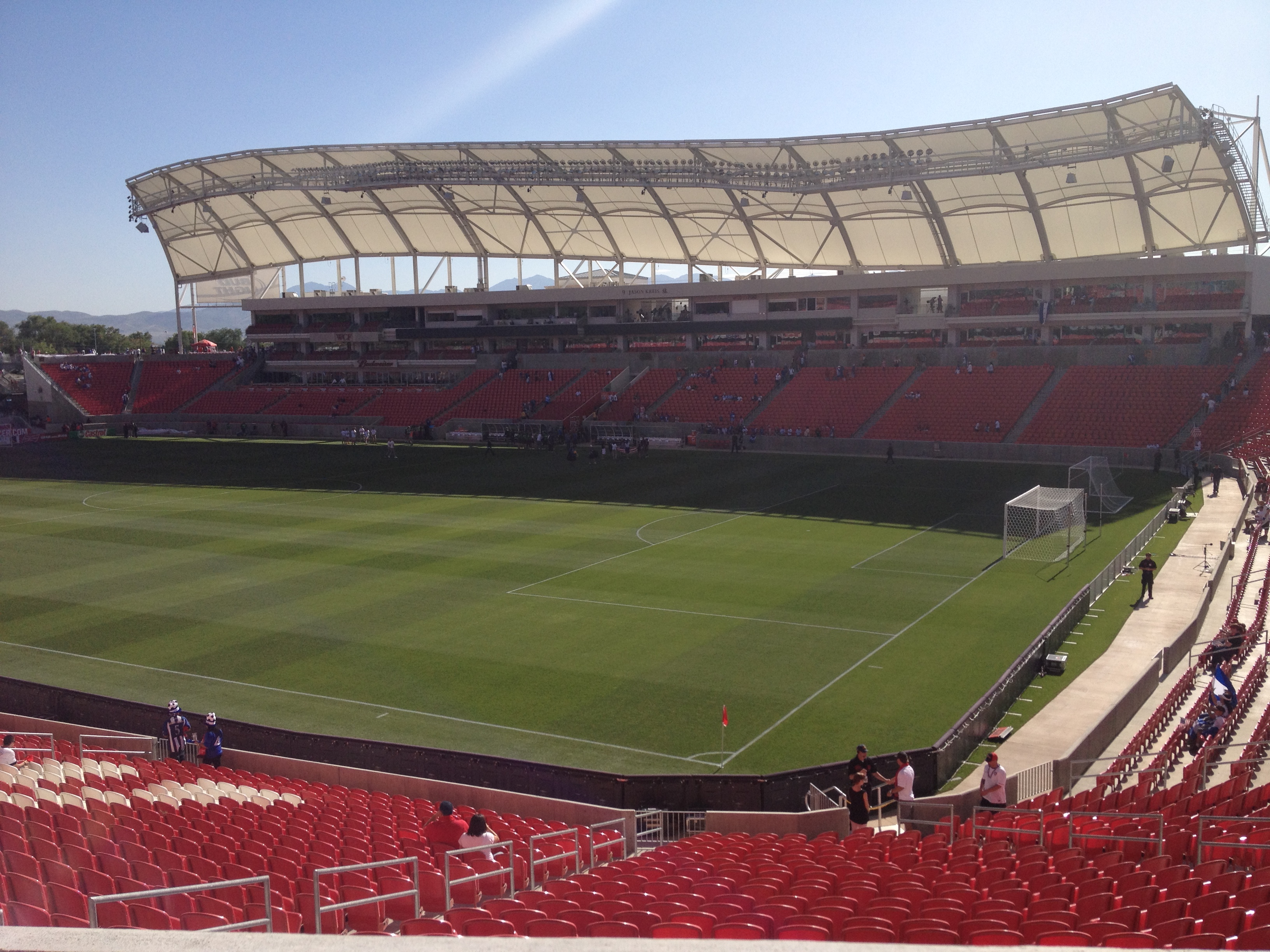 Rio Tinto before the crowd arrived
The first thing we discovered about the stadium, other than its architecture, is that the guy in charge of parking must have been sick when they decided upon the location of the park. Because there is none. Not a single space designated for “stadium parking”. However, there is lots of shopping nearby, so we parked in a strip mall lot a few blocks away and enjoyed a short walk to the stadium. At this point , 2 hours before kickoff , I became worried about our home field advantage. Many have written ( including myself in my last post) about the fans in Seattle and the effect they had on the atmosphere surrounding the contest there. This match was expected to have a similar crowd albeit smaller. BUT at 5:00 Tuesday night, the crowd waiting to enter Rio Tinto stadium was easily 75% Honduran. Granted, it was only a couple thousand people out of the sell-out 20,500, but my experience said,” uh-oh, another “away game” at a home field”. Over the years, enough international matches have been played in Southern California and New York and Miami where the noise for the visitors exceeded the support for the USA, we don’t need THAT anymore. AND : in addition to the number of Honduran fans; there was All-State.
All-State insurance has an agreement with the USSF to market at USA matches. They had a tent outside Rio Tinto with USSF logos all over it. Just give them your name and email and they give you a FREE soccer hat! Complete with a soccer ball image on top! BUT , the same guy who was in charge of Rio Tinto parking must have been in charge of selecting the hat colors. One would expect red, white and blue, yes? Well, All-State chose to use ” the All-State colors” of blue and white, at least that is the reason we were given for the choice of colors. Now, if the USA was playing anybody else in the hex it would be no big deal. BUT Honduras’ colors happen to also be blue and white. Sooooo, the Honduran fans , by the droves, gave All- State their info and gratefully walked away with more garb with which to support their team.
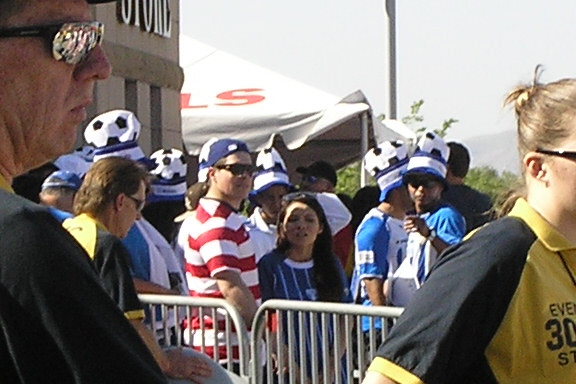 One American amid many Hondurans wearing All State no-red, white and blue hats.
By game time, however, my fears were gone. Most of the crowd arrived in the last 20 minutes before kick-off and they were decidedly American. I have heard and sung the national anthem hundreds ( perhaps thousands) of times prior to athletic events. Its usually rather perfunctory, once in a while the person singing draws some notice. But Tuesday night was different. In a time when our nation is more divided politically then I have ever seen it, when views on so many issues seem so far apart….at 7:00 PM, on June 18,2013, in Sandy,Utah, approximately 18,000 Americans put all that aside and rose as one to state and sing their loyalty to their country and to the team representing it. It was pretty damn amazing.
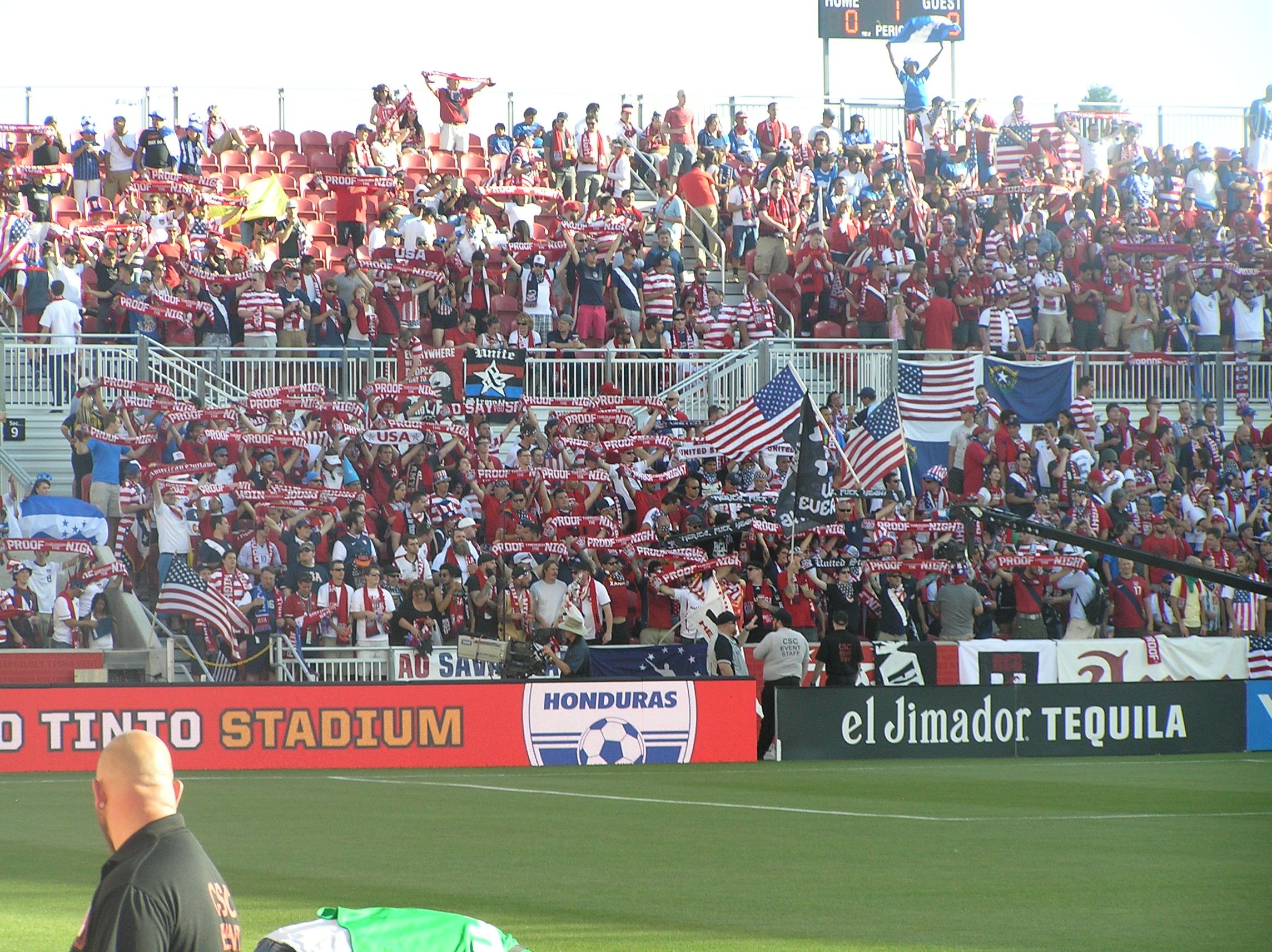
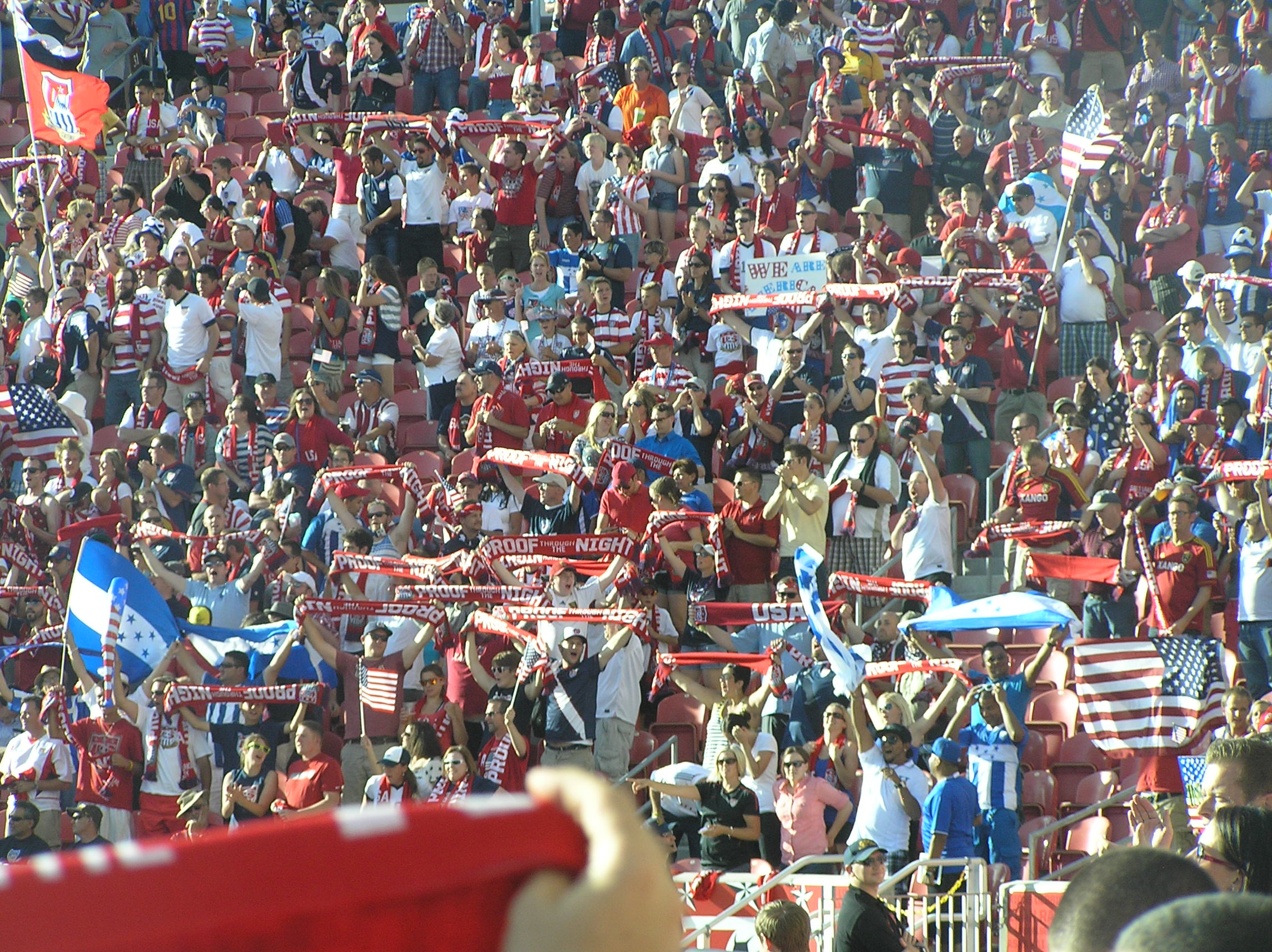 the national anthem
Then the game started. The USA immediately abandoned the controlled possession game it used so well in Seattle for an over-the-top long ball approach. Perhaps Coach Klinsmann felt that putting quick pressure on the inexperienced Honduran defense would crack them right away. The problem was two-fold: one, the Catrachos defenders marked well, battled in the air and refused to be intimidated. Two, the field was not soft. The ball bounced and skidded and the long through balls sent by USA backs and deep midfielders ran away from Altidore, Dempsey and Johnson. On occasion the Americans settled down and played with shorter passes and more lateral movement. These attacks were more productive and produced a good shot by Eddie Johnson and several corner kicks. Honduran goalkeeper Noel Valladares was up to the challenges and the Americans were unable to score in the first half. In addition, the Hondurans were playing for a draw and they began time-wasting right away. Valladares got scolded by the referee for taking so much time setting up his goal kicks and it seemed that blue players were going down when Americans stared hard at them. One stoppage was particularly long as Jomas Costly went down, was examined by the ref, the stretcher was sent in, he refused the stretcher and finally limped slowly off the field. After 45 minutes of play only 2 minutes of stoppage time was added, once again proving that FIFA needs to wake up and join the 20th century and recognize the existence of that incredible invention- the stopwatch ( since FIFA is stuck in the 19th century, the 20th is next). The first half was more notable for Honduran stalling and falling than anything else.
The second half was different as the USA played under control, passed well, and found space, especially on the left. E.Johnson and Zusi continued alternating at the outside mid positions, switching left and right every few minutes. In the second half, they were given lots of room by the Hondurans and the Americans frequently found them, first with short passes, then longer . The constant pressure found some room and although the Catrachos didn’t make any drastic errors, they failed to stick as tightly to the USA forwards as in the first half. Eventually Fabian Johnson overlapped, got a nice pass from Dempsey, coolly passed back to Altidore who had some space and he one-touched the ball into the far corner of the goal. And that was that.
 American defenders double up
For the Soccer Yoda, the game was a terrific experience. Thanks to my family, I sat closer to the field than at some games that I have coached. (All photos in this post were taken by the Soccer Yoda) I watched our nations best players close-up and learned a lot in doing so. I felt the new passion of the American soccer fan and once again marveled at how this game can bring people of all kinds together. Oh…one other outcome, plans for Brazil next summer must be made because barring a complete disaster in September- the USA is going to the World Cup!
 The Soccer Yoda
Recent Comments