Freedom on the Field
Posted: April 30, 2017 Filed under: Uncategorized 1 CommentOne of the unique features of soccer is the number of players on the field with the freedom to go anywhere they choose. The rules of the game do not restrict their placement or movement other than the temporary restriction of the offside rule. Although it is more efficient for goalkeepers to stay in the penalty area where they can use their hands and protect the goal, the rules allow keepers to roam the field. And in some cases, they take advantage of that freedom and play just like one of the other ten, at least for a few minutes. 11 players free to put themselves wherever they want. I know of no other sport with so many participants having so much leeway. It is this freedom that inspires teams to play with so many formations and styles. It is one of the reasons why soccer games can look so different, even when involving the same teams.
Take Barcelona for example. This past week they played two very important matches ….. important for very different reasons. Although Barca was the same, their opponents were not and neither were the circumstances of the games. And so we saw just how different the game can be played when opponents have different objectives, even when the team in question plays the same.
The first match Barcelona played involved Juventus, from Italy. It was the second game of the quarterfinal round played between these two teams in the European Champions League. The Champions League is arguably the most prestigious club competition on the planet. The top club teams in Europe all wish to claim the title of European Champions, it is the highest honor a club team can win, even surpassing the World Club championship in which the winner gets to compete. This is due to the high number of excellent teams in Europe.
The round is played in 2 matches, one in each home stadium. The first contest was in Italy and Juventus won 3-0. Given Barcelona’s reputation and their number of star players this would typically be considered quite an upset. But this year Barca has had a very inconsistent defense and displayed an even more inconsistent intensity of play. The team consists of many players who have accomplished just about everything there is to do in world soccer and sometimes they have appeared to be tired of it all. Of course, other times they get truly motivated, display that tremendous skill and flair they are known for and remind observers of just how good they can be when they want to be and when their shaky defense isn’t being tested. They displayed that exact manic nature in the previous round when they fell behind to Paris St Germain 4-0 in the away match and then pulled off the most amazing comeback in modern soccer history by scoring 3 times in the last 7 minutes of the home game to win the round 6-5. So entering the home game down three goals was not a totally lost cause.
Now, lets consider that positional freedom we have talked about. Here is Juventus’ formation:

Juventus plays a 4-1-1 when on defense.
Going into Camp Nou, Barcelona’s famous home stadium, with a 3-0 lead, defense was the order of the day. Although Juve often pushes more players forward, especially against weaker opponents, they knew what they had to do in that second Barca match. Barcelona, on the other hand plays a 4-3-3 virtually all the time and this was no different. Of course many teams have attempted to play defense against Barca to no avail. Those teams typically get rattled under the constant intense pressure, make a mistake and pay for it by giving up a score, then try to play more offense, and end up giving up more goals. But this was different. For one thing Juventus has that strong Italian defensive mindset and they have the quality players to go with it. And they have Gianluigi Buffon. Gigi Buffon was considered the best goalkeeper in the world for decades. He is now 39 years old and yes, there are a few keepers in the world considered better than him at this point. But very few. He has won virtually every team championship available except this one….something of which his teammates are very much aware.
Once the match started Barcelona threw it all at Juventus and the Italians held. The home team fired 19 total shots and ended up with one on goal. One… 19 shots and one on goal. You read it right. Actually Juve came closer to scoring in their few trips forward than Barcelona did with their 19 shots. Messi was off, Neymar overdribbled, Suarez disappeared. The score of the game was 0-0 and Juventus moved into the semifinals of the tournament with their 4-1-1 while Barcelona had no rest. 5 days later they moved into their next match, one that holds the complete attention of the soccer world and a match that might even mean more to Barca than did the Juventus contest.
If there is a club in the world with a greater winning tradition than Barcelona it is Real Madrid. The Blancos have been among the worlds elite since the 1950’s and this year’s edition is following in prior Real team’s footsteps. Since both clubs play in Spain’s first division they meet at least twice a year and their meetings are so momentous they are called El Classico. Both teams use 4-3-3 formations although the manner in which they move within those systems differ somewhat. Going into the match Real was leading the league with Barcelona not far behind but needing a win to narrow the gap.
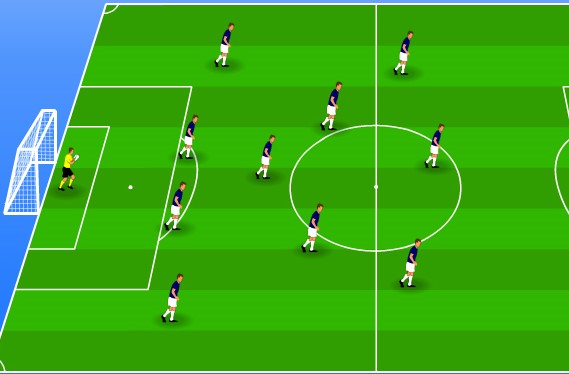
The 4-3-3 formation used by both teams.
Barca was missing Neymar who sustained numerous bruises after the Juventus match and Real lost an already hurting Bale during the first half, so things were fairly even in regard to injuries. From the very beginning, this game was nothing like the Juventus contest. Both teams attacked, both teams were determined to score first, both goalkeepers were called on to make great saves. Finally a Real shot rebounded off the near post and went across the goal to an unmarked Casemiro, a Real midfielder who had come forward and was alone. He took a second to control the ball while 3 Barcelona defenders pulled a youth soccer mistake and watched him without moving. 1-0 Real Madrid. Meanwhile Real was beating up Messi, hitting him both legally and otherwise, knocking a tooth out and motivating Lionel to prove he could not be intimidated.

Messi packed his mouth to stop bleeding.
Sure enough 5 minutes after Real’s goal, he took a pass and worked his way past 2 defenders to tie the game. The second half was even crazier than the first. Again both teams attacked well and at 72 minutes Barcelona midfielder Rakitic scored with a great left footed shot to put Barca ahead. Note that 2 of the three goals scored at that point were from midfielders; these teams freely use the liberty given to players by the rules. 5 minutes after Rakitic’s goal the game defining event occured. Sergio Ramos, Real’s best defender, dove in with both feet in order to take down Messi. The ref didn’t hesitate pulling out the red card and suddenly Madrid had only 10 players on the field. Although Real manager Zinedine Zidane had a number of options to move players back from midfield positions to keep his team at 4 defenders,he was trailing with only about 15 minutes left so he left his team with the 3 remaining backs. He told his 6 forwards and midfielders to attack Barca’s goal while moving his defenders back, thus isolating them. The strategy paid off 6 minutes later when, amazingly enough, James Rodriguez took advantage of more sloppy defensive play by Barcelona to get free and tie up the game. Although a draw might have seemed a satisfactory outcome for Real at this point, Zidane wanted to win in front of his home crowd and his tactics, although very risky, were working, so he kept at it. For the next 9 minutes Madrid controlled play and hammered at Barca’s goal, 10 men or not. Finally, in the last minute of stoppage time, Barcelona got possession of the ball and poured up the field, driving at those 3 Real defenders left stranded by Zidane’s strategy.
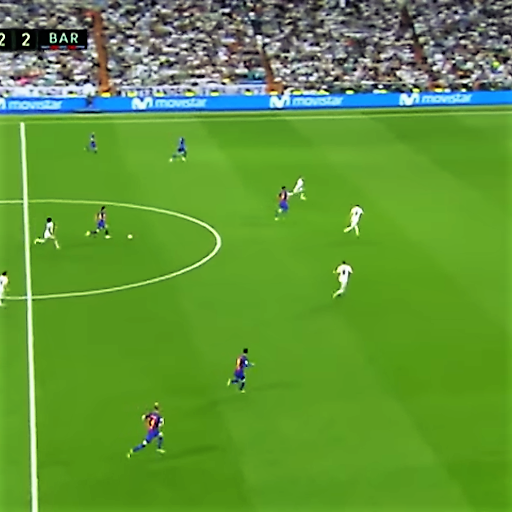
As seen above, Barca had a 6 to 3 advantage as they ran at Real and they took full advantage by pulling off something the Soccer Yoda had never seen before in all my many years of watching and participating in thousands of soccer games. Messi, using the space afforded by his teams numerical superiority, took a left footed shot into the lower right corner of Real’s goal and scored with the very last kick of a non-sudden death game. A walk-off goal. An amazing ending to an amazing game. He then, uncharacteristically, rubbed it in by taking off his shirt and waving it at the home crowd.

Messi lets the Real crowd know who won the game.
So, in the span of 5 days Barcelona played in two very important, but two very different kinds of games- games that were defined by the skill of the players of the teams and the rules that allowed them the freedom to use those skills in the manner that they and their managers felt would best suit them at that time. And that is the major reason, among others, why this game is the #1 sport in the world.
Back in the Mix
Posted: April 4, 2017 Filed under: Uncategorized 3 CommentsWhen the United States men’s national team suffered two defeats in its first two games in the last round of competition to qualify for the 2018 World Cup, the result was the firing of Jurgen Klinsmann and the hiring of previous national coach Bruce Arena. Since only 2 of the 10 matches in this round had been played, and 3 of the remaining 6 teams automatically qualify and the fourth still gets a playoff, it was way too early to panic. However, two more losses in the games played last week would have drastically increased the odds of our nation occupying an observers seat in the worlds most watched athletic competition. Given the intense interest in the USA during the 2014 Cup, a failure to qualify would be a sorely missed chance to once again cast the public eye on soccer.
The upcoming games consisted of a home game (San Jose, California) against Honduras and a trip to Panama City to play Panama. Neither of these opponents would typically strike fear into USA hearts , but given our team’s position, earning points from these 2 matches was considered a must. Honduras handled Trinidad and Tobago 3-1 last time out and Panama has one of the toughest defenses in the region, so nothing was for sure. Most observers were hoping for 4 points – a win against Honduras and a draw vs Panama. Although 2 wins would be great, CONCACAF away games present challenges rare in most soccer venues anywhere. Crowds within throwing range (fireworks, bottles filled with various distasteful liquids, etc), field surfaces that make every ground pass an adventure, and referees that turn blind to ridiculous physical play by the home team, make getting points on the road very difficult in our region. So a draw in Panama was going to be a tough ask.
First up was Honduras and Arena came out with a 4-4-2 diamond formation. The Soccer Yoda is very familiar with this system. It is my preferred formation, and I coach it in the same manner that the Americans used it against Honduras. The two forwards (Altidore and Dempsey) have complete freedom as to their movement. They can come back to get short passes from the midfield; they can run laterally and forward…looking for open spaces to receive balls that allow them to attack; they can work together in tandem so as to outnumber any defenders close by; they can run independently to create havoc with defenses who can’t figure out where to go and who to cover. Aiding them is an attacking midfielder who often is the key to the offense. This player provides passes to the forwards to put them into position to go toward the goal and can make the “killer” pass that creates scores. If the forwards pull defenders away from goal with their movement, the attacking mid can run into the open space behind them to strike at goal. Depending on the situation, this player can be more of a withdrawn forward than a midfielder and can join the forwards to provide three attackers in a close area. For this important task Arena chose Christian Pulisic, the 18 yr old Pennsylvania prodigy playing and starring in Germany with Dortmund, one of the best teams in the Bundesliga. This was a gamble in trusting such an important position to a youth who is comparatively new to the national team battles with regional foes. Behind Pulisic was a defensive or “holding” midfielder who provided defense in front of the back line and helped the offense, acting as the instigator of attacks by providing that all important first pass that set the offense in motion. Micheal Bradley, a veteran who has had both brilliant and not-so-brilliant outings, took this role.
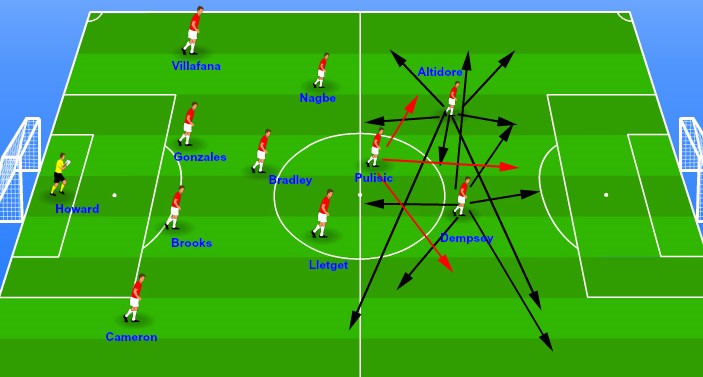
The 4-4-2 used by the USA vs Honduras with a diagram of the top 3 player movements
As it turned out, the system worked to perfection. Honduran defenders stayed back allowing Altidore and Dempsey to roam. Although a withdrawn defense can be tough to beat, Pulisic joined the top 2 and provided some excellent passes to break the defense and assisted on 2 goals in the first half alone. And the unsure Hondurans allowed Bradley to dribble across the top of the penalty area without pressure so he fired a left-footed shot with eyes on it into the lower far corner of the goal. By halftime it was 3-0. At the half, Honduras decided to become more aggressive in the back and challenge the forwards as they moved. Immediately Pulisic saw the space behind them and with a nice pass from Altidore it was 4-0 with 15 seconds of the start of the 2nd half. Another Altidore pass to Pulisic, who found Dempsey running free and the score mounted. Add a rather amazing Dempsey free kick and the 6-0 final gave the Americans not only the 3 points they needed but also the unexpected benefit of six goals to create a positive goal differential which may become all important at the end of the qualifying competition.
The next game was a different situation altogether. First of all, 3 starters from the Honduras match were unable to play against Panama. Sebastian Lletget, who started against Honduras at right midfield and scored the first goal, was injured just a few minutes later in that game and had to come out. He was replaced by Alejandro Bedoya who did well for the rest of the time, so Bedoya got the start against Panama. Larger losses came from John Brooks’ sinus condition and Geoff Cameron’s muscle strain. The towering Brooks had started at center back and Cameron on the right of the back four versus Honduras. Cameron himself was a replacement for two players who might have started in front of him, DeAndre Yedlin and Fabian Johnson. So Coach Arena faced some tough choices in deciding what to do about his defense for this important game. He went with Tim Ream in the middle and Graham Zusi on the right. Ream had a minimum of national team experience and Zusi has done well as a midfielder, but was a question mark as a back. However, with so many injuries on defense, there were few other choices. In addition, this was an away match with many of the previously mentioned problems staring the Americans in the face (and other body parts) when they took the field in Panama City. As a result, Arena changed his formation in the midfield. Instead of the diamond, he went with a flat four midfielders across the field. Pulisic went to the wide right, Nagbe went wider left and Bradley shared the middle with Jermaine Jones. Jones is a very experienced defensive midfielder, having played in many USA matches in the Caribbean. That experience, along with Bradley’s own history with the national team, would help balance Pulisic and Nagbe, the newcomers to this type of battle. The problem with a flat defensive midfield and two running forwards is that is difficult to find the front men without the attacking midfielder that the diamond midfield provided against Honduras. But the American coach knew that his defense was tentative and wanted the midfield to help the task of keeping Panama off the scoreboard.

The flat 4-4-2 used by the USA vs Panama.
The game was every bit a CONCACAF qualifier played in Central America. The field was chopped liver, the crowd was bananas (no pun intended) and the ref could hardly find his whistle or cards. As for match quality, I surely wouldn’t show the video of this match to any prospective youth players. Neither side could maintain any real possession and constructive offensive moves were few. Although having Pulisic isolated on the wide right with space to operate would seem to be a good move, the Panamanians had an effective strategy. They simply knocked him down…..again and again. And it worked fairly well as the referee did nothing to deter their behavior. Jones was appropriately destructive on defense, but he contributed little of any offense except for one notable long ball and Bradley was too far from his forwards to deliver any effective passes. So the game devolved into a physical long ball exercise. But, at the 38 minute mark, Pulisic ran deep down the right getting past the Panamanian left side defense and Jones found him. Once he got the ball he broke to the center, held off Torres, the strong Panamanian center back and slipped a short pass to Dempsey who didn’t miss. The lead was short lived however as the Central Americans converted a monstrously long throw-in thanks to a poor clearance by Ream and a lucky bounce. The second half was more of the same but without any Pulisic heroics and the only drama came late when Panama realized that a win at home is the aim in these matches and raised their offensive game. But Tim Howard is still Tim Howard and the rest of the USA defense did just enough to exit with a draw. It was an effective result even if purists like myself turned their eyes away during much of the game.

Dempsey scores vs Panama
So, the USA got the 4 points minimum that was the goal before these particular games began. In June, Trinidad and Tobago comes to Denver. They are in last place right now and playing in Denver should produce a win for the Americans. But then it is off to Mexico, to mile high Estadio Azteca and the toughest venue in the region. A draw in that one would be a real success. Once again, to get 4 points in the pair of games would be a good result and would possibly earn that important trip to Russia in 2018.
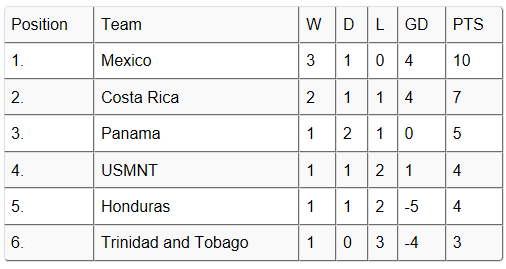
The Hexagonal Standings at present
So far Bruce Arena has done what was asked of him and has done it while coping with a mountain of injuries. With consistent effort, some better luck with hurt players and continued solid results, in a few months we should be calculating how early in the morning we will need to get up to watch the USA in the World Cup.
Movement and Reading and our Youth
Posted: March 19, 2017 Filed under: Uncategorized 4 CommentsA note about this post: the soccer software used is Tactics Manager by Soccer Tutor.com. It is an excellent aid! Also, for simplicity I refer to players as male but there is no gender discrimination intended. Observations of girls play indicate that this post refers to both boys and girls.
A number of weeks ago, the Soccer Yoda watched a number of u-11 and u-12 teams. I wanted to get a view of the effects that the new youth soccer rule changes are having on our younger players. This past week it was time to watch older teams. These players grew up playing under the old youth rules, which were basically adult rules with (sometimes) smaller fields and a smaller ball. Do these players have adequate ball skills to play high level soccer? Are their tactical ideas sufficient to compete with teams around the world? Has long ball mania stifled the development of these youth players? I was very interested to get some answers to these questions.
As luck would have it, the USYS National League had a weekend of competition right here in Las Vegas. This is a competition in which many of the nation’s top youth clubs send their best teams to play against each other. The league is divided into divisions and division winners earn a ticket to the national championships held in the summer. Every team playing in Vegas was ranked in the top 10% of its state and many were their state’s #1 side. This competition was an excellent sampling of the best youth soccer in the USA. I decided to concentrate on the u-15 and u-16 teams as these ages are old enough and experienced enough to play high level soccer but are young enough to still be learning. This weekend the play was limited to boys teams.
Overall, I was impressed by the technical skill of the boys. Their ball control was very good, first touch to settle passes and interceptions was excellent and many times was used to set up a second touch shot or pass. I saw defensive heading, head passes and several goals scored off of air balls. Basic turning was also very good. One area that could use work was one touch passing in that there wasn’t very much of it. One touch requires skill, vision and tactical knowledge……it is certainly a high level type of play, but youngsters at this age are capable of one touch if they get enough practice at it.
But, the biggest opportunity for improvement and learning lies in the level of the tactics played by virtually all of the teams that I watched.
When youngsters start playing soccer they concentrate on two things…..where is the ball and how do I kick it? As they get more experience and better ball skills they learn to relate to their position on the field and also the position of their teammates. They learn to make choices as to what to do with the ball when they have it at their feet. These choices are dependent upon many factors, one of the most important being the position of their teammates. As players continue to develop they begin to consider the position of defenders in their decision making and the teams I saw are at this point. The next step in the progression to higher levels of play is to influence defenders and then play according to the movement of those defenders. And that step was missing from virtually all the play that I witnessed in the National League.
The basics of this concept is taught in a simple 3 v 1 drill:
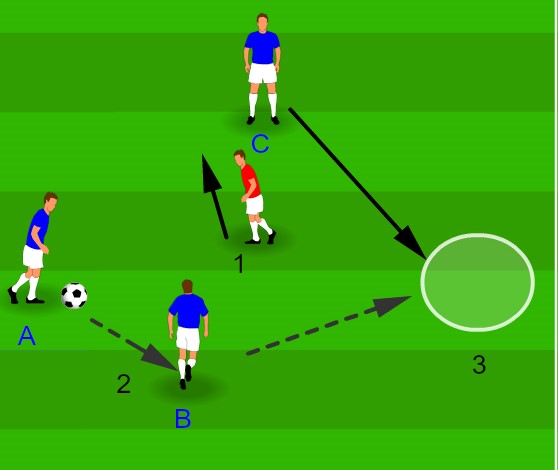 In this drill, 3 offensive players position their angles so that the defensive player cannot cover both of the players who don’t have the ball (players B and C). If the defender moves toward one of the receivers (solid line -step 1) , the passer ( player A) sends the ball to the open receiver player B(dotted line -step 2).Then player B , seeing the open space created by the defenders movement, passes into the space. Player C runs to the space as soon as he sees the ball being passed to player B (solid line step 3). This seems like very obvious play but it requires player A to see both teammates and the opposition. He must react to the defender’s movement and his mates must position themselves to take advantage of the number mismatch and the space available. For youngsters learning the game, this takes thought, decisiveness and the ability to make an accurate pass……and hours of practice to develop those abilities.
Now , lets expand this concept into a game situation. American youth coaches have a seeming love affair with the 4-3-3 formation ( 80% of the teams I viewed used it), so we will use it in our example.
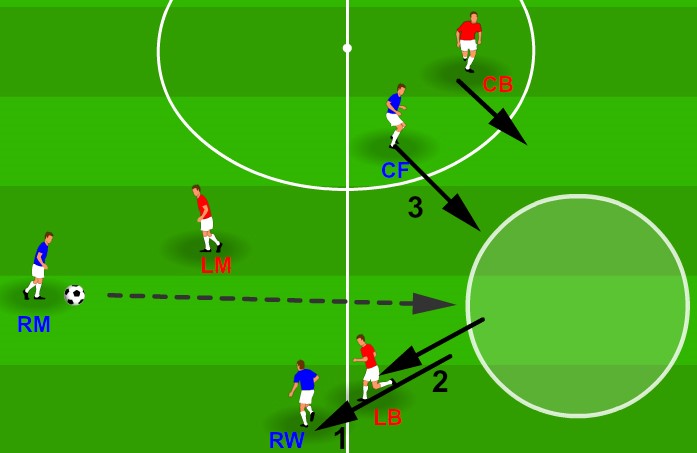 In this play, the offensive right wing has checked back to offer the player with the ball a passing option (step 1). The defending left back has decided to move with him in order to keep pressure and prevent an easy pass (step 2). In doing so, the defender has opened up the space behind him and the offensive center forward, seeing that , is running into the open space (step 3). The player with the ball also sees the movement by the left back and plays the ball into the space for the center forward to run to. The ball should be played in front of the center forward to avoid offside and allow the forward to receive the ball facing the attacking direction. The right wing has created an attack by his movement and the other two attackers have read the defenders movement and played accordingly.
But, what happens if the left back decides not to stay with the right wing and instead remains back, refusing to be drawn up?
 The left back has not followed the right wing (steps 1 and 2). So the center forward, seeing that the space he is moving toward has a defender in it, bends his run to offer another passing option to the right midfielder. Now the right mid has two choices to receive his pass, he can pick out either player. Whoever gets the ball (the center forward or the right wing) will have time to turn and can team up with the player who didn’t get the pass to attack the left back, as seen in the example below.
 The right mid has passed to the right wing who received the ball, turned and dribbled a few yards (step 1) . He then passes the ball into space behind the left back (step 2). The center forward reads the left back and runs to the pass.
In either case, whether the left back moves or not, the offensive team has a play to beat him and advance the ball toward the goal. This type of play can be used all over the field. It follows simple concepts:
A. Offensive players without the ball move their position.
B.This requires defenders to make decisions as to what they do in response to the movement
C.Offensive players read the defenders and act accordingly.There is a play for each defender reaction.
There are some basic understandings surrounding these concepts……whether to move toward the teammate with the ball or to run to open space, when and where to pass the ball, etc. But the overriding concepts of off-the-ball movement, reading the defenders and acting in response to those defenders are fundamental to advanced offensive play.
So, where are our youth in regards to these ideas? They do move, but generally in a north-south direction, either straight to the teammate with the ball , or away from him. Far too many times players with the ball are looking at the backs of potential pass receivers. Lateral movement across the field , which can totally confuse defenses, is almost nonexistent. Players with the ball seldom check out the defensive players before deciding on passes. The kids have excellent ball skills and they are comfortable on the field. Their work rate is very high, perhaps too much so. International rules only allow 3 substitutions and one wonders whether American youth can pace themselves under that circumstance. But to the Soccer Yoda, the ability to force defenders into making decisions and then playing to take advantage of those decisions is the next step for our kids, and they are definitely ready for it. Can younger players perform at that level? Absolutely! Given the practice time to develop the physical and mental skills needed to pull off this type of play, teens are very capable and they enjoy it. It is time for our coaches to move our youth to this level.
The Ups and Downs of the Game (except in the USA)
Posted: February 26, 2017 Filed under: Uncategorized Leave a commentLast week, after Paris St Germain surprisingly trounced Barcelona 4-0, a friend of mine asked me what this meant for Barca’s season. This person is an avid sports fan but is a minimal follower of soccer, keeping up with the sport mainly because so many of his friends and family are involved. I replied that , barring an amazing comeback in the return game, this finishes Barcelona’s Champion League experience for this season, but they still have a shot at winning the Spanish league title and they are in the final of the Spanish cup tournament, the Copa del Rey. This initiated a discussion of the difference between American sports and their single-objective seasons ( play league games, make playoffs, win the championship) and the multiple-objective seasons of most of the world’s soccer teams (play league (win league or avoid relegation),win cup or cups,win regional league) . When I discussed another major difference….promotion/relegation…. my friend expressed at first…surprise…and then an appreciation of the concept. “Wow, they should do that in here and in other sports”.
The idea that the bottom teams in a league should be relegated to a lower division is standard to the world’s soccer leagues along with the promotion of the best lower league teams to the next highest division. This concept is a major point of discussion among fans of the professional game here in the United States, at least concerning the men’s game. It has been a topic numerous times on virtually every soccer talk show, with views both for and against. Soccer purists tend to want promotion/relegation , mostly because it is used in the rest of the world and they consider it to be a part of the sport. But there are more concrete arguments both for and against it’s inclusion in the American professional soccer structure.
One consideration is the basic structure of the sport. As an example, even if the NFL wanted to incorporate this movement of teams at the bottom of the league, the lack of minor league professional football would be a stumbling block to any immediate implementation. But the USSF has the setup in place. Most casual American soccer fans know of the Major Soccer League, but the national organization has designated two other leagues as Division 2 level ….to complement the Division 1 MLS. The North American Soccer League (NASL) and the United Soccer League (USL) are Division 2 and could act as ladder steps in a promotion/relegation system. So, if the leading figures of the sport wanted that setup, they could implement it.What are the pros and cons to joining the rest of the world in this type of league organization?
Pros:
Excitement: American professional sports leagues attempt to build excitement during the season by dividing their leagues into divisions or conferences and qualifying a specific number of teams for post season play.If the leagues are lucky, the competing teams are very even in competition and the races for playoff spots go to the last game. But in most years there are at least a few teams ( and in some years it is more than a few) that are out of the competition for the post-season long before the end of the regular season. For those teams and their fans the season drags on and occasionally teams are even accused of losing games purposely in order to increase their draft positions. But in the world’s soccer leagues the bottom teams drop into the next lower division and the battle to avoid relegation goes on , often to the last day. In the English Premier League this season, going into the February 25 games , there is only 7 points separating the bottom 7 sides. The last 3 teams at the end of the season are going down, so although these teams have no real chance of winning the league, the battle to maintain a place in the top division is just as compelling as the championship race.

The bottom of the English league is very tight at this point.
Minimal Complacency:
Even if a sports organization does not achieve success on the field or court, the mere existence of that organization as a major league member may be enough to satisfy its owners. American sports have been continually populated by franchises who didn’t care about winning. The basketball Clippers, the football Cardinals, etc were not-so-shining examples of sports teams who continually occupied the lower rungs of their league ladders and , by all actions, just didn’t give a hoot about it. But they did care about their place as major league teams and about getting the benefits that come from playing at those levels. International soccer teams can’t be so complacent about their results. If they want to remain in the highest divisions of their sport or even in whatever division they occupy, they need to achieve some level of competence.
The American Dream
Ironically, its the ability to rise through the ranks, to start from scratch and achieve the highest levels, that constitutes the proverbial American Dream and is a possibility for international soccer franchises, but not for those in the USA unless an expansion spot opens up. Example: since the 1920’s an small Italian team, Empoli, toiled in the lower divisions of Italian soccer. Empoli is a town about the size of Utica, NY. Two years ago, Empoli reached the top level in Italy, Serie A, and last season finished in the middle of the division. Example: the English second division, the Championship, presently has two teams in the top 3 that have never been in the top league in the country. One of them, Brighton, didn’t even have a stadium 20 years ago. Yet, they both stand excellent chances of reaching the Premier League next year. This type of advancement offers fans the opportunity to support and dream for their teams , even if small and “minor league”, in a way not possible for small club fans in the US.

Brighton and Huddersfield could reach the Premier League for the first time next season.
Cons
Increased Stratification
As we have discussed, the multiple goals of the typical international soccer league can create more excitement and interest during the whole season for more teams than the single objective setup used in the USA for most of our sports. And we haven’t even mentioned the additional goal of qualifying for regional competitions the next season. These competitions often carry the biggest prizes of all… championships of whole continents. But the additional objectives can also produce a satisfaction with lower achievements. Faced with possible relegation, fans of many teams will be happy with remaining in the present league of a team, especially if it is the top division in the country. While some organizations strive for the highest goals, others are happy with lesser achievements. American sports use limitations to create comparatively even competition as epitomized by the NFL’s “on any given Sunday” mantra. Drafts and salary caps can give any smart franchise the ability to win and make it difficult to achieve year after year. Soccer in the rest of the world typically has none of these limits. If an organization can obtain enough financial backing and is smart in their acquisitions, they can compete at the top year after year. As a result, many leagues consist of teams at mediocre levels of performance which seem to satisfy the team and its fans. One wonders how American fans would react to a team that aspires to the “achievement” of not getting relegated each year. Which brings up another possible drawback here in our country.
Growth of the Sport in the USA
One of the success stories of the MLS has been Orlando City. The Lions have drawn terrific crowds despite not qualifying for the playoffs in its short two year history and playing in a less-than-perfect facility. But here is the problem……Orlando is not a new team. The Orlando Lions played in lower divisions for years, doing so very successfully on the field and producing a small (compared to MLS crowds) but avid fan base. The presence of an existing franchise helped get Orlando the expansion slot coveted by other cities. So why the sudden jump in interest and the accompanying crowds? Unfortunately it wasn’t the sport alone, it was the major league nature of the team. If Orlando City were to be relegated back to the lower divisions where it came from, what would happen to it’s support? Back to 5,000 fans a game from the 31,000 the team averaged last year? What would happen to any of the MLS franchises given a minor league scenario? Soccer is not the cultural institution in this country that it is around the world.

60,000 fans attended Orlando City’s opening game last year
MLS owners are not inclined to take the chance that minor league play means drastic reductions in crowds and interest in their teams. The chance of promotion/relegation becoming a reality here in the USA is very small, if nonexistent, at this time. Perhaps, if the sport grows to where large crowds and successful marketing are possible regardless of the level of a team’s competition …then this system… used throughout the world, might become a reality. But that is a very big MIGHT.
Shortside Rules for Long Term Benefits
Posted: January 29, 2017 Filed under: Uncategorized 2 CommentsLast year the USSF, which controls a heavy majority of the youth soccer in this country, issued two major changes in the structure of the game in regard to our youth. Although the changes are not required until August, 2017 ( next soccer season) most associations have begun adopting the rules now. As this is somewhat of a transition year for these new rules, different leagues and tournaments have their own versions of the changes, but by next year things should be fairly standard around the country. This month the Soccer Yoda watched some of the youth affected by the changes and it was very interesting to see where we are in regard to the improvements that the changes were designed to inspire.
Change #1 involves the date of birth used by the USSF to place children in age-group teams. For about 40 odd years the birth date used to group players was August 1. The reason was simple….it is the same date or very close to the same date as that used by our schools to place kids in the many school districts in the country. It also mirrors the playing season since a summer break is typical for teams and leagues. By using the school birth dates players generally played with and against classmates and players in the same grade. From a socializing standpoint this was a good thing. Youth players shared their experiences, played with school friends and, since most opposition players were in the same grade, there was a sense of fairness about the grouping of players. But, in all the world, only the USA and Canada used August 1. The rest of the world uses the calendar year of birth in their groupings. January 1 is the date which separates one child from another in their competitions. This difference made it awkward when USA teams played teams from other nations. Either our kids were half a year ahead of the competition or half a year behind. True, as I experienced a number of times, this was a minor difference among teenagers…..in our games overseas the difference in age of the players never really played a major part in the competition, except in attempting to explain our team age to people. After a while we just said u-14 or u-16 and didn’t worry about birthdays. Of course, when we did well the home folks often had a ready excuse if the situation fit…..we were older and therefore had an advantage. Unlike the US, in the rest of the world school and soccer are not intertwined. School teams are rare, club teams are the important place to play and a calendar year grouping is easy. This year, being the first year of the change , a lot of teams and clubs experienced a regrouping of players and a difference in the makeup of longstanding teams. And this produced the resultant angst that such a change causes, especially among youngsters. But in a couple years calendar year grouping will be the norm and it will be easier for young teams to play internationally and for parents to figure out in what age group their children belong.
The second change, or group of changes to be more exact, makes a far greater impact on the game for our youth and their coaches. These changes standardize and reduce the number of players on the field particularly for u-12 and u-11 teams. In addition, the size of the field is made substantially smaller and so is the goal. The reason for the changes involves the observation that despite the boom in the number of youth soccer participants in our country, the overall quality of play of those children and particularly the skill level of our top players is not improving. And the reason for this leveling off of our kids soccer ability? None other than the good’ol American will to win.
Up until this season our 11, 10 and sometimes even 9 year olds have often played on adult size fields. Putting these kids on an area that averages 110 by 70 yards tends to negate skill development and create wide open spaces for players to run in. In order to cover that space, to advance the ball to the goal, the most effective thing to do is find the biggest, fastest player and fire the ball to that player who has lots ( and lots and lots) of room to run forward to the goal. Once there, that player would simply kick the ball up so as to clear the heads and hands ( goalkeepers) of the opposition and into the adult size goals that was the target of these players. A coach could spend the days and weeks and months needed to develop the physical and mental skills that youth of these ages are fully capable of learning. But on the big field , even after a great sequence of dribbling and passing, the diminutive size of the players would leave them looking at a figurative mile of space still to travel to reach the goal. It was much easier to get a super fast forward and smack the ball as hard as possible and get to the goal quickly. Ever since the USSF has been conducting coaching classes, they have extolled the virtues of teaching the game and not worrying about wins and losses ( I was there back then so I know !) But we are Americans, we believe that draws are like kissing your sister and sports aren’t life and death…..they are much more important than that. And winning by pace and power is still winning. So….the USSF has finally changed the game for our youth so that teams with skills of mind and body can stand a better chance of winning.
So…the Soccer Yoda decided to look at a number of u-12 matches , both boys and girls, because this age group is probably more affected by the changes than the younger groups. Here are my observations……
Number of players: Instead of the full complement of 11 players, u-12 teams now play with 9. This means a drop of 10 field players to 8 ( not counting the goalkeeper) or 20% fewer participants occupying space on the field. This creates more opportunity for kids to touch the ball and be involved in the play. Combined with the smaller field, the space between players is much smaller, the ball gets to each player more and therefore the chance to be involved is greater than before the change. But the biggest change I saw in regard to the number of players is in the imaginations of the coaches. Last year the number of teams playing 4-3-3 was so numerous this observer began to wonder if there had been a rule requiring that system that I had missed. Other observers agreed, 4-3-3 was THE formation of American youth, at least in the western half of the country. Its true…..there is nothing wrong with that setup… but there are others and many players would thrive and more important…learn …from playing other formations or at least seeing other formations on occasion. But now…what about having only 9 players? I have seen 4 backs, 3 backs , 2 backs…….3 forwards, 2 forwards, 1 forward. The u-12 age group now has a plethora of formations. I am skeptical enough to believe that some coaches either don’t know how or absolutely prefer not to play with anything other than 3 forwards, but with only 8 field players, having 3 forwards forces adjustments elsewhere and those coaches will still be forced to think about their team and their system of play and teach their kids some fundamentals of offense and defense to counter those opponents using different formations and the combination of skills that those systems and the other rule changes require. No more “play tough defense, beat them to the ball and send it up to our forwards as soon as you can.” if a coach wants success.
Field Size: The u-12 and u-11 field is recommended to be 75 yds long and 47 yds wide. This is easy to set up by playing across the width of most adult fields and allows for two games to be played at the same time on one full size field.
The shorter field allows players to get into the attacking third much much quicker than playing on full size areas. There is less room to run so pure speed has less positive effect and solid possession and passing play actually pays off in attempts at goal. But I noticed another outcome of the smaller field that will require a major switch in coaching emphasis. To appreciate this let’s look at some geometry: the area of a 110 x 75 yd soccer field is 8,250 sq yards. The area of the recommended 75 x 47 u-12 field is 3,525 sq yards. So, while the number of field players has been reduced by 20%, the playing space of the field has been reduced by 56%.
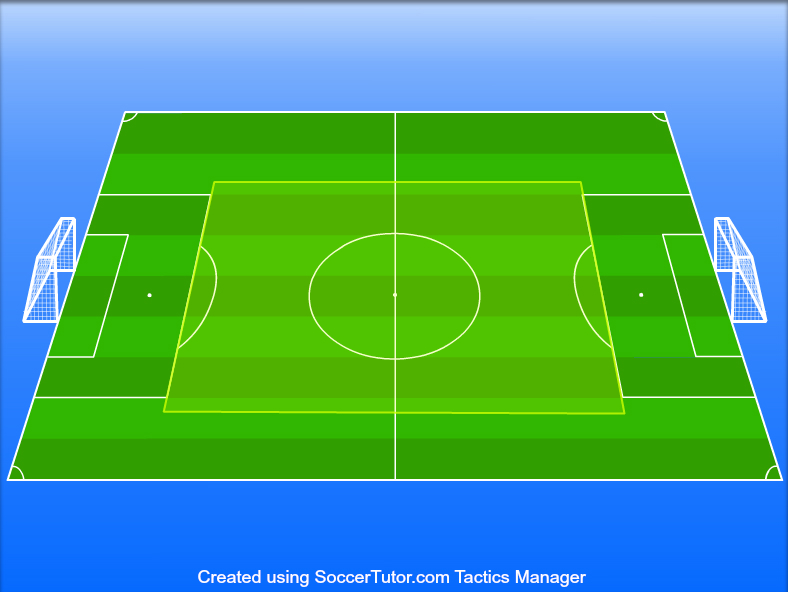
The new field size (light area) compared to the full field
This means, despite the reduced number of players, that more players are closer to each other and there are tighter spaces during play. Good players can work in tight spaces, they keep possession, find teammates and get the ball into the more open places on the field, ideally in more advanced positions. This does require technical ball skills, but perhaps even more important, players need the knowledge to move into positions to help mates who have the ball but who don’t have much room. It takes hours and hours of work for teams to know how to create and solve 3 v 1 , 4 v 2 , 5 v 3 situations during play. I observed many youth players with the ball skills to play through these situations but saw few teams with the knowledge to work in the many tight spaces that the new field size creates. Coaches who spend time developing the short game with their players will reap benefits that were not there on adult size fields. Granted, its only been 6 months since the new rules were implemented, we must give coaches a chance to adjust. To the Soccer Yoda, it is this facet of the new rules that carries, perhaps, the biggest gain to the development of our youth.

There are now many more of these situations in the youth game.
Goal Size: This change is almost monumental in its effect on the youth game. Adult goals foster two things: 1) shooting high…..kids can strike a ball well and keepers are very small compared to an 8 ft by 24 ft goal. Shoot up in the air and goals are scored. 2) Shoot early from distance….again, the power possessed by u-12 and u-11 players allow them to reach the goal from 20 yds , 25 yds… even farther. Big goals and small goalkeepers means easier goal scoring. Free kicks from anywhere in the attacking third become very dangerous and not because of well designed set plays. A player with a big foot can just hit a high ball in the general direction of the goal and score often. Of course, when these children grow to adult size they 1) can’t keep a shot down and on goal …and…2) have little concept of how to create true scoring opportunities because those type of chances haven’t been very necessary when firing high anywhere near the goal can be successful. The new goals are 6.5 ft high by 18.5 ft wide and the smaller target changes the game for sure. Players must learn to shoot accurately ….low and on goal.

The smaller goal requires more skill to score
Perhaps even more important, teams must learn to develop real scoring chances by actually creating shooting space in cramped areas ( remember, there is much less room)….just like adults! This means quickness, ball control, shooting skill and creative team play…..exactly what young players need to learn.
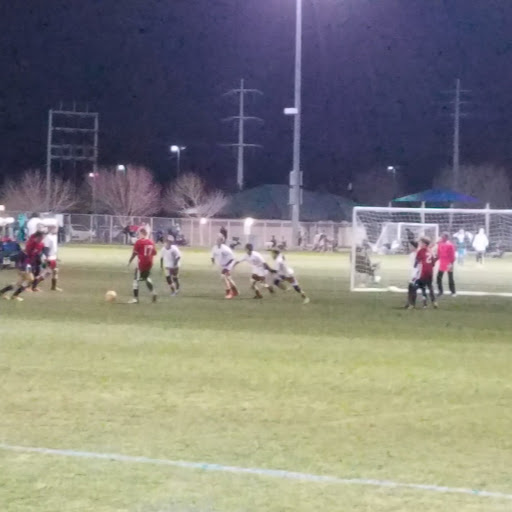
Free kicks now require more skill and creativity
Topics for future posts involve some other new rules for younger players and the fact that heading has become restricted for younger players. But for now, it is my belief that the new rules are a terrific change in the right direction which will pay off in those all-important wins IF coaches develop the ball skills and tactical knowledge that , in the opinion of the Soccer Yoda, they should have been developing all along .
Does The Ends Justify The End?
Posted: December 30, 2016 Filed under: Uncategorized 1 CommentDuring the month of December the MLS and the NCAA soccer championships were decided. But the circumstances surrounding both the victories have invited a torrent of commentary.
The MLS season championship was won by the Seattle Sounders, this is the Sounders first MLS title.They defeated Toronto F.C. on penalty kicks after a scoreless draw. Congratulations to the Sounders on winning the championship and rewarding the amazing support they get in Seattle.The NCAA Division 1 mens championship was won by Stanford, for the second year in a row. The Cardinal defeated Wake Forest, also on penalty kicks after a scoreless draw. Congratulations to Stanford , especially for becoming the first NCAA team to win consecutive titles since 2007.

Roman Torres scores the winning PK for Seattle
Both of these teams play fine soccer, but the similar circumstances of their victories brings up a controversial topic for soccer fans, one that is debated world-wide. The Sounders did win but not only did they fail to score during 120 minutes of regular soccer, they didn’t even manage a shot on goal during the entire game. They only took 3 shots of any type, the worst such performance in a final in MLS history. In the NCAA final, Stanford did take a number of shots and 5 of them were actually on goal. But their offensive futility was highlighted even more than Seattle’s was, amazingly enough. This is because Stanford qualified for the final by beating North Carolina in their semifinal match after – you guessed it- a scoreless draw. Yep, the 2016 NCAA Div 1 champions didn’t score a single goal from the field during 2 full games and 4 overtime periods in their final games of the tournament. These outcomes beg the question,” how does soccer manage to reward offensive inefficiency by bestowing championships on teams that can’t score in title games?”. And the answer is – by providing a means to win that has little to do with playing the game according to FIFA rules – penalty kicks.
There are a few topics in the soccer world which prompt a very wide variety of opinions and the taking of penalty kicks to decide winners ranks among the most divisive. On one hand, there are those who think it is ingrained in the sport. Millions of fans love the game as it is and look poorly on any real changes. Gary Richards , a Los Angeles soccer radio personality, vocalizes this thought when he says,” Nothing wrong for a hundred years”. But, while it is true that major changes to the game are few and far between, the taking of penalty kicks as a means of deciding match winners is a relatively recent innovation. Written rules of the game have been around since 1815 but end of match PKs weren’t introduced until 1970. Before 1970 if a tournament game ended in a draw FIFA did ….well……literally nothing. The most typical result if the score of an elimination match was even after regulation and overtime was to come back another day and try again. Match replays were used to get a winner when possible. Even today the English FA Cup uses replays if matches are drawn in the early rounds although if the second game is also a tie then penalties come into play. If it was not feasible to play a drawn match over again, coins were flipped or lots drawn to decide winners. In 1970 FIFA decided that drawing lots just wasn’t a very good way to determine winners and penalty kicks became the standard method of ending ties.
Of course, there were many who didn’t like penalty kicks and the NCAA (which is not governed by FIFA) was among them. College soccer had a play-until-somebody-scores rule and in 1982 the championship went to Indiana who beat Duke after 8…..yes…..8…..overtime periods. In 1985 UCLA and American U. did it again. Eight overtimes and even more time played in the eighth extra period than in 1982 before UCLA finally scored. After those exhausting experiences the NCAA joined the rest of the world and penalty kicks became the norm.
Those who advocate penalty kicks like its drama, even if they recognize it is not the ideal solution. Gary Richards says,” …The anticipation. The fear and nerves. The exhilaration and the crush of defeat is what makes the suspense of penalties great.” Scott French, ESPN soccer writer agrees,”….brings great drama. Some PK shootouts are extraordinary- there was one in the African nations championship a few years ago that was better than most games.” This excitement and the typical quick conclusion that the PK contest brings has many fans.

Seattle celebrates the exciting finish to the MLS title game
But what bothers so many in the soccer world is the disconnect between the game as played on the field and the action of taking penalty kicks. Being the declared the victor in a soccer match should, in the minds of many, be reflective of the better team in those attributes that make the sport a desirable activity in the first place. Soccer is a game of fine physical skills, aerobic conditioning, quick decisions taken in the context of many moving parts, and great courage to face the opponent and the ball while all are moving at speed. The taking or defending of a penalty kick involves few of these factors. The penalty kick itself is only in the game at all to act as a deterrent to purposeful fouling near the goal. Many fans of the game feel that there should be a closer relationship between any means of deciding a winning team and the action on the field during regulation time. Those who are dissatisfied with pk’s claim it is akin to taking free throws to decide basketball games or kicking field goals to end American football games.
But, if not the PK shootout, then what? Richard Broad , former head coach at George Mason U. and frequent TV soccer commentator, broached the subject on Facebook recently and initiated a lengthy discussion with lots of input from a number of notable soccer people. There were both those in favor of the present method of ending games and those opposed to it with the objectors having a slim majority. The most commonly mentioned alternative to penalties was to remove players from the field during extra periods until goals were scored that produced a victor. The added space and time afforded the players should result in additional chances to score and therefore some goals to decide a winner. There were many different suggestions as to the number of players to be removed and the timing of the removals, but overall the reduction of the number of players was by far the most popular suggestion made by those who don’t like the penalty kick method.
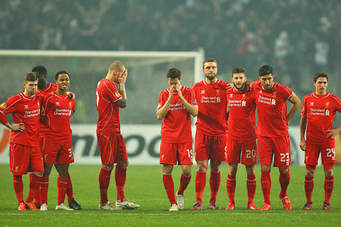
Liverpool players endure 15 penalties in cup game vs Middlesbrough in 2014
So, what does the Soccer Yoda think of PKs for ending games? Those who know me are very familiar with my passion for the “good game”. My ideal score is one that has come about through a number of players working the ball from the defensive third by using quick touch passes to teammates who have sprung free through movement to the goal which has been left poorly defended by the aforementioned passing , movement and team-based thinking. So, it shouldn’t be a surprise that I don’t like penalties. Rather than change the mechanics of the game at all, I would change the method of scoring. Once a game has gone into overtime I would count corner kicks earned when the defender who last touched the ball is completely inside the penalty area ( in order to reward attacking the goal and not the corner flag). At the end of extra periods if no goals have been scored the team with the most of these “conditional corner kicks” would win. This would bring about an offensive mindset throughout the additional game time because even if a team has scored a corner they would be foolish to “park the bus” when the likelihood of giving up a corner is so high when playing all defense.
And perhaps it is that – the all defense strategy – which represents the biggest danger of a game-deciding method which discounts the ability to actually play the game. How many teams enter games hoping to get to PKs? How many teams decide during regulation to play for penalties? We don’t really know. But if more and more elimination matches end up in penalty kicks after scoreless draws, it must be considered that the end-of-game process is affecting the whole game in a negative way and that must be dealt with no matter how much drama is produced at the end. Is it worth it to endure 120 minutes of boredom to get to 5 minutes of excitement?
A Second Beginning
Posted: November 29, 2016 Filed under: Uncategorized | Tags: 3-5-2, Bruce Arena, Hexagonal, tactics, USA, World Cup 3 CommentsIts been awhile ( OK, a long while) since The Soccer Yoda has written a post. But recently some major events have occurred in the world of soccer, especially in the United States. A number of soccer fans surprised the Soccer Yoda by asking what were his views on the change in national coach and the events which led to that change. Frankly, I was somewhat surprised and flattered that there were those out there in the soccer world who remembered this blog, so I dusted off the computer and relearned to hunt and peck with more than just my thumbs. It’s a second beginning for our new ( sort of) national coach and a second beginning for the Soccer Yoda and this blog. So……lets take a look at the recent national team results and their effect on our national coach position.
On November 8 of this year the USA played Mexico in Columbus, Ohio in the first game of the “Hexagonal”. This is the final qualifying round of matches to decide who goes to Russia in 2018 to represent our region in the World Cup. There are 6 nations left , hence the name. There are 42 countries with teams in the Confederation of North,Central American and Caribbean Association Football or CONCACAF, so it would seem that it is an accomplishment just to get through the several preliminary rounds to reach the final six. And if our region was like Europe or South America it would be exactly that. But, given that the majority of those 42 nations have a population about the size of New Haven, Connecticut, the USA is absolutely expected to make the top six . As a matter of fact, finishing in the top two (along with Mexico) has become absolutely expected ever since the soccer boom in this country started producing decent players in greater numbers than somebody like say… Bermuda. In order to make it to the World Cup without an additional playoff game, we need to finish in the top three of the six. In light of our international results in this century, this should not be a challenge.
Although playing Mexico in the first game would seem a tough task, the fact that the game was a home match for the USA created an expectation of victory and not just by any score either. The last 4 matches against Mexico in Columbus, Ohio had all been 2-0 wins for the Americans, so cheers of “Dos a Cero” rang throughout the stadium before the start of the game.Then the USA came out in a 3-5-2 formation and the game took on a tone very different from those notable American victories.
One of the knocks on Jurgen Klinsmann during his tenure as our national coach had been that he tended to put players in positions for which they are unsuited. One rational for this is that he had a formation that works best and into which he must fit his players. During the 2014 World Cup cycle he used a 4-2-3-1 system very effectively and although all players were not the best fit for the formation, they grew familiar with it – they learned to play it – they knew who was where and how their teammates would react to the game in that formation. But since then Klinsmann had tinkered with several different formations and didn’t settle on anything in particular. The 3-5-2 was very different from anything the team had played before and they had only practiced it for a few days prior to the Mexico match.

It has been said that the wing-backs are the key to the 3-5-2. When advancing the ball in possession from the back line the wing-backs must get wide and be available for outlet passes that start the attack. When the team gets the ball near the opposing goal the wing-backs must be in advanced wing positions, ready to provide width to the attack and both supply and receive crosses. On defense the wing-backs must cover the deep wide spaces to prevent the opposition from exploiting the narrow positioning of the centerbacks, in effect providing 5 back defenders at that moment. The American wing-backs vs Mexico were Tim Chandler on the right and Fabian Johnson on the left. These guys are decent players when positioned correctly ( especially Johnson), but against Mexico, in this formation, they were lost. They didn’t provide for outlet passes which forced the USA centerbacks into central passes and long balls which lost possession. They were not in wide offensive areas very often and when they were the balls they played in were mostly misplaced. And they disappeared in those wide deep defensive spaces which allowed the Mexicans to play from those spaces without pressure. Mexico grabbed the momentum from the start and it was only a matter of time before they scored and not that much time either…..like 20 minutes. At the 26 minute mark Michael Bradley and Jermaine Jones , the American central midfielders, took advantage of a break in the play and asked Klinsmann to change the formation. He did and the US got back into the game playing a much more familiar 4-4-2. The score was equal late in the game when another tactical mistake cost the USA a chance to gain at least a draw.
The common method of defending corner kicks is to place a defender on each post thus reducing the area of the goal that the keeper needs to protect. Some coaches prefer to leave one post or both posts without a defender which adds to the number of players which can cover attackers in front of the goal. Obviously, if an offensive player can still get his head on a corner kick against a goal defended with open posts then the open-post strategy is worthless. This is one of those times so common in sports when an uncommon tactic is a genius idea if it works and a goat idea if it doesn’t. So coach Klinsmann had the USA leave the far post open on a Mexican corner in the 89th minute and Rafael Marquez hit a brilliant shot with the side of his head into the open post area to win the game. So it was another mark against Jurgen’s coaching which cost the US the game and ended an unbeaten-at-home world cup qualifying streak that started in 2001. After the game Jurgen blamed the failure of the 3-5-2 on his midfield, particularly Bradley and Jones. This certainly did not go over well with those two or the team as a whole. It wasn’t very smart on Klinsmanns part, especially considering the caliber of the next opponent and the motivation needed by the team for that game, coming only 4 days after the loss to Mexico.
 Mexico scores a corner against an undefended post to beat the USA.
The next game in the Hex was against Costa Rica and in this match our role was reversed when compared to playing Mexico in Ohio. This time the USA was the visitor playing away to a nation that we have not had any success with when playing in their home stadium. Given the loss to Mexico, one would think that the Americans would be sky high to both A) break the Costa Rica away game jinx and B) get our first win in this round so as to put us in a good position going into the rest of the games. Instead the Americans came out slow, again unable to maintain possession and almost lackadaisical on defense even in the preferred 4-4-2 setup. The result was a 4-0 shellacking by a team that, while competitive with the USA, certainly is not four goals better than our team under most any other circumstance. It was very obvious that Klinsmann was not able to motivate this team to play their best AND added to the tactical and psychological mistakes made in and after the Mexico match AND the controversial stances that Jurgen has taken during the last couple years including the Landon Donovan World Cup Drama, his comments about MLS vs European experience, his seeming preference for dual-citizen players trained in Europe over USA developed players ………well..the writing was on the proverbial wall.
With the change of national coach coming in the middle of the Hexagonal round, the job of replacing coach Klinsmann took on some definite prerequisites. The next matches are in March and , to be sure, the new coach has one specific goal……to get the United States into the 2018 World Cup. It would be nice if the USA could also have a decent performance at that World Cup, but first things must be first. Given the short preparation time before March the new coach should 1. Be familiar with our present players and prospective players. 2.Be familiar ( being experienced would be even better) with our competition in CONCACAF and the challenges of playing away in their home stadiums. 3.Have experience coaching a national team with its unique circumstances. 4.(Optional but preferred) Know the soccer culture of our country and its ups and downs. This list narrows the number of candidates down to a very few ( like maybe 3) and one just signed a contract to coach in the English Premier League. So that left former USA coach Bruce Arena as the most obvious and possibly only choice. Bruce was the national coach from 1998 to 2006. His record of 78-28-27 , a quarterfinal finish in the 2002 World Cup and an American #4 FIFA ranking makes him the most successful American national coach ever. Arena has a much more subdued character than Jurgen Klinsmann and is known for his seriousness about his craft. He has had overall success at every coaching position he has pursued , but a poor performance in the 2006 World Cup cost him his spot with the national team. He has until March to gain the confidence of the USA team and to put together enough wins to get us to Russia. Lets hope his 2nd beginning as USA coach is successful in accomplishing his singular goal of an American presence at the World Cup in 2018.

Kickball- What it is; What it is not
Posted: October 22, 2014 Filed under: Uncategorized | Tags: soccer tactics, street soccer, strike zone Leave a commentRecently the Soccer Yoda has reentered the world of youth soccer coaching. Although I have coached many different age groups and both genders, this is a new experience. I am working with a team of 12 yr old girls, most of whom are new to club soccer. The experience is proving to be highly educational, infinitely challenging, very humbling , yet at the same time, very rewarding.
It has also reintroduced me to a term I have not heard in a while – kickball. In a soccer sense, kickball is not the baseball-like game played with a big rubber ball. It refers to a long kick, one which is considered to be very poor in terms of soccer tactics and , by extension, the use of these kicks as a team tactic. I have heard this term used frequently since my reentry into youth coaching.
First of all, lets discuss why we are talking about tactics at all in regards to youth. Many “experts” say that youth – up to as old as 14-16 – don’t need to be taught tactics. The emphasis should be totally on technical skills, tactics can come later. Indeed, many world stars didn’t even play organized soccer until around 12 yrs old or so. There is no evidence that playing on a organized team at early ages prepares a player better than playing hours of street soccer and many believe just the opposite. Kids will keep their own score in street soccer games but will typically forget about the result very quickly. But the ball skills learned in those small, informal games last a lifetime. So the “experts” aren’t necessarily wrong in questioning the need for tactical training among youth.
They just aren’t paying attention to reality.
Somewhere in the USA there might actually be an organization that simply provides a place for youngsters to play small- sided games ( 4 v4 ; 5 v 5) with small goals and coaches to merely suggest or demonstrate skills for the kids to try. No scores, no refs, no uniforms………….no parents screaming, no pressure. There MIGHT be such a club…..but I haven’t seen it or heard of it. No… American youth soccer is all about making the team, playing positions, winning games, even getting ranked high. Yes, in a true emulation and over-exaggeration of adult world practice, there is a web site in which youth soccer teams as young as 10 are ranked by a point system on a national, regional and state level and unfortunately there are adults who pay attention to those rankings. This is the reality of youth soccer in America. If street soccer has a place, it is surely hidden behind the organized youth soccer world. So….since our kids are on fields, with uniforms and goals and refs and scores and championships……tactics must be taught to compete….and those who suggest that kids of 14 or 12 or 10 or anything older than 5 cannot be taught team tactics…they are wrong.
Which brings us to kickball.
The Soccer Yoda has heard this term tossed around a lot lately from players, coaches, parents, anyone involved in youth soccer. It is said with derision, as a criticism, supposedly describing a unsophisticated, unskilled style of soccer used by teams who either ( mentally) don’t know better or ( physically) are incapable of playing a more skillful, controlled passing game. Unfortunately , in many cases the use of the term is all-inclusive of any ball kicked farther than 10 yards and therefore is often misused.
To understand why that is so, we must go back to the basics of the game. The object of soccer is NOT to make pretty passes, to control the ball, to play with great positional sense, etc…..it is to score more goals than your opponent. The rest is merely a means to that end. True, in some cultures the art of soccer is considered more important than the score……the USA is not one of those cultures. We like to score, we like to win.
So, here is the Soccer Yoda’s concept of modern soccer tactics:
Every soccer player, from an age 5 beginner up to Lionel Messi, can kick a ball past a goalkeeper into the goal- if that player is close enough to the goal and if the player is given enough time to strike the ball with the best technique capable of that player. Each player has a distance from the goal that represents his or her maximum distance from which the ball can be kicked into the goal given a certain amount of time. That amount of time we can call the players “strike-time”, the area inside of which the ball can be kicked into the goal is that players “strike zone”. A study of goals scored at all levels indicates that most goals are scored when players get inside their strike zones with time enough to exceed their strike-time and with the ball at their feet (or head). Our 5 yr old beginner might have a strike zone of 3 yards with a strike time of 5 seconds while Renaldo has a strike zone of 25 yards and a strike time measured in tens of a second , but they both need their strike time inside their strike zone and the ball in order to score goals. Remember – more space between a player and an opponent means more time to strike the ball well. So modern soccer becomes an effort by teams to get players into their strike zones with enough space ( and therefore time) and with the ball in order to score goals and an effort to deny the opponent the ball, the space, the time or any combination thereof, in order to prevent goals.
Given the objective of getting players into strike zones with time and space and the ball, teams must either 1) take what the defensive team gives in terms of space or 2) create that space and deliver the player and the ball into it. Defenses can be very good at denying space near the goal, therefore at high levels teams must work hard to create space inside strike zones if they want to score. This can be done by 1) set pieces 2) turning defenses 3) unbalancing defenses. More on these concepts in future posts. Good defenses follow certain “rules” and these are not new. One of the most important rules is that defenders must be provided with cover whenever possible. If a defender is to attempt to pressure an opponent , there should be a teammate in place to pick up that opponent if the first defender fails and the opponent gets past with the ball. Modern teams typically play with 4 defenders and they are tasked with providing cover for each other. In particular , the central two backs must have a great understanding of when to go forward to attack the ball or an opponent and when to drop back to cover a teammate who is going forward. If they get caught level with each other or “flat” , the offense can beat them both with one well placed pass through the defense and one running player who now ,depending on the distance to the goal, has space and time to prepare a shot.

If a defense fails to cover for each other. one pass beats all of them
As teams control the ball and move up the field, they tend to give up space behind them. As long as they keep the ball or regain it quickly if lost , or drop back having lost possession, then having the ball in the other teams half should not be a problem. But often teams push up too much and fail to retreat when the ball is lost, so the space at their back is totally open.If an opponent gets into that space and gets the ball, we see the goal “against the run of play” which happens so often in soccer. Its a known fact that owning field position in soccer can be the very thing that creates goals for the opposition.

If the player with the ball (blue dot) passes the ball behind the defense to his teammate (red dot) on the run , they beat the white defense
Lately the Soccer Yoda has seen many youth teams play their defenders high up the field. IF they are covering for each other and dropping back when opponents attack them , this does not have to be a problem. However, many of these teams play their defenders flat across the field , so they are leaving space behind them and allowing well placed passes to put opponents into that space. (see above illustration)
Great teams and players can exploit space behind defenses in the blink of an eye (see below)

Renaldo passes to James (blue line) and then runs behind the defense as James hits a long ball to him.
So what IS kickball? In my view, a kick made in the general direction of the opposition goal without aiming for a teammate or a space, is “kickball”. And , yes, many…perhaps even most… youth teams use kickball as their primary means of playing the game. But playing balls into open space for attackers to run to is not kickball, it’s smart soccer.
This leaves the youth coach with a dilemma, does the coach, in the interest of teaching the skills and tactics of the “good game”, ignore the space being left open by high, flat defenses? Does the coach, in the interest of winning, abandon all attempts at short passing and individual ball skills and just put long balls into that tempting space? ( And thereby be accused of playing kickball). I have seen both strategies being employed. Ideally, youngsters are taught a combination of these strategies….pass short when appropriate to establish possession and move defenses, pass into space when it is offered or created. However, this requires skill and knowledge and to teach it to youngsters is not easy, even as they become older. If our youngsters were playing more street soccer than anything else, we wouldn’t worry about any of this until they become much older. But they aren’t, so it’s a constantly discussed matter with no true right answer. But, one thing is certain….well placed long passes into space for running teammates are not kickballs.
Howard County Soccer- a perspective
Posted: September 10, 2014 Filed under: Uncategorized 5 CommentsHoward County, Maryland lies halfway between Baltimore and Washington, D.C. It includes one of the first and arguably the most successful of the planned cities that have been developed in this country – Columbia. Columbia was built mostly in the early 1970’s and as the city grew, soccer in the new city grew also. Eventually soccer in Howard County became as integral to life there as it is to any community in the world, even in those countries known far more for their “football” than is the United States. And it is not the just the number of participants in Howard County that is of note. The area has produced numerous state, regional and national championship club teams as well as professional and national team players and scores of college participants. The high schools typically draw four figure crowds , state championships have become a regular , almost expected, event. Sports Illustrated ran a story on the county, calling it the “heartland of American soccer”. It is amazing that such a small county has had such success in promoting and playing the sport. So how did this particular area become so inundated and successful with the sport of soccer?
The story of Howard County soccer is one of hard work, dedicated people and smart marketing.
The ” new town” of Columbia attracted a diverse population and there were a number of internationally born families living in the city even as it first developed. Three of these came together in 1971 to form the Soccer Assocation of Columbia and they attracted about 60 boys in their first season. Felix Rausch, Doug Goodsir and Bill Simm, an Austrian and two Englishman, worked hard to start the organization. Each season thereafter the number grew.. From 60 to 200 to 600 to over 1000. The growth was fueled by a couple of smart marketing decisions by the founders.
First- The city is composed of ” villages” , each made up of smaller areas called neighborhoods. Each neighborhood has it’s own elementary school. When forming the new soccer organization, it was decided that the teams would represent the neighborhoods, and would be composed by players who lived in those respective neighborhoods. While most American youth sports had sponsors , there was something far more compelling for a youngster to be playing for Thunder Hill or Bryant Woods than for Joe’s Gas Station. The results of the weekly games were reported in the local newspaper – the Columbia Flier, with a couple sentences naming players who had good games, for both the winners and the losers. By the second season, community citizens were reading the reports and identifying with the teams from their neighborhood. Although there were no elementary school sports teams, the nature of the teams made it easy to connect the teams to the schools that the players attended. An upcoming big game produced the same excitement in the elementary school that it would have if it were in a high school. The players became celebrities of sorts, which encouraged more children to sign up the next season.
Second- Each participant was given a team shirt to wear during the games. But the shirt was not a soccer jersey. Each player received a t-shirt which was identical to all the other t-shirts except for color. Each neighborhood had it’s unique color to identify it; Swansfield was red, Faulkner Ridge was yellow, etc. Each shirt had a large soccer ball on the front encircled by the words ,” Columbia Soccer” . The players were proud of their shirts and because the apparel was a t- shirt, it was worn constantly by the soccer kids. Columbia was getting an enormous amount of publicity at this time, being one of the first examples of a successful planned city, and photos of the city and it’s residents were everywhere- magazines, newspapers; publications of all types. And, given the family nature of the community, these pics had tons of children in them. So, to the outsider it seemed that every child in the city played soccer, given that nearly every photo had at least one child wearing a shirt with a large COLUMBIA SOCCER emblazoned on it. It was free publicity and well, you just weren’t anybody at school if you didn’t have one of those shirts!
Within a few years the growth of the sport prompted the leaders of the organization to test the quality of the players compared to soccer played in other nearby areas.In 1974, Columbia was represented by an all-star u-10 team at a local single elimination tournament held in suburban Baltimore. The result was a 5-1 thrashing by a Baltimore team from the Shrine of the Little Flower church. Little Flower was the reigning youth soccer power in the Baltimore and the game showed the gap between the fledgling Columbia kids and the established Baltimore soccer community.
A year later , Columbia returned to the tournament with a new u-10 team consisting of boys born in 1965 or later as well as a 1963 boys squad. This time the results were different. The Columbia soccer people were now aware of the caliber of play outside of Howard County and adjusted their coaching accordingly. Both teams did well, reaching the finals, and the 1965’s faced Little Flower again. This time the Columbians raced to a 5-0 win. It was the first tournament win for a Columbia team, the first of many, many triumphs. The Baltimore soccer community was talking about Columbia and that reputation only grew in the coming years.
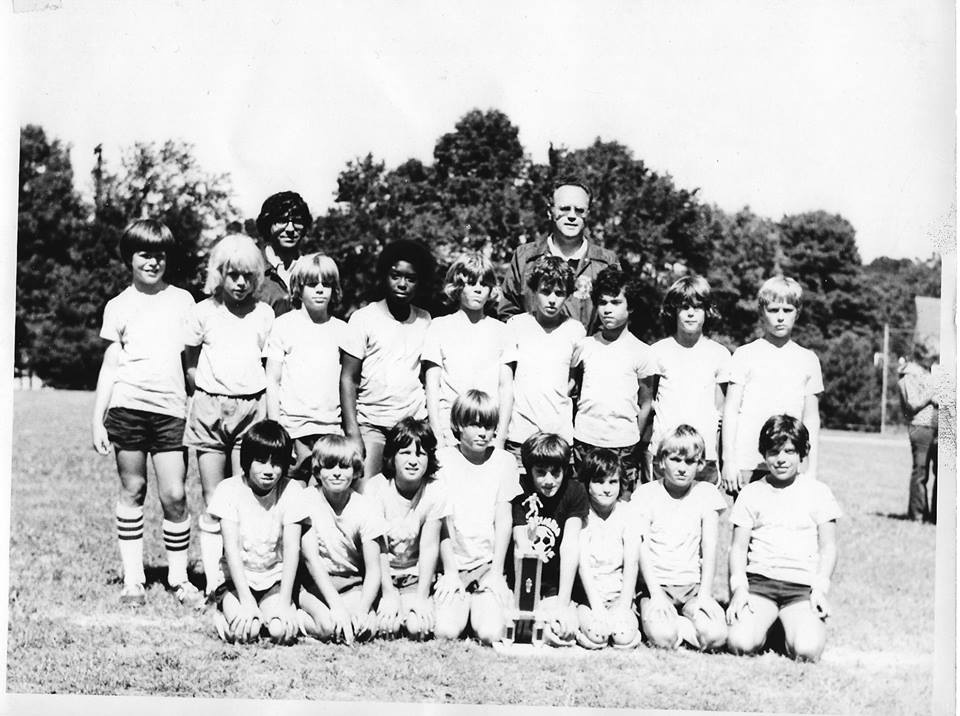
Howard County’s first tournament champions- 1965 Columbia boys
Two years later , in 1977, the Columbia 1965 boys broke through the Maryland State Cup barrier, winning the cup without giving up a goal in the tournament. Once the feat was accomplished , several teams followed suit , including the 1967 girls who eventually ruled the state by claiming 3 State Cup titles. Two years later another level was reached. Both the 65 boys and 67 girls won Md cups and went to Binghampton, NY to represent the state in the Eastern Regional tournament. Both teams reached the final game with the boys claiming the championship. Now Howard County soccer was officially a national power. But these accomplishments were dwarfed by the 1966 boys who as u-16’s and again as u-19’s reached the highest accomplishment in American youth soccer by winning the national championship twice. In 1987 the 1971 boys took the national u-16 title and in 1996 and 1997 , Howard county ruled the country in the u-17 and u-18 bracket by winning consecutive national championships. What an amazing set of accomplishments from an area as small as one county in a suburban location!
So what was the secret? How did this community manage to turn out the quality of player and teams that put it on the national youth soccer map? To the Soccer Yoda, there were several unique characteristics that helped produce those amazing results:
The major common thread running through all the successful teams was the presence of one , dedicated, knowledgable coach , working with a core group of players for several years as they developed their skills and efficiency as a team. These coaches varied in their backgrounds from teachers and professors to businessmen. Their soccer backgrounds varied from professional players to dad’s who picked up the game when their kids did. But the common thread was that they stuck with their teams , continued to learn the game and never asked for more than the dedication of their players. They insisted that their teams played quality soccer, they didn’t short-cut the learning curves of their players for immediate wins. In the long run, the players became increasingly proficient and their teams rose up the ladder of youth soccer achievement.
These coaches were allowed to express themselves with their teams. It is not uncommon for modern clubs to dictate coaching methods, styles, even formations, in the interest of club continuity. But the successful Howard County coaches varied greatly in these areas. Al Goldstein’s 1965 boys who won 2 Md cups and a regional title were known as the ” passing team” and used possession and movement to control opponents. But they were subject to physical play in attempts to literally knock them out of their comfort zone. At the other end of the spectrum, when Rudy Storch took his Longfellow neighborhood team and added a couple of Goldstein’s players and a couple more from other neighborhoods to form his 1966 boys squad, he headed off the rough stuff by presenting a tough physical aura to the team. They wore plain gray shirts ….nothing fancy ….and retaliated quickly to any attempt to intimidate them. Almost lost in the atmosphere was the quality of play, the control, quickness and skills of the team. The mix brought national championships to the team and to Columbia. Coaches who were free to coach as they wanted were responsible for highly successful sides and players.
Another distinguishing factor was the incredible community support afforded Columbia teams.As the city grew its reputation as a youth soccer hotspot, it’s Memorial Day tournament drew top teams from around the East. Many spectators turned out for group games, but the finals became a “event”. Hundreds of local soccer fans turned out for the championship games and any local team which earned its way into a final enjoyed a major boost of hometown support. Big high school games were played on Saturdays or under the lights at Howard High School, which was the only high school to have a lit field at that time. These matches drew crowds exceeding 1000 fans with a couple estimated at double that number. Columbia players and coaches became local celebrities, which increased the number of new youth playing the sport and , perhaps more importantly, kept them playing in Columbia rather than journeying into Baltimore or down Rt 29 to DC to join the clubs in those cities.
That above mentioned factor- keeping the talent at home, proved to be another important ingredient in the Howard County success recipe. Not only did the area produce excellent players, but they represented Howard County when they played. The combination of quality coaching, support and results actually encouraged top players from other localities in the Baltimore-DC area to join the Columbia locals. Although predominantly Howard County grown, several of the high reaching sides had players from outside central Maryland.
So, by dedicating themselves to quality soccer, having soccer knowledgable coaches and administrators, by marketing the sport and the players and keeping the quality talent at home, Howard County became one of the top soccer communities in the country and for its size, perhaps the highest concentration of soccer success in the nation. It’s a formula that would work today as well as then.
5 Things We Learned From the World Cup
Posted: August 9, 2014 Filed under: Uncategorized 2 CommentsThis summer soccer fans were treated to the biggest spectacle in sport….the World Cup. Practically every country in the world fields a national soccer team in hopes of making it to the final tournament where 32 teams, representing the various regions of the planet, play to determine the best national side in the world. This year the tournament was exciting, surprising, somewhat controversial and was worthy of the massive amount of attention afforded it around the world.
In following a popular format among sports columnists, this post is dedicated to 5 major learnings that the Soccer Yoda came away with from the competition.
1) Year in and year out the best national team program is Germany- no doubt
This conclusion probably comes under the “no duh!” category. Germany won the title; scored 18 goals in 7 games, gave up only 4 goals and on occasion looked like they were in another universe compared to their competition. But the real learning concerning the quality of national teams coming out of the Cup is the German’s amazing consistency from one tournament to the next – from one generation to the next. They have made it to the semifinal round for 4 consecutive tournaments. That’s 16 years. There are other nations with strong performances during the last 20 years but no one matches up to the Germans. The results are not the only thing that is impressive about Germany. They manage to consistently play quality soccer with an impressive balance in their players and their style. They play a possession game, but not to the detriment of their ability to counter-attack, nor to the excitement of watching them. They play outstanding defense, but because they don’t pack their defensive half of the field with players and because they can score plenty of goals when given the opportunity, their defense is largely overlooked. And they do all this, time and again, without a “super” star who carries the team. There is no German Messi or Neymar or Ronaldo. The rest of the world has some catching up to do to match Germany.

Germany was the best, it was no fluke.
2) It’s still a defensive game
Soccer is about ball skill and running and decision making and team tactics. But,more than anything else, it’s about defense. Teams with poor defenders and goal keepers are at a great disadvantage. Even more so, teams without players that have the will to play defense, all 11 of them, are done before they start. Portugal had a decent team, but their desire to play team defense was questionable and when their best defender, Pepe, lost his brain (he didn’t lose his head, he used it!) and then head butted an opponent during their first game, it was over for them. Even Cristiano Ronaldo couldn’t make up for a porous defense. Of course, the biggest example was Brazil, who thought they could overwhelm the Germans with offensive players, but forgot that those players needed to get back to help their back line. Despite having arguably the best defender in the world ( Thiago Silva), the Brazilians consistently overcommitted and failed to track overlapping late German runners who took open shots at the Brazilian goal. For all the ball skill of the Brazilians, it was their failure to play defense that doomed Brazil to an embarrassing loss in front of their home fans, with or without Neymar. Meanwhile, Mexico and the USA rode hot goalkeepers and a willingness to play team defense to achieve results above the general talent level of their teams. The US in particular, came but one Chris Wondolowski short volley from moving into the quarter finals strictly because Tim Howard was everywhere and the team was willing to work incredibly hard at defense with the occasional run up the field when the opportunity presented itself. The lesson is that at this level, teams need quality defenders and , even better, the desire to defend, to be successful.
3) Technology is good
Soccer is a game ( on the international level anyway) that is steeped in tradition. FIFA looks at every proposed change like it is changing the course of world history. So it was somewhat surprising that in this World Cup, two major technological innovations were used. Of course, the most discussed change was the use of goal-line technology to decide if goals were scored. It was very reassuring to see that goal line graphic after each close attempt at goal; to know that if a goal was awarded it was truly a goal. The technology was needed more often than one would have imagined. On more than one occasion, first looks seemed to indicate that the ball had crossed the line and we learned that even tv replays can be deceiving when several angles looked like the ball was over that line. But the technology said no, and in each case some angle of the replay showed that the correct decision had been made. Less momentous, but more useful, was the use of the disappearing foam to place the ball and the wall on free kicks. The constant infringement of players with the literal push back from the referees finally came to an end. The ball was placed, the wall formed , and the kick was taken. And the game moved on with a minimum of time wasted by the jockeying for position which has become so common. So what next? To the Soccer Yoda, the failure of Fifa to recognize the existence of the stopwatch is rediculous. Time wasting mars the game, and the added time which is supposed to make up for it never equals the time spent waiting for players to get treatment for their ” injuries” , much less the lolly gagging spent on substitutions. And to think that the game clock is running while players run all over the stadium celebrating goals with teammates , coaches, fans, food vendors … Anybody they can find who will hug them…makes no sense to me. The added time itself is a mystery. Nobody can figure out where the ” 1 minute ” or “5 minutes” comes from! It’s simple….stop the clock on goals, injuries, and substitutions. When it gets to the point that commentators rag on players , as was done to Graham Zusi, for taking so much time coming off the field that a minute was added, therefore giving Portugal the chance to tie the game in the last seconds, Fifa needs to move out of the 19th century in regards to game stoppages.
4) Playing well in the World Cup increases a player’s reputation …and value
A number of players had strong tournaments and their worth has increased because of it. Of course, the soccer world knew that would happen. Many clubs completed transfers before the Cup because they knew that if they waited until after the tournament the price of their desired new member would increase. What is interesting is that the world also knows that some players stand out when playing for their country while others don’t and a player’s overall ability may not be evident in the World Cup. Even superstar Messi would not be so well thought of if his performances for Argentina, prior to this World Cup, were the only consideration. Although Neymar always played well for Santos in Brazil, it was his ability to spark Brazil’s national team, particularly in the 2013 Confederation Cup, that earned him his huge contract at Barcelona. But he has been somewhat of a disappointment there, and the Cup would have been his ” reassurance games” for those who question his ability to help Barca. But between Brazil’s disappointing performance and Neymar’s injury, those doubts remain. So…soccer people know that just because a player does well in the World Cup, that alone is no guarantee of his worth to a club. Didn’t matter- the world went gaga over the tournament stars anyway. It is true that some of the tournament stars were already well thought of. We all knew that Tim Howard was one of the best in the world, so his brick-wall performance against Belgium was not a surprise and Everton congratulated itself on recognizing his talent before the rest of the world. But Guillermo Ochoa was let go by the French team Ajaccio ( and they are no major power , even in France) and had lost his spot as undisputed goalkeeper for Mexico. It was generally felt that his career had peaked. But Brazil fired a multidude of shots at him and he parried them all, then followed that with a strong game against Netherlands. Suddenly Ochoa became a sought-after good.After considering offers from some high caliber squads ( Arsenal, Liverpool) he decided on Spanish side Malaga. Malaga is a mid-table team that shows no sign of challenging for a higher spot in La Liga. But Ochoa got a nice deal and perhaps he feels that the microscope he would be under playing for a top level organization would not be favorable. One thing for sure, 2 excellent performances, coming at the right time, certainly helped him. James Rodriguez (Columbia),Divock Origi (Belgium), Christian Gamboa (Costa Rica), even USA substitute DeAndre Yedlin , all have signed or are close to signing lucrative new contracts as a result of the Cup and there are other players also cashing in on strong performances. But…..history shows these are not “sure-thing” players just because of their play this summer.
Ochoa stops Brazil again.
5) Soccer is more popular in the USA than any of us imagined
I’m not going to restate the obvious ( any more than I have in previous posts, anyway) but soccer is growing like crazy in this country! The crowds, the excitement, the patriotic fervor……wow! And for those way-behind-the-curve commentators like Ann Coulter, Keith Ablow, Jim Rome, etc. who claimed that once the World Cup was over, our interest would wane away…….well , the other day 109,000 ( yes, that’s correct- it’s a LOT of people) went to see two non-USA teams play a meaningless preseason game here in this country. And not in LA or Miami or some such city that would be expected to have a large crowd due to its ethnic makeup …no, this was in Ann Arbor , Michigan! Anti-soccer commentators only display their ignorance of the sports following in this country with their comments. If they don’t wake up, their own relevance will be questioned far more than they question soccer in this country.

Amazing crowd in Michigan.
 The Soccer Yoda
Recent Comments