How To Beat A Defense
Posted: April 8, 2018 Filed under: Uncategorized | Tags: Isco, Marcelo, Real Madrid Leave a commentSoccer Yoda would like to thank the many readers of this blog. In the last couple months soccer fans from many countries around the world have become viewers. It is quite an honor to have an audience as widespread and diverse as this one has become. Thank you all!
This past week the European Champions League played it’s first leg of it’s quarterfinal matches. As expected, Barcelona did well against Roma, winning 4-1 and Bayern Munich downed a surprisingly stubborn Sevilla team 2-1, in Spain. This makes Bayern a large favorite for the overall result given the second leg will be at home. Liverpool astounded everyone, especially Manchester City, in thrashing them 3-0 at home. It remains to be seen if City can come back in Manchester this week. The big contest, pitting Real Madrid against Juventus in a repeat of last years final proved to be disappointing, unless one is a Real fan. Madrid rolled to a 3-0 win, and in Italy no less. In doing so, Real scored a terrific goal that caught the eye of the Soccer Yoda in it’s application of modern soccer tactics. And no, I don’t mean Ronaldo’s overhead scissors goal. That was an amazing display of technique and athletic ability. That kind of skill can decide matches regardless of whatever tactics are being applied.
The goal that impressed the Soccer Yoda so much was the third one, scored by Real’s left back Marcelo. It involved a fair amount of technical skill with the ball, mainly the ability to control a pass to feet and the ability to deliver an accurate pass under some pressure. But what it really demonstrated is that an understanding of space and movement can beat the best defense. And the fact is that this understanding can be taught to youth.
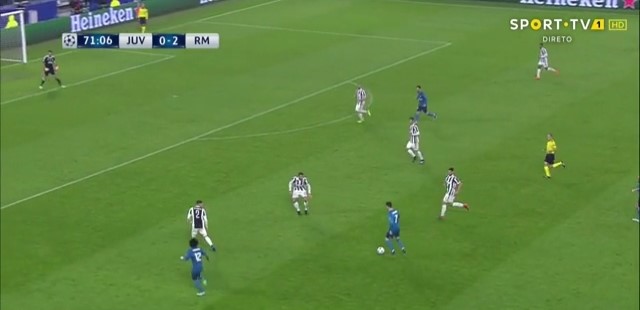
At the beginning of the move (above picture), Ronaldo has the ball in Real’s attacking third. He is moving with a deliberate slow pace. Marcelo has moved up the left side and is position to support Ronaldo. Farther away on the right Isco is literally in the picture but is a tough pass for Ronaldo. It should be noted that Juventus has 5 defenders in the area and another moving in from the far right. Real has 3 attackers against 5+ defenders of one of the best defensive teams in the world. This doesn’t look like a positive situation for the Spaniards.
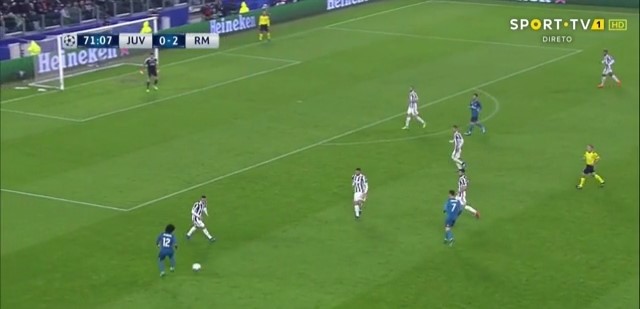
With no penetrating move available and Juventus defenders closing in, Ronaldo makes a safe pass to Marcel0. Meanwhile Isco sees space open behind the 3 defenders marking Marcelo and Ronaldo. He starts a diagonal run into that space using the concept that attackers away from the ball should make runs into space left open by the defense.

Marcelo takes the ball inside toward the space while Isco continues his run across the defense. Isco’s run forces the Juventus defenders to decide whether to stay where they are or to follow him as he moves into an open area.
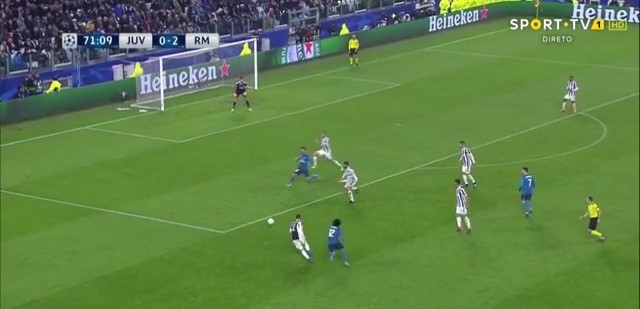
Isco’s run takes him into the space and the defenders decide to move with him to prevent him from getting the ball unmarked in a dangerous area.But diagonal runs that are properly made allow the receiving player to shield any following defender with his body and Isco can take a pass from Marcelo while shielding the defenders. So Marcelo slips Isco a short pass using the outside of his left foot. The diagonal run has taken 2 Juventus defenders out of crucial areas and now there is a large open space inside the Italian penalty area right at the penalty spot. But how to get the ball into that spot at a Real player’s feet and at the same time keep that space devoid of defenders?

Isco is receiving a pass with a defender on his back preventing him from turning with the ball. This is a classic “man on” situation in which the receiver being pressured passes the ball back to the original passer. In this case, the original passer has moved since making the first pass. The defender marking Marcelo has turned to watch the ball and lost sight of Marcelo who is now in a good position to receive Isco’s return pass.

Marcelo has the ball he obtained from Isco. That big open area at the penalty spot (opened by Isco’s run) is still there but Marcelo is surrounded by defenders and the chances of carrying the ball into that spot past all those defenders is slim. However, Ronaldo has followed one of the basic concepts of possession soccer. He has put himself into a position where his close teammate with the ball can reach him with a pass. Marcelo knows that although he would have trouble reaching the open space with the ball, there is another way.
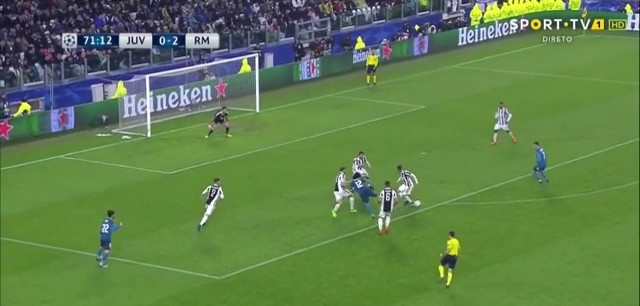
Marcelo takes advantage of Ronaldo placing himself on a line with him. He passes the ball through the surrounding defenders to Ronaldo. But he knows the importance of that empty space in front of the goal and he continues his movement toward it after making the pass.

Ronaldo receives the pass from Marcelo and although he could shoot from where he is, he sees Marcelo making the run toward the penalty spot. Juventus defenders have been turned again as they follow the ball. Each turn costs them a couple steps and so they seem rooted to the ground while the Real players move around them. Ronaldo makes a “second side” pass to take advantage of the turn and cause the defenders to lose sight of Marcelo. A “second side” pass is made to the opposite side of a defender than the side that the offensive runner is on in respect to the defender. Since the ball and the runner are on opposite sides of the defender he will not be able to keep both of them in sight. In this case, the Juventus defenders are watching the ball and lose sight of Marcelo.

Marcelo is meeting the ball in open space with only the keeper to beat. The defenders are calling for offside, but Marcelo timed his run to coincide with Ronaldo’s pass and he is not offside. Ronaldo gets the assist for the prospective goal and the player who created the goal by his run is standing alone watching the culmination of his work. Isco knows that he played a crucial role in this score even though he neither scored nor assisted on it. In modern movement-oriented soccer, many times the player whose movement opened the defense is not part of the actual scoring of the goal.
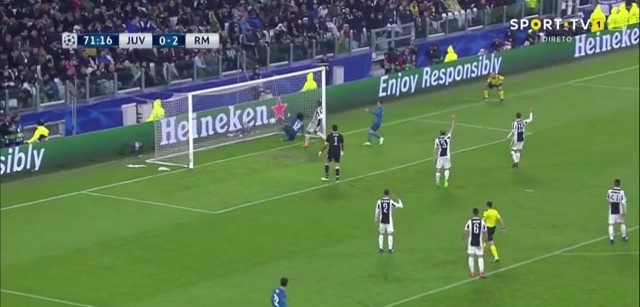
Ironically, Marcelo fumbled the actual shot on goal, but the position and lack of defenders around him allowed him to stumble into the goal with the ball. Real was up 3-0, the game and likely the movement into the next round was settled.
Real scored with only 3 players against a number more defenders by using modern offensive concepts that involve possession by having close support, movement by players into space from off-the-ball locations, forcing defenders to make choices as to their position and then taking advantage of those decisions. This may seem like extremely high level play reserved for only the best of the best in the world. It is not. The basics of this style of play can be taught to single digit aged youngsters. As they become familiar with possession and simple movement they can learn more complex strategies like diagonal runs, second side passes, decoy runs designed to move defenders away from important areas and more. And while they play this type of offense they develop the technical skills of control, passing and vision that this style of play needs to be successful. If American youth coaches were tuned in to developing these ideas and skills in our youngsters, we would not be worrying about qualifying for the World Cup. It can be done, we just need to educate our coaches to teach our youth and eventually the USA will have our own Isco, Marcelo and Ronaldo scoring goals like this one.
Soccer’s Triple Conundrum Part 2 + Breaking News
Posted: May 29, 2014 Filed under: Uncategorized | Tags: Champions League, Donovan, FIFA, Klinsmann, Real Madrid, Sergio Ramos Leave a commentIn my last post, we discussed the rules of the game and how they allow an unlimited number of options in regard to tactical decisions that soccer coaches make. These decisions are made in each game, sometimes based on the particular circumstances of that game. But, there is a larger decision to make, the decision to have an overall philosophy of play – be it strong defense or possession first or pass/move or whatever type of play the coach and organization decides is their preferred mode. Each game the team works on developing the philosophy of play, attempting to become more proficient at it. Sometimes the philosophy will come into question for a specific game and the coach will have to decide if this time a departure from the norm is called for, or does “team style” mean EVERY game regardless of situation. So there are two difficult decisions or conundrums to be made- one for each game and one for overall style of play.
A few weeks ago Chelsea and Liverpool played an important match which had a large bearing on the English Premier League title. Chelsea played a very defensive formation, putting a large number of defenders in front of their goal and basically daring Liverpool to break them down. Liverpool tried but never managed to accomplish that feat and when a misplayed control and a slip on the turf combined to give Chelsea a goal, Liverpool’s fate was sealed. This particular game illustrates our soccer conundrums in that while Chelsea and manager Jose Mourinho had no trouble deciding how they wanted to play, Liverpool manager Brendan Rodgers faced a more complex situation. Rodgers has always preached and practiced a pass and move offensive brand of soccer. This season the Liverpool squad was great at it, although it occasionally cost them goals on their defensive end. But, for this game, a draw and the one point in the standings that is earned by a draw would have helped Rodgers toward the championship. The idea of sitting back and walking away with a 0-0 result must have crossed Rodgers mind, but he chose to stay with the “Liverpool Way”.
After the game the soccer world was abuzz with conversation concerning this tactical battle between Mourinho and Rodgers. The Soccer Yoda listened with great interest, one- because he is, after all, The Soccer Yoda- and listening to the soccer community was of great interest; two- he is a Liverpool fan, so there was the added incentive of hearing what people were saying about his favored club. But during the many discussions in person, on radio and on television, Soccer Yoda heard one caller to a phone-in program bring up a very interesting point. The caller said,”I wonder what NBC would have thought if Rodgers had decided to take the draw and the two sides simply stared at each other for 90 minutes, Liverpool in their half of the field with the ball, and Chelsea in their half without it”.
To fully grasp the weight of the callers comment, we must take into consideration the fact that NBC paid $250 million for a three year ownership of the Premier League television rights in the United States. The company owns a number of channels and has successfully shown league games this season on these channels with the viewership increasing each month. The expenditure was a gamble, but it seems to be paying off well. The increasing soccer audience in this country has managed to get up at early weekend hours to watch the arguably best league in the world and NBC appears to have pulled off quite a coup in its purchase. The televised matches have absolutely increased American interest in soccer. Many new fans, perhaps thousands of them, have been drawn in by the drama and action of the sport and of this particular league. Although a dull draw in the Chelsea- Liverpool game probably wouldn’t have dented the viewing numbers much, a series of similar matches definitely would take a toll. In this country and to a much lesser extent in others, a third question arises at high levels and perhaps at lower levels also: what is good for the game? I am pretty sure that Mourinho and Rodgers probably didn’t give that question a seconds thought combined…..yet for American coaches , when faced with competition from other sports and attempting to convert sport fans to soccer, the question ,” should we do what is best for us or what is best for the game?” should take at least a moments thought.
The only entity which is specifically tasked with doing things for the good of the game is FIFA, the international organization which governs most all soccer in the world. But FIFA fails at that job time after time. For example, FIFA hasn’t yet been introduced to the stopwatch. The concept of stopping the clock during specific events such as injuries, goals, substitutions, blatant timewasting, etc. is seemingly unacceptable to FIFA so not only does the timewasting constantly occur, but once in a while the added time which is supposed to nullify the effect of any stoppages during the game comes into question – like this past weekend when no one could figure out how the Champions League final got 5 minutes of stoppage time. Real Madrid used those added minutes to score a goal, force extra time and eventually win the title. More important issues like racial abuse, overspending by rich clubs, breaking contract rules governing youngsters, get a slap-on-the-wrist approach. No, FIFA does little for the good of the game and awarding the 2022 World Cup to Qatar probably tops the “not for the good of the game” list of FIFA actions and nonactions.
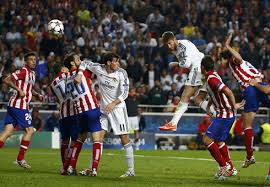
Sergio Ramos scores for Real Madrid late late in the Champions League final
So, it falls on other organizations; national federations, leagues, clubs, and coaches to ponder whether their actions are for the good of the game or if they should even worry about that concept when faced with more immediate and closer-to-home decisions. Certainly, in many countries………………………………………….We (actually I , the Soccer Yoda) interrupt this post to bring you breaking news!!!!
Landon Donovan, the all time leading national team goal scorer and arguably the best player ever to represent the United States, has been left off the USA World Cup roster by coach Jurgen Klinsmann !!

Landon Donovan scores the winning goal vs Algeria in the 2010 World Cup
Ok, this actually happened a few days ago, but I couldn’t post this piece without mentioning the most talked about soccer controversy that this country has ever seen. I am not going to repeat all the arguments, theories and accusations that have been discussed since Klinsmann announced the 23 player World Cup roster. Gad, even his announcement of the roster caused a stir, coming as early as it did, even before any tune up matches were played. But, in a sense ,the decision falls under the category of “good for the game”. How so? The news of Donovan’s absence from the team has been announced and discussed on virtually every sports network and talk show in the country. Who would have ever thought that the NBA playoffs, the upcoming NFL season, the daily MLB scores, would ever be pushed back on the sports news agenda by news of a surprising soccer roster announcement? If Jurgen wanted to make sure that the country was talking World Cup soccer- even non-soccer people, mind you- a month before the actual tournament begins……well he certainly did it. Even I have been asked by individuals who know little and usually care less about my sport….” what’s up with this Landon Donawhatcha thing?”. So, in that regard……in consideration of the third conundrum-the good of the game…..way to go Jurgen! As for the good of USA World Cup fortunes……well, that remains to be seen.
Brazil 3 -Spain 0: Tactics for Common Person Part 1
Posted: July 2, 2013 Filed under: Uncategorized | Tags: Barcelona, Real Madrid, ticky-tacka Leave a commentOn Sunday Brazil gave Spain a 3-0 beating that was a shock to the soccer world. Not the fact that Brazil won – many thought that was possible. But few predicted that the Brazilians would trounce the defending World Cup champs , Euro championship,28 consecutive wins, no 1 in the world ,etc Spanish team in the manner that they did. And now , of course, the bandwagon jumpers are claiming that Spain is dead and that their style and that of the Spanish club Barcelona that makes up the majority of the Spanish squad has had it also.
The Soccer Yoda says ,”not so fast!”.
Now, to understand the what happened Sunday from a strategy standpoint, we must look at the tactical plan used by Spain and Barcelona ( it is very much the same) and see what Brazil did to defeat it. I will describe it by the basics. If the reader is a very knowledgable soccer person, you might find this part boring (that’s assuming you don’t find the whole blog boring!) If you are a fan, the forthcoming explanantion could be enlightening. If you aren’t a soccer person at all, you will learn much……but I am not sure what you are doing here in the first place! (Don’t leave though!)
One of the main concepts of modern soccer that most coaches accept (not all, mind you) is that in order to win a team must keep possession of the ball for at least a portion of the game. Just kicking and shooting isn’t enough; passing the ball around while looking for and creating openings is needed. In order to do that there must be more offensive players around the ball than defenders. Rule 1 of possession soccer : outnumber the opposition around the ball! To do that a team must (at least to an extent) forget the concept of spreading out and playing position. Players must move into positions that give the ballholder options to pass without interception. At least one player must be open, so there has to be more offensive than defensive players in the vicinity.
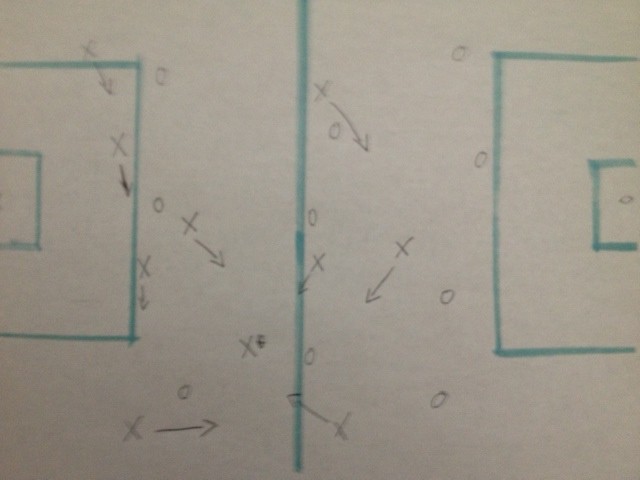
team x attacks to the right in a typical situation, note players moving to teammate with the ball
A few years ago Barcelona started taking that concept to the extreme. They moved their midfielders around so much that it became a moot point as to what position they played other than “midfield”. Their forwards moved back to help in the “outnumbering”, so much so that some observers said they had no “real” forwards at all. The center forward ( who often wears #9-that’s a soccer history thing) moved back so much that the formation was called the”false 9″. And yes, defenders joined in also. It is VERY common for Barcelona backs to go down the wing when the opportunity presents itself. The supporting players get so close to the person with the ball that often the passes are very short ( 2-3 yards) and one might wonder why they passed it at all. Commentators called these super short passes “ticky” passes and the next super short pass was a “tacka”pass and lo and behold, the style got a name! Ticky-tacka became the signature style of Barcelona and since the Spanish national team consists mostly of Barca players, it became their style also.
What happened on the field was that teams employing traditional “spread-out” formations could never get the ball. They couldn’t intercept the passes because not only were they outnumbered , but the Barca/Spain players had incredible ball control, passing accuracy and the vision to spot the open player ( and there always was one). They got physically and mentally tired of chasing the ball all game trying to avoid being “it” in the game of keep-away being played against them. The Barcelona offense would move down the field, often at a very slow pace….I mean a VERY slow pace! At a Barcelona match that I saw at Barcelona’s Camp Nou stadium, they averaged 27 passes per possession; AVERAGED 27 passes! Sometimes it got into the 40 and 50 passes without an opponent touching the ball. When they arrived within striking distance of the goal : they often only had to beat the keeper, a few out-numbered defenders and the offside rule in order to score. The rest of the defending team had been passed by the passing!

team x player hasn’t passed the ball BUT now has many options AND receiving players will also have options
In one memorable game Barcelona played Real Madrid in what is referred to in Spain as “El Classico”. Whenever these teams meet it is an “El Classico”. That’s how good Real is. They are always among the world’s best club teams. Barca was just really getting into the ticky-tacka and Real didn’t adjust at all. The result was a humiliating 5-0 defeat and ( as they say) it could have been worse!
The ticky-tacka does have a weakness, of course. All styles ,formations, etc in all sports have strengths and weaknesses. Ticky-tacka’s inherent weakness is the very movement that sets it up. On the rare occasions when the ball IS lost, the team is in a poor position to defend in the spaces that have been left open by the movement. Sometimes they have less backs than they would like; sometimes the entire team is caught upfield as they were passing the ball around. So the counter-attack is their Achilles heel. Any team playing this style effectively must have fast defenders who tackle well and understand the situation when the other team is coming at them. A good goalkeeper doesn’t hurt either. For Barcelona and therefore Spain, that wasn’t a problem, they had the required backs and keeper and next thing you know, they were winning almost every thing. Barcelona was being called the best club team “ever” by more than a few, and the Spanish national team started a winning habit that had few bumps. Opponents did try to adjust ( more about that next post), but largely to no avail. But things have changed in the last few months, cumulating in Spain’s defeat on Sunday. What has happened? What did Brazil do to breakup ticky-tacka? Next post ( probably tomorrow if the Soccer Yoda can get off the xbox) we will talk about why. How’s that for a teaser?
 The Soccer Yoda
Recent Comments